
We read your photo as:
Discuss the term "Electrophoresis" under the following captions: i. Definition, ii. General principle, iii. Instrumentation, iv. Procedure, v. Applications.
ScanSolve AI Answer
Here is the discussion on Electrophoresis:
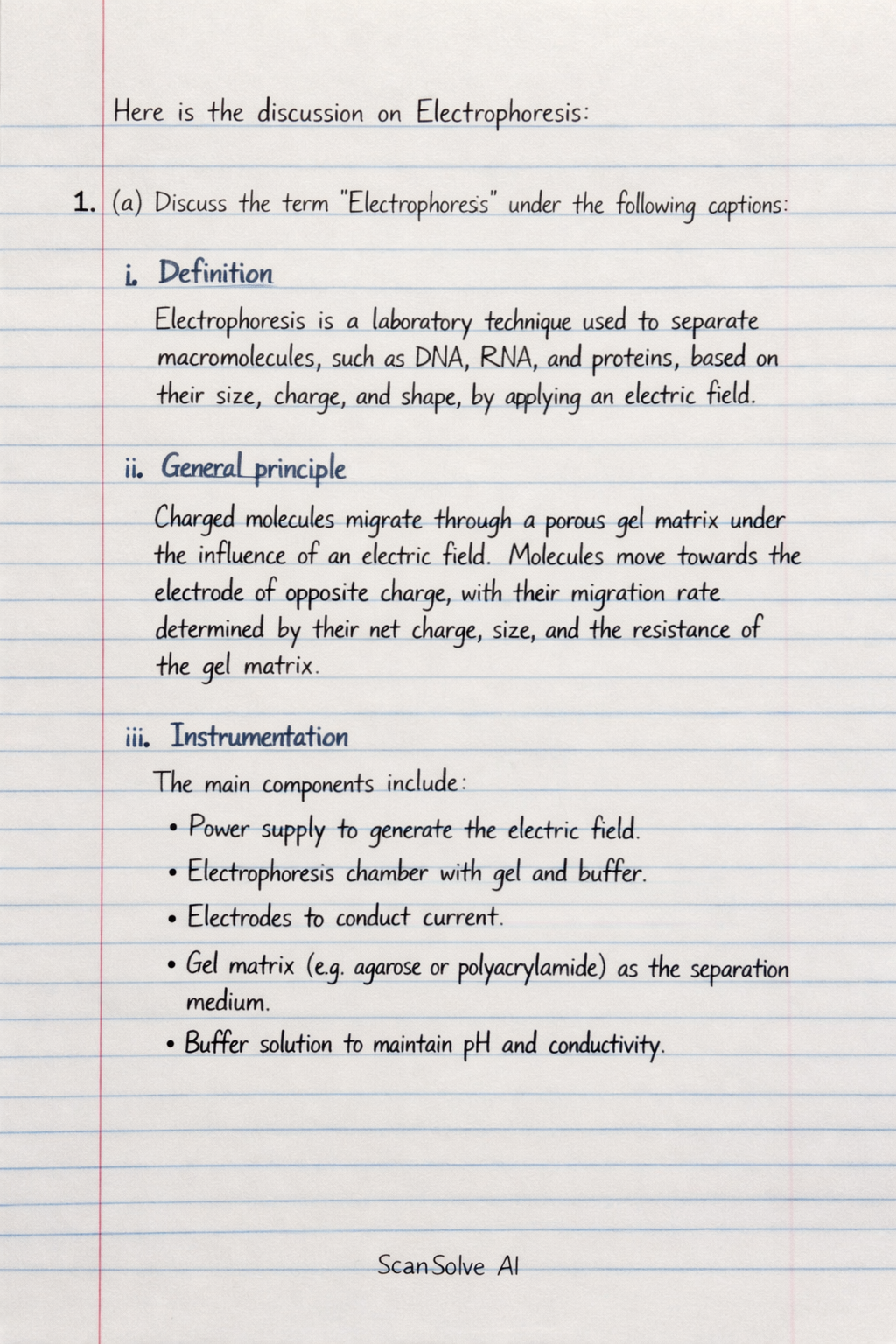
1. (a) Discuss the term "Electrophoresis" under the following captions:
-
i. Definition Electrophoresis is a laboratory technique used to separate macromolecules, such as DNA, RNA, and proteins, based on their size, charge, and shape, by applying an electric field.
-
ii. General principle Charged molecules migrate through a porous gel matrix under the influence of an electric field. Molecules move towards the electrode of opposite charge, with their migration rate determined by their net charge, size, and the resistance of the gel matrix.
-
iii. Instrumentation The main components include a power supply to generate the electric field, an electrophoresis chamber containing the gel and buffer, electrodes to conduct current, a gel matrix (e.g., agarose or polyacrylamide) as the separation medium, and a buffer solution to maintain pH and conductivity.
-
iv. Procedure The procedure involves preparing a gel with wells, loading samples into these wells, placing the gel in a buffer-filled chamber, applying an electric current to initiate migration, and finally visualizing the separated molecules using appropriate staining methods.
-
v. Applications Electrophoresis is widely used for DNA fingerprinting, analyzing PCR products, determining protein purity and molecular weight, diagnosing genetic diseases, and in various molecular biology and biochemistry research applications.
1. (b) Explain the following types of electrophoresis:
-
i. SDS-PAGE electrophoresis SDS-PAGE (Sodium Dodecyl Sulfate-Polyacrylamide Gel Electrophoresis) is a technique that separates proteins primarily based on their molecular weight. Proteins are denatured and coated with SDS, an anionic detergent, which imparts a uniform negative charge and unfolds them. This ensures that all proteins migrate towards the positive electrode solely according to their size through the polyacrylamide gel.
-
ii. PAGE electrophoresis PAGE (Polyacrylamide Gel Electrophoresis) is a general method using a polyacrylamide gel as the separation matrix. In its native (non-denaturing) form, PAGE separates proteins based on both their intrinsic charge and size/shape, as proteins retain their native conformation and biological activity. It is used when the native state of the protein is important for analysis.
Still stuck on this one?
Ask a follow-up, and the answer starts from this question.
More Biology Questions
Handwritten Step-by-Step Solution
Get this as a handwritten image on WhatsApp — like a tutor wrote it for you.
Try on WhatsApp