
We read your photo as:
Distinguish between heterochromatin and euchromatin. Name types of centromeres. Distinguish between gene and allele, and homozygosity and heterozygosity.
ScanSolve AI Answer
Answers
3 partsHere are the answers to the questions:
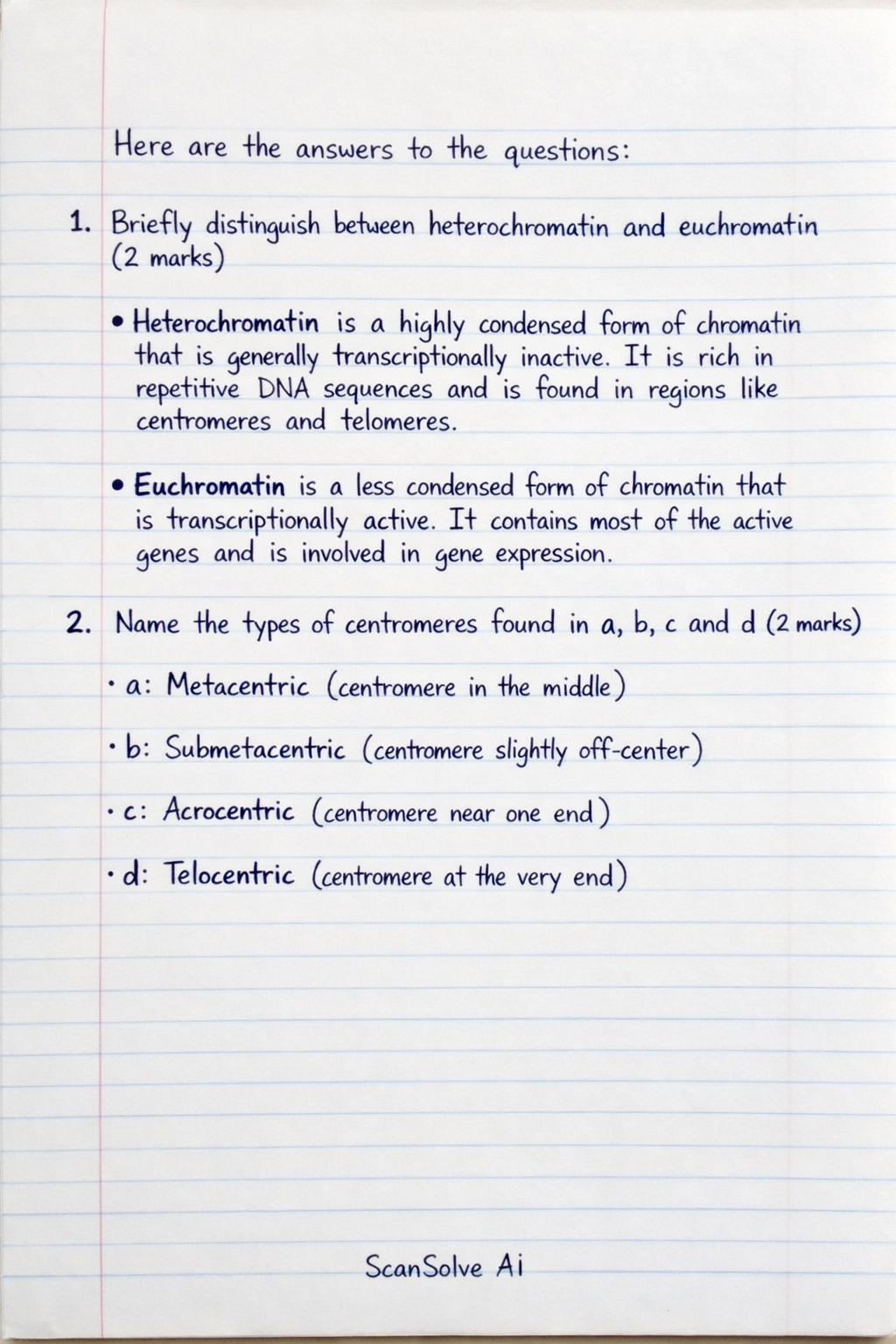
1. Briefly distinguish between heterochromatin and euchromatin (2 marks)
- Heterochromatin is a highly condensed form of chromatin that is generally transcriptionally inactive. It is rich in repetitive DNA sequences and is found in regions like centromeres and telomeres.
- Euchromatin is a less condensed form of chromatin that is transcriptionally active. It contains most of the active genes and is involved in gene expression.
2. Name the types of centromeres found in a, b, c and d (2 marks)
- a: Metacentric (centromere in the middle)
- b: Submetacentric (centromere slightly off-center)
- c: Acrocentric (centromere near one end)
- d: Telocentric (centromere at the very end)
3. Distinguish between the following
- i. gene and allele (1 mark)
- A gene is a basic unit of heredity, a segment of DNA that codes for a specific protein or RNA molecule, determining a particular trait.
- An allele is an alternative form or variant of a gene, located at a specific locus on a chromosome. For example, a gene for flower color might have alleles for red or white flowers.
- ii. homozygosity and heterozygosity (1 mark)
- Homozygosity describes an individual having two identical alleles for a particular gene (e.g., or ).
- Heterozygosity describes an individual having two different alleles for a particular gene (e.g., ).
- iii. polyploidy and aneuploidy (1 mark)
- Polyploidy is a chromosomal abnormality where an organism has more than two complete sets of chromosomes (e.g., triploid (3n) or tetraploid (4n)).
- Aneuploidy is a chromosomal abnormality where an organism has an abnormal number of chromosomes, typically involving the gain or loss of one or more individual chromosomes, but not a complete set (e.g., trisomy (2n+1) or monosomy (2n-1)).
4. Briefly describe the two major events that underpin variations in eukaryotic organisms that exhibit sexual reproduction. (2 marks)
The two major events are:
- Crossing over (or recombination): During prophase I of meiosis, homologous chromosomes exchange genetic material, creating new combinations of alleles on chromatids.
- Independent assortment: During metaphase I of meiosis, homologous chromosome pairs align randomly at the metaphase plate, leading to different combinations of maternal and paternal chromosomes in the resulting gametes.
5. A man visited a dog farmer to buy a dog...
To solve this problem, we need to make assumptions about the dominance of the traits. Given that the man wants a specific combination of traits (brown fur, short tail, sharp canines) and the farmer "had no dog with such traits" but promised to get one by crossing dogs, it is highly probable that these desired traits are recessive.
Let's define the alleles:
- Fur color: Black () is dominant over Brown ().
- Tail length: Long () is dominant over Short ().
- Canine type: Blunt () is dominant over Sharp ().
To produce offspring with recessive traits, the farmer would likely cross two dogs that are heterozygous for all three traits (a trihybrid cross):
Parental Cross:
We can calculate the probability for each trait independently and then multiply them, assuming independent assortment of genes.
- For a monohybrid cross ():
- Probability of dominant phenotype () =
- Probability of recessive phenotype () =
i. What is the probability that the man will get a dog with all three traits (brown fur, short tail, sharp canines)? (2 marks)
The man wants a dog with brown fur (), short tail (), and sharp canines ().
- Probability of brown fur () =
- Probability of short tail () =
- Probability of sharp canines () =
The probability of getting a dog with all three desired traits is:
The probability is .
ii. Calculate the probability of getting a black fur, short tail and blunt canine dog (2 marks)
- Black fur () =
- Short tail () =
- Blunt canine () =
The probability is:
The probability is .
iii. Calculate the probability of getting a brown, long tail, sharp canine dog (2 mark)
- Brown fur () =
- Long tail () =
- Sharp canine () =
The probability is:
The probability is .
Try one yourself
A new problem that tests the same skill.
Still stuck on this one?
Ask a follow-up, and the answer starts from this question.
More Biology Questions
Handwritten Step-by-Step Solution
Get this as a handwritten image on WhatsApp — like a tutor wrote it for you.
Try on WhatsApp