
We read your photo as:
Distinguish between striated (tissue), cardiac (tissue), motor (tissue), and sensory (tissue).
Biology
ScanSolve AI Answer
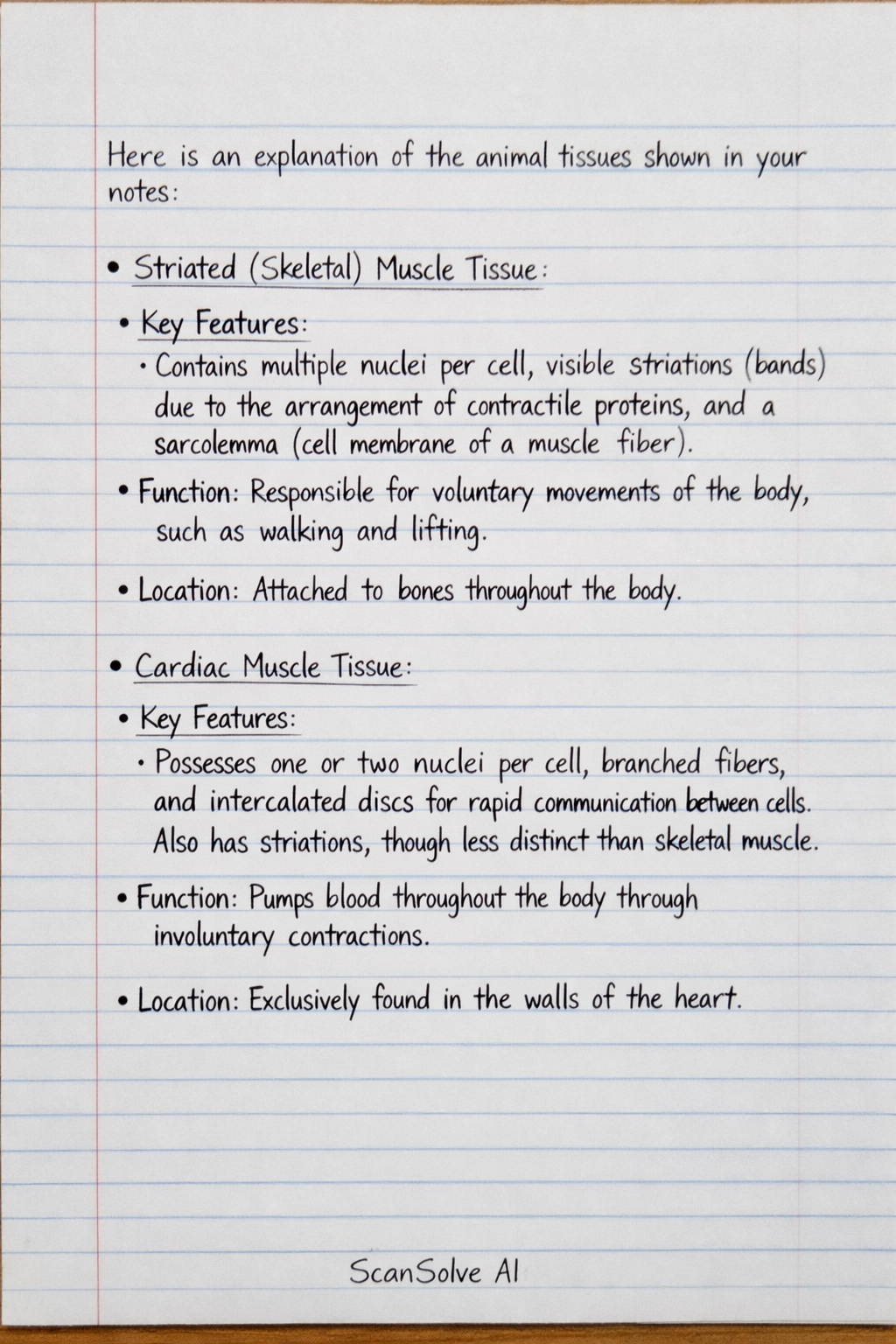
Here is an explanation of the animal tissues shown in your notes:
-
Striated (Skeletal) Muscle Tissue:
- Key Features: Contains multiple nuclei per cell, visible striations (bands) due to the arrangement of contractile proteins, and a sarcolemma (cell membrane of a muscle fiber).
- Function: Responsible for voluntary movements of the body, such as walking and lifting.
- Location: Attached to bones throughout the body.
-
Cardiac Muscle Tissue:
- Key Features: Possesses one or two nuclei per cell, branched fibers, and specialized junctions called intercalated discs that allow for rapid communication between cells. It also has striations, though often less distinct than skeletal muscle.
- Function: Pumps blood throughout the body through involuntary contractions.
- Location: Exclusively found in the walls of the heart.
-
Motor (Nerve) Tissue / Motor Neuron:
- Key Features: Composed of motor neurons, which have a cell body (soma), an axon (long projection that transmits signals away from the cell body), and dendrites (branching extensions that receive signals).
- Function: Transmits electrical signals (nerve impulses) from the central nervous system (brain and spinal cord) to muscles and glands, initiating movement or secretion.
- Location: Found in the brain, spinal cord, and peripheral nerves leading to muscles and glands.
-
Sensory (Nerve) Tissue / Sensory Neuron:
- Key Features: Composed of sensory neurons, which also have a cell body, an axon, and dendrites. Their structure is adapted to detect stimuli.
- Function: Transmits electrical signals from sensory receptors (e.g., in the skin, eyes, ears) to the central nervous system, allowing the body to perceive stimuli like touch, light, and sound.
- Location: Found in sensory organs and peripheral nerves, connecting to the spinal cord and brain.
Was this helpful?
Still stuck on this one?
Ask a follow-up, and the answer starts from this question.
Got a different question?Ask your own question
More Biology Questions
QUnderstand the different types of muscle tissue.QDescribe the three main types of cardiac muscle tissue and their functions in the heart.
Browse by topic:Anatomy
Handwritten Step-by-Step Solution
Get this as a handwritten image on WhatsApp — like a tutor wrote it for you.
Try on WhatsApp