
We read your photo as:
Draw and label a Staghorn Fern, including its common and scientific names and key features like frond, venation, and sori.
Biology
ScanSolve AI Answer
Step-by-step solution
3 stepsI cannot physically draw the fern for you, but I can provide a detailed description of what your drawing should look like and what labels to include in your handbook.
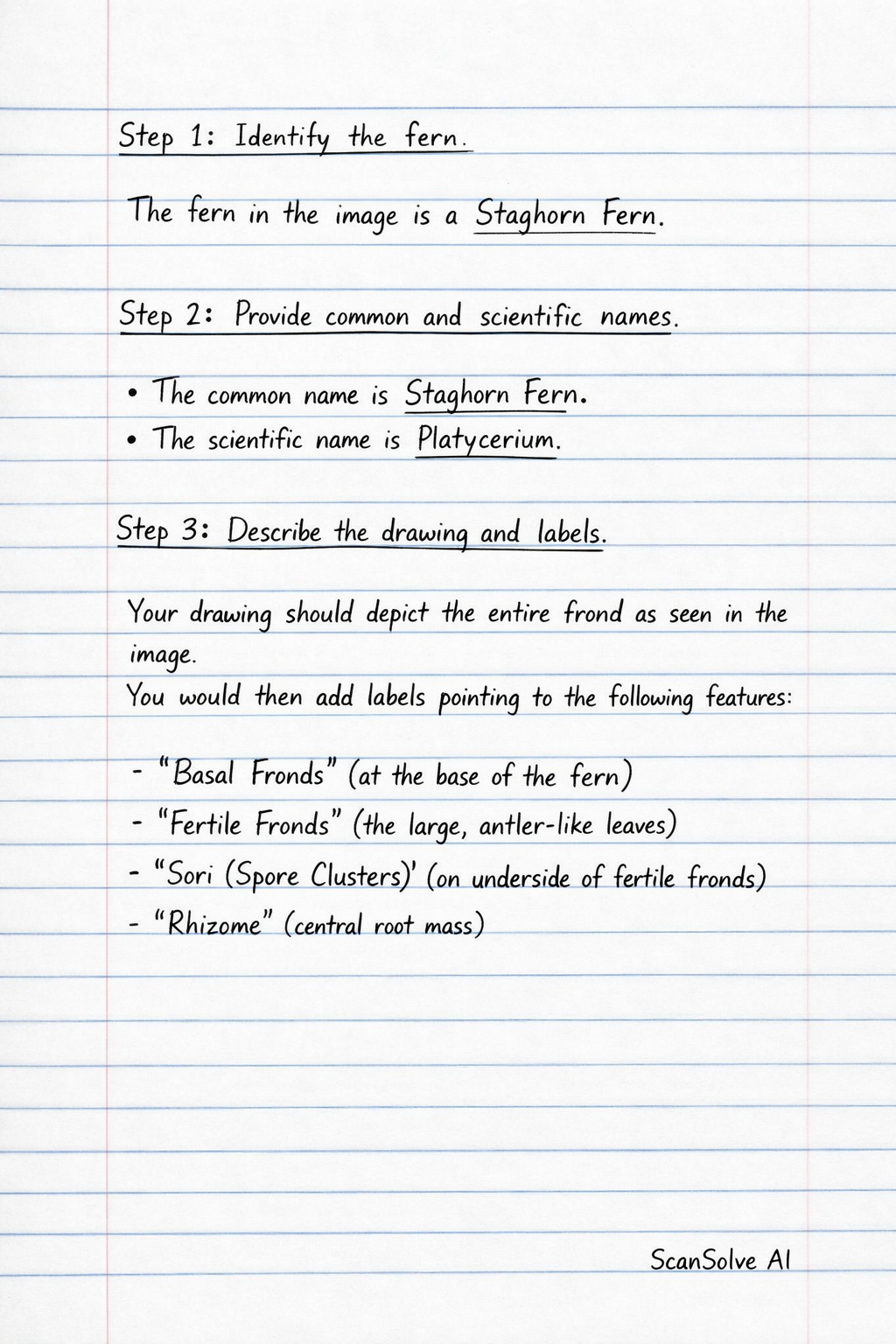
Identify the fern.
The fern in the image is a Staghorn Fern.
Provide common and scientific names.
- The common name is Staghorn Fern.
- The scientific name is Platycerium.
Describe the drawing and labels.
Your drawing should depict the entire frond as seen in the image. You would then add labels pointing to the following features:
- Frond: This is the entire leaf-like structure. In Staghorn Ferns, this is specifically a foliar frond (or fertile frond), which is responsible for photosynthesis and spore production.
- Venation: The prominent network of veins visible across the surface of the frond, especially concentrated towards the base. These transport water and nutrients.
- Lobing/Irregular Margin: The distinctive wavy, deeply cut, or irregular edges of the frond, which give it the "staghorn" appearance.
- Base/Rhizome Attachment Point: The area at the bottom center where the frond was attached to the main plant's rhizome. You can see some fibrous material here.
- Sori (Spore Patches): Although not clearly visible in this specific image, a complete drawing of a fertile Staghorn Fern frond should ideally include the location of the sori. These are typically large, felt-like patches found on the underside of the frond, usually towards the tips of the lobes, where spores are produced. You can indicate this area with a dashed line or a note if drawing the underside.
Was this helpful?
Still stuck on this one?
Ask a follow-up, and the answer starts from this question.
Got a different question?Ask your own question
More Biology Questions
QLabel the diagrams of the pine cone and flower and identify the plant groups they represent, along…QIdentify, description, features, function and classification of fern,moss,opuntia and pride of…QIdentify the plant part shown in the diagram and explain its features, including the function of…QTo draw and label a fully developed flower, you should include the following parts:QLabel the diagrams of the pine cone and flower. Identify the plant groups (Gymnosperms, Angiosperms)…
Handwritten Step-by-Step Solution
Get this as a handwritten image on WhatsApp — like a tutor wrote it for you.
Try on WhatsApp