
We read your photo as:
Draw one example each of the Phylum of Invertebrates i.e. Protozoa, Coelenterata, Platyhelminthes, Nematodes, Annelida, Arthropoda, Chordata.
ScanSolve AI Answer
Here are the answers to your taxonomy questions:
8. Draw one examples each of the Phylum of Invertebrates i.e. Protozoa, Coelenterata, Platyhelminthes, Nematodes, Annelida, Arthropoda, Chordata.
As an AI, I cannot draw diagrams. However, I can describe the key structural features of a representative example from each phylum:
-
Protozoa (e.g., Amoeba): A single-celled organism that lacks a fixed shape. It moves and feeds using temporary cytoplasmic extensions called pseudopods. It has a nucleus, contractile vacuole, and food vacuoles.
-
Coelenterata (Cnidaria) (e.g., Jellyfish): A radially symmetrical animal with a bell-shaped body (medusa form). It has a mouth on the underside, surrounded by tentacles armed with stinging cells (cnidocytes). It possesses a simple nerve net and a gastrovascular cavity.
-
Platyhelminthes (e.g., Flatworm - Planaria): A bilaterally symmetrical, flattened, unsegmented worm. It has a distinct head region with eyespots and chemoreceptors. It possesses a simple digestive system with a single opening (pharynx) and a ladder-like nervous system.
-
Nematodes (e.g., Roundworm - Ascaris): A bilaterally symmetrical, unsegmented, cylindrical worm with tapered ends. It has a complete digestive system (mouth and anus) and a tough outer cuticle. It moves with a characteristic thrashing motion.
-
Annelida (e.g., Earthworm - Lumbricus): A segmented worm with a cylindrical body. Each segment contains similar internal and external structures. It has a well-developed coelom, a closed circulatory system, and bristles (setae) on each segment for locomotion.
-
Arthropoda (e.g., Insect - Grasshopper): An animal with a segmented body, an exoskeleton made of chitin, and jointed appendages. The body is typically divided into a head, thorax, and abdomen. It has compound eyes and antennae.
-
Chordata (e.g., Tunicate - Sea Squirt): While many chordates are vertebrates, some are invertebrates. A tunicate larva has a notochord, a dorsal hollow nerve cord, pharyngeal slits, and a post-anal tail. The adult form is sessile and filter-feeding, often losing some of these chordate characteristics.
9. List 10 differences between Vertebrates & Invertebrates.
| Feature | Vertebrates | Invertebrates |
|---|---|---|
| 1. Backbone/Spine | Present (made of vertebrae) | Absent |
| 2. Internal Skeleton | Present (endoskeleton of bone/cartilage) | Absent (some have exoskeletons or hydrostatic skeletons) |
| 3. Nervous System | Dorsal hollow nerve cord, complex brain | Ventral solid nerve cord (if present), simpler brain/ganglia |
| 4. Body Size | Generally larger | Generally smaller |
| 5. Body Symmetry | Bilateral symmetry | Bilateral, radial, or asymmetrical |
| 6. Locomotion | Often complex, using limbs/fins/wings | Diverse, often simpler (crawling, swimming, flying) |
| 7. Complexity | Highly complex organ systems | Simpler organ systems or lack thereof |
| 8. Habitat | Diverse (terrestrial, aquatic, aerial) | Diverse (terrestrial, aquatic, aerial) |
| 9. Limbs | Typically possess paired limbs/fins | May or may not possess limbs/appendages |
| 10. Blood System | Closed circulatory system (most) | Open or closed circulatory system (variable) |
10. Draw the Diagram of One example of the Phylum Vertebrates i.e) Reptiles, Aves, Mammals, Piscos, Amphibians.
As an AI, I cannot draw diagrams. However, I can describe the key structural features of a representative example from each group:
-
Reptiles (e.g., Snake): A snake has an elongated, limbless body covered in scales. It moves by undulating its body. It has a distinct head with eyes and a forked tongue. Internally, it possesses a backbone and a well-developed endoskeleton.
-
Aves (e.g., Pigeon): A pigeon has a streamlined body covered in feathers. It possesses a pair of wings for flight and a pair of legs for perching and walking. It has a beak instead of teeth and a lightweight, hollow-boned endoskeleton.
-
Mammals (e.g., Human): Humans have a body covered in hair (though sparse in adults). They possess two pairs of limbs (arms and legs) and a highly developed brain. They have a backbone and an internal skeleton, and females possess mammary glands for milk production.
-
Pisces (e.g., Tilapia): A tilapia has a streamlined body covered in scales. It possesses fins (dorsal, caudal, pectoral, pelvic, anal) for movement and balance in water. It has gills for respiration and a backbone with an internal skeleton.
-
Amphibians (e.g., Frog): An adult frog has a smooth, moist skin and typically lacks a tail. It has strong hind legs adapted for jumping and webbed feet for swimming. It possesses a backbone and an internal skeleton. Its life cycle involves a larval (tadpole) stage that lives in water and breathes with gills, and an adult stage that can live on land and breathes with lungs and skin.
Still stuck on this one?
Ask a follow-up, and the answer starts from this question.
More Biology Questions
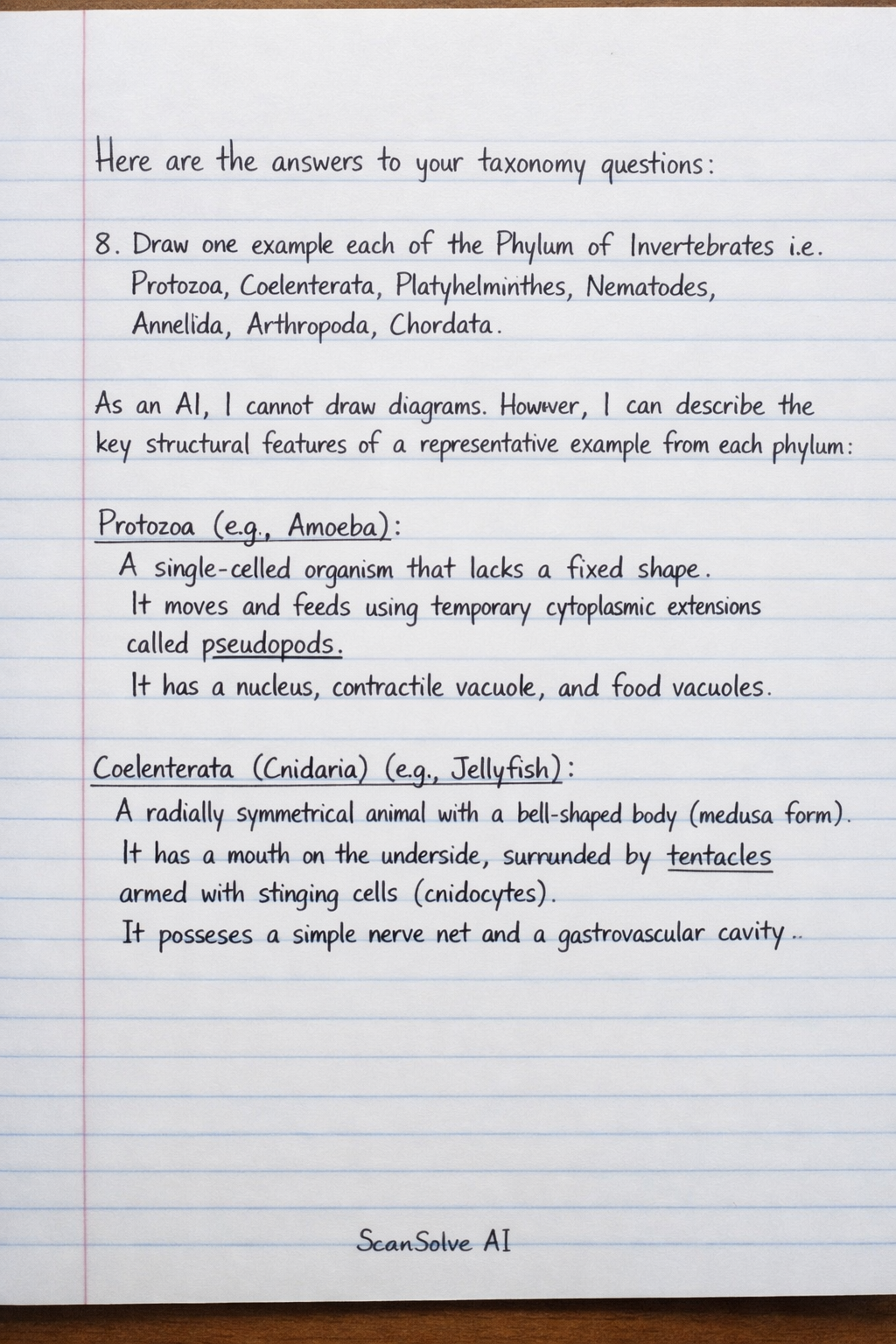
Handwritten Step-by-Step Solution
Get this as a handwritten image on WhatsApp — like a tutor wrote it for you.
Try on WhatsApp