

This biology question covers important biological concepts and processes. The step-by-step explanation below helps you understand the underlying mechanisms and reasoning.
ScanSolve AI Answer
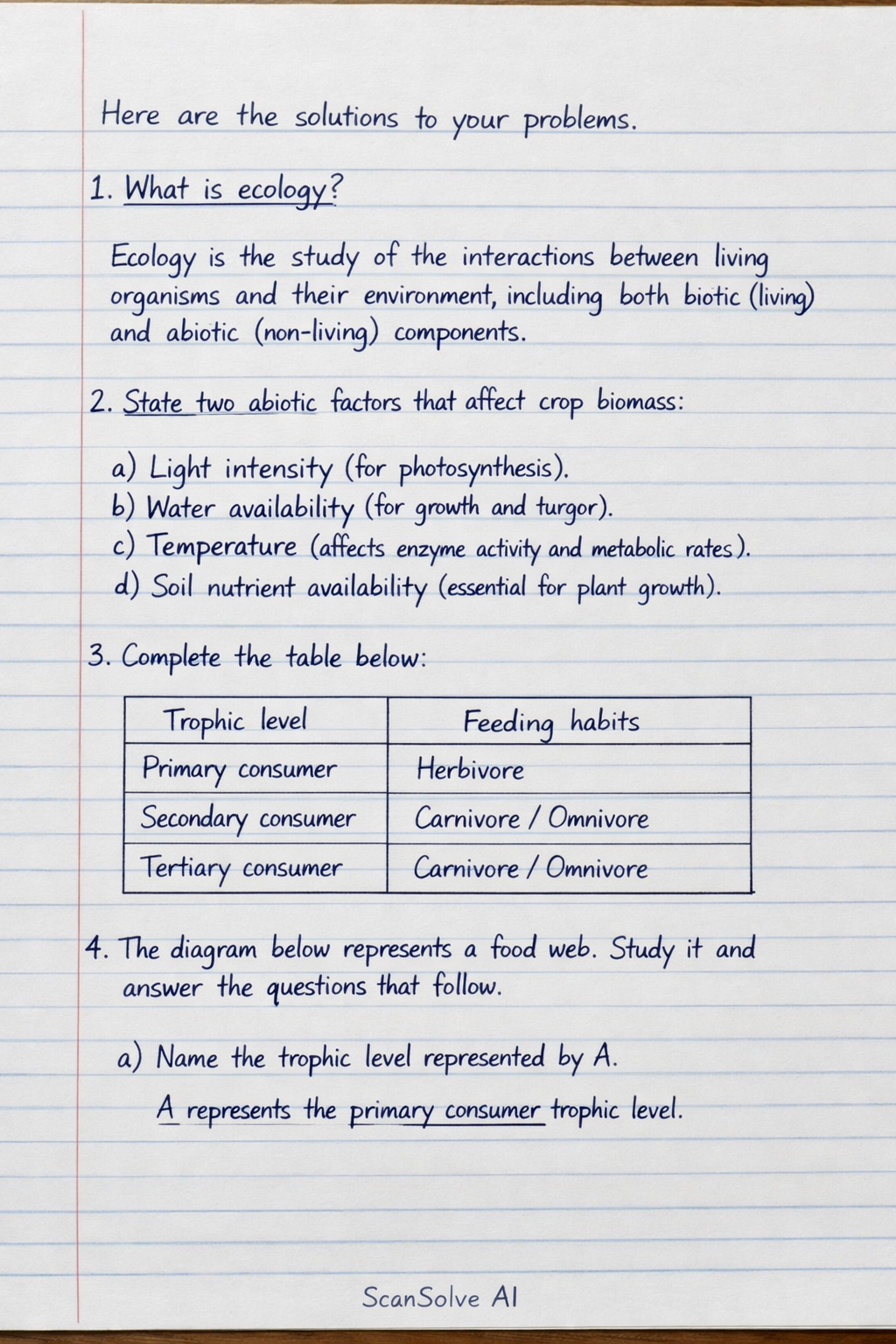
Here are the solutions to your problems. 1. What is ecology? Ecology is the study of the interactions between living organisms and their environment, including both biotic (living) and abiotic (non-living) components. 2. State two abiotic factors that affect crop biomass. a) Light intensity (for photosynthesis). b) Water availability (for growth and turgor). c) Temperature (affects enzyme activity and metabolic rates). d) Soil nutrient availability (essential for plant growth). 3. Complete the table below. |c|c| Trophic level & Feeding habits \\ Primary consumer & Herbivore \\ Secondary consumer & Carnivore/Omnivore \\ Tertiary consumer & Carnivore/Omnivore \\ 4. The diagram below represents a food web. Study it and answer the questions that follow. a) Name the trophic level represented by A. A represents the primary consumer* trophic level. b) Name the process represented by X, Y, and Z. X, Y, and Z all represent feeding or consumption*. c) Name the organisms involved in process P. Process P represents decomposition. The organisms involved are decomposers* (e.g., bacteria and fungi). d) How would removal of the organism at level A affect the ecosystem? Removal of organisms at level A (primary consumers) would lead to an increase in the population of producers (their food source) and a decrease in the populations of secondary and tertiary consumers* (their predators). 5. What is nitrogen fixation? Nitrogen fixation is the process by which atmospheric nitrogen gas (N_2) is converted into ammonia (NH_3) or other nitrogen compounds that can be used by plants. This can occur biologically (by bacteria) or abiotically (by lightning). 6. Describe the nitrogen cycle. The nitrogen cycle describes the movement of nitrogen through the atmosphere, soil, and living organisms. It begins with atmospheric nitrogen (N_2) being converted into usable forms through nitrogen fixation by bacteria (e.g., Rhizobium) or lightning. This fixed nitrogen (ammonia, then nitrites and nitrates) is then assimilated by plants. Animals obtain nitrogen by feeding on plants or other animals. When organisms die or excrete waste, ammonification occurs, where decomposers convert organic nitrogen back into ammonia. Ammonia is then converted to nitrites and then nitrates by nitrifying bacteria (nitrification). Finally, denitrifying bacteria convert nitrates back into atmospheric nitrogen, completing the cycle. 7. The table below shows the population of organisms found in a given habitat. a) Construct a pyramid of numbers from the data above. A pyramid of numbers for this data would be an upright pyramid*: Base: Grass (1000) Second level: Antelope (100) Third level: Lion (10) Apex: Vulture (2) b) Explain why the number of organisms at trophic level 4 is low. The number of organisms at higher trophic levels is low due to the loss of energy at each successive trophic level*. Only about 10% of energy is transferred from one level to the next, meaning less energy is available to support a large population of top consumers. c) State two ecological importance of fungi in plants. 1. Decomposition*: Fungi break down dead organic matter, recycling nutrients back into the soil for plants. 2. Mycorrhizal associations*: Many fungi form symbiotic relationships with plant roots, enhancing the plant's absorption of water and nutrients (especially phosphorus). d) Distinguish between commensalism and mutualism. Commensalism is a symbiotic relationship where one organism benefits and the other is neither harmed nor helped*. Mutualism is a symbiotic relationship where both organisms benefit* from the interaction. e) Name the density identifying the relationship between: i) Parasitism: Host-parasite relationship* ii) Predation: Predator-prey relationship* iii) Interspecific competition: Competition between different species* 8. (i) Name the bacteria involved in the conversion of the following where the 'X' is the role of the bacteria involved in the process. Ammonia to Nitrites: Nitrosomonas* (X) Nitrites to Nitrates: Nitrobacter* (Y) 9. The diagram below represents the nitrogen cycle. a) Identify the processes labeled A and B. A: Nitrification* (specifically, conversion of nitrites to nitrates). B: Denitrification*. b) Name the group of organisms represented by C. C represents nitrogen-fixing bacteria*. c) Name the process represented by D. D represents ammonification*. d) Name two ways in which nitrogen is lost from the soil. 1. Denitrification* (conversion of nitrates back to atmospheric nitrogen gas). 2. Leaching* (nitrates dissolving in water and being washed away from the soil). 3. Harvesting crops* (removes nitrogen stored in plant biomass). e) State two ways in which nitrogen is added to the soil. 1. Nitrogen fixation* (by bacteria or lightning). 2. Decomposition* of dead organic matter and animal waste. 3. Application of nitrogenous fertilizers*. 10. The rainfall and distribution of species in three different habitats is shown below. a) Prepare the pyramid of biomass of each of the three habitats. Habitat A (1200mm rainfall, Tall grasses): This represents a grassland ecosystem. The pyramid of biomass would be upright*, with a large base of producers (grasses) supporting smaller biomasses of consumers. Habitat B (150mm rainfall, Cactus): This represents a desert ecosystem. The pyramid of biomass would be upright*, but with a much smaller overall biomass at all levels due to limited productivity. Habitat C (2000mm rainfall, Broad-leaved trees): This represents a forest ecosystem. The pyramid of biomass would be upright*, with a very large base of producers (trees) supporting smaller biomasses of consumers. b) From the information that you have, state the type of vegetation that would be found in habitat B. Habitat B would have xerophytic vegetation* (plants adapted to dry conditions), such as succulents and shrubs. 11. (i) State two ecological importance of fungi in plants. 1. Decomposition*: Fungi break down dead organic matter, recycling nutrients back into the soil for plants. 2. Mycorrhizal associations*: Many fungi form symbiotic relationships with plant roots, enhancing the plant's absorption of water and nutrients (especially phosphorus). 12. Distinguish between commensalism and mutualism. Commensalism is a symbiotic relationship where one organism benefits and the other is neither harmed nor helped*. Mutualism is a symbiotic relationship where both organisms benefit* from the interaction. 13. Name the density identifying the relationship between: i) Parasitism: Host-parasite relationship* ii) Predation: Predator-prey relationship* iii) Interspecific competition: Competition between different species* That's 2 down. 3 left today — send the next one.