
This biology question covers important biological concepts and processes. The step-by-step explanation below helps you understand the underlying mechanisms and reasoning.
ScanSolve AI Answer
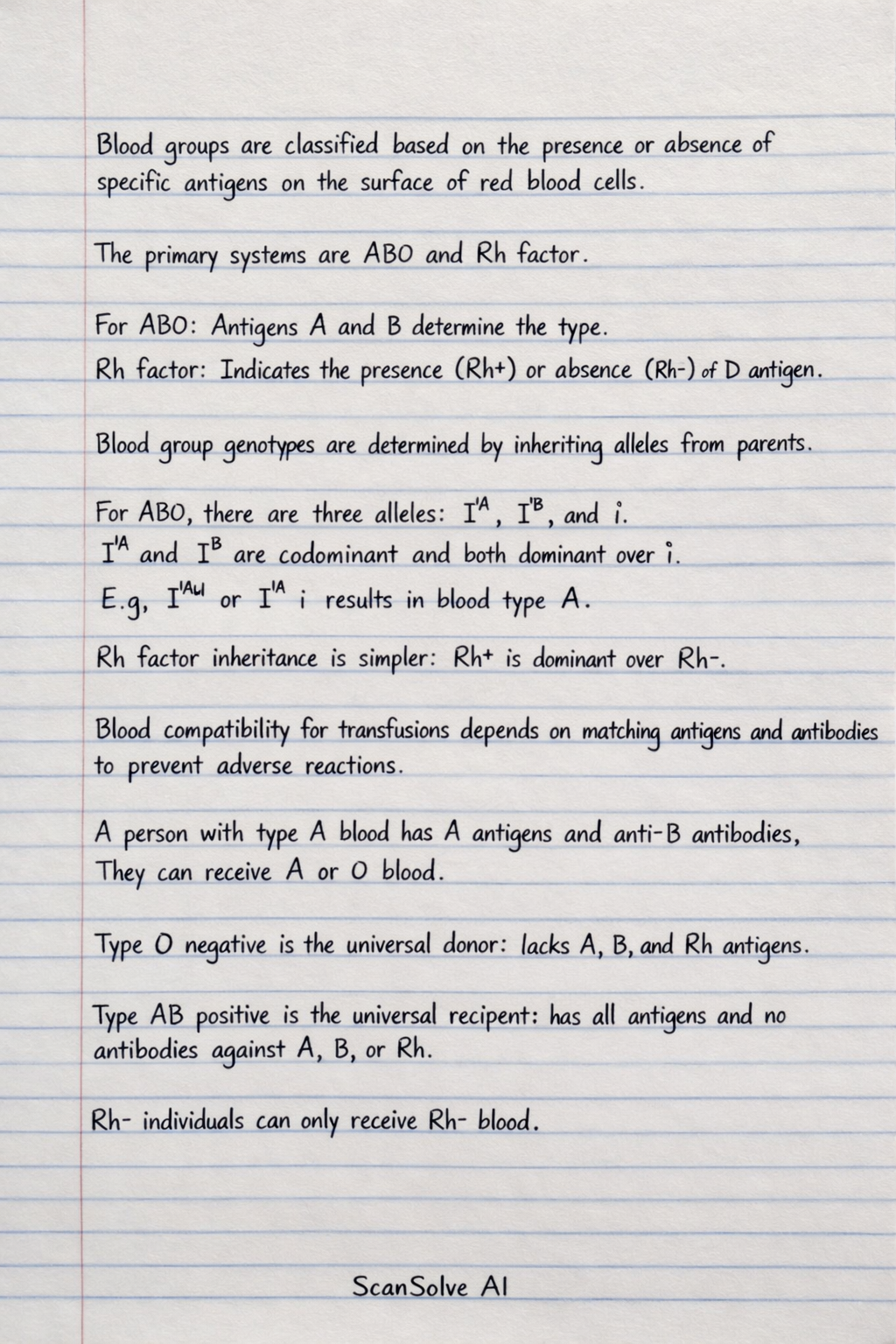
Blood groups are classified based on the presence or absence of specific antigens on the surface of red blood cells. The primary systems are ABO and Rh factor. For ABO, antigens A and B determine the type, while the Rh factor indicates the presence (Rh+) or absence (Rh-) of the D antigen. Blood group genotypes are determined by inheriting alleles from parents. For ABO, there are three alleles: I^A, I^B, and i. I^A and I^B are codominant and both are dominant over i. For example, genotype I^A I^A or I^A i results in blood type A. Rh factor inheritance is simpler, with Rh+ being dominant over Rh-. Blood compatibility for transfusions depends on matching antigens and antibodies to prevent adverse reactions. A person with type A blood has A antigens and anti-B antibodies, so they can receive A or O blood. Type O negative is the universal donor because it lacks A, B, and Rh antigens, while Type AB positive is the universal recipient as it has all antigens and no antibodies against A, B, or Rh. Rh- individuals can only receive Rh- blood. That's 2 down. 3 left today — send the next one.