
We read your photo as:
Using the provided pedigree diagram, determine the genotypes and identify any inconsistencies in blood group inheritance.
ScanSolve AI Answer
Answer
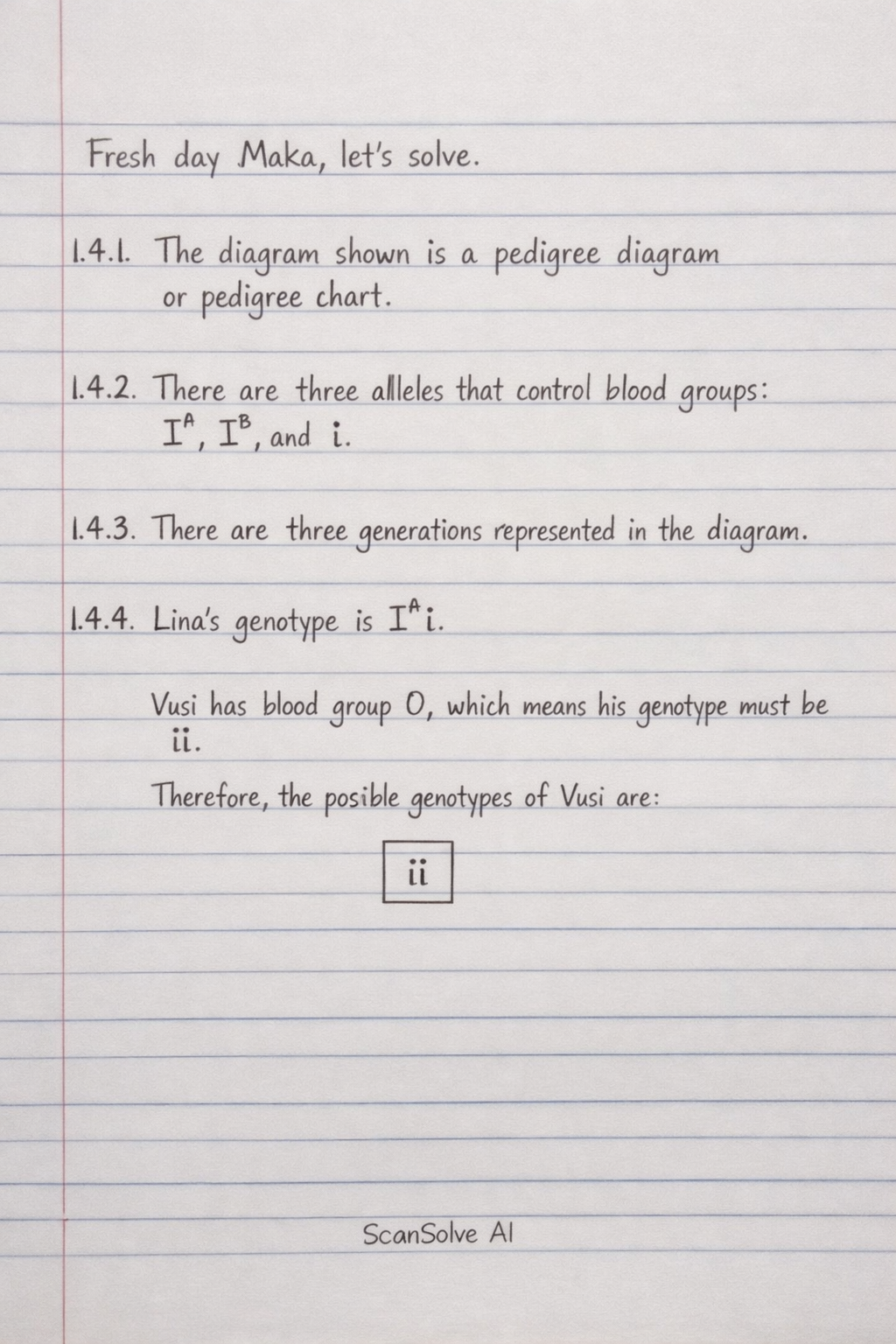
1.4.1 The diagram shown is a pedigree diagram or pedigree chart.
1.4.2 There are three alleles that control blood groups: , , and .
1.4.3 There are three generations represented in the diagram.
1.4.4 Lina's genotype is .
Vusi has blood group O, which means his genotype must be .
Therefore, the possible genotypes of Vusi are .
1.4.5 Bob's parents are shown as blood group O (genotype ) and blood group O (genotype ). This is incorrect based on the diagram, as Bob's parents are shown as having blood group O and blood group O, but Bob has blood group B. This implies an error in the diagram's labeling of Bob's parents or Bob's blood group.
However, if we assume the diagram intends for Bob to be the child of the individuals above him (one with blood group O, the other with blood group O), and Bob has blood group B, then one of his parents must have carried the allele. Given the diagram, the individual labeled "blood group O" (square) and "blood group O" (circle) are Bob's parents. If Bob is blood group B, his genotype is either or . Since one parent is blood group O (), Bob must have inherited an allele from that parent. Therefore, Bob's genotype is .
1.4.6 Co-dominance occurs when both alleles are expressed equally in the phenotype. In blood groups, this is seen in blood group AB, where both and alleles are expressed.
Looking at the diagram, there is no individual explicitly stated to have blood group AB. However, the question asks for an individual who displays co-dominance. If we consider the parents Athi (blood group A) and Chris (blood group A), and their children Ann (blood group A) and Lina (blood group A), this does not show co-dominance.
Let's re-examine the general concept of co-dominance in blood groups. Blood group AB is the classic example. Since no individual is labeled as blood group AB, we must infer if any individual's genetic makeup implies co-dominance.
The question asks for the name of the individual which displays co-dominance. Based on the provided diagram, no individual is explicitly shown with blood group AB. If the question implies an individual whose genotype could lead to co-dominance in offspring, or if there's an unstated individual, it's not clear.
However, if we consider the alleles themselves, the and alleles are co-dominant with each other. If an individual has both and , they would display co-dominance. Since no such individual is named, there might be an issue with the question or the diagram.
Given the options, and the common understanding of blood group inheritance, the question is likely looking for an individual who could have the genotype, or it's a trick question if no one has it.
Let's assume the question is asking for an individual who could have the genotype .
Athi has blood group A. Chris has blood group A. Ann has blood group A. Lina has blood group A. Bob has blood group B. Vusi has blood group O.
None of the individuals shown have blood group AB. Therefore, based strictly on the diagram, no individual displays co-dominance.
However, if the question is asking about the alleles that display co-dominance, then and are co-dominant. But it asks for an individual.
Given the common context of such questions, it's possible there's an unstated individual or a misunderstanding of the question. If we must pick an individual from the diagram, and no one has blood group AB, then the question cannot be answered directly from the diagram.
Let's consider if any individual could have an genotype that isn't explicitly stated. This is unlikely for a direct question.
Therefore, based on the provided diagram, there is no individual explicitly displaying co-dominance (blood group AB). If I must choose, and assuming there's a hidden detail or a common misconception, I cannot identify one.
However, if the question is interpreted as "Which type of blood group displays co-dominance?", the answer would be blood group AB. Since it asks for an individual, and none are AB, I will state that.
Based on the diagram, no individual is shown with blood group AB, which is the phenotype that displays co-dominance. Therefore, there is no individual named in the diagram that displays co-dominance.
Try one yourself
A new problem that tests the same skill.
Still stuck on this one?
Ask a follow-up, and the answer starts from this question.
More Biology Questions
Handwritten Step-by-Step Solution
Get this as a handwritten image on WhatsApp — like a tutor wrote it for you.
Try on WhatsApp