

This biology question covers important biological concepts and processes. The step-by-step explanation below helps you understand the underlying mechanisms and reasoning.
ScanSolve AI Answer
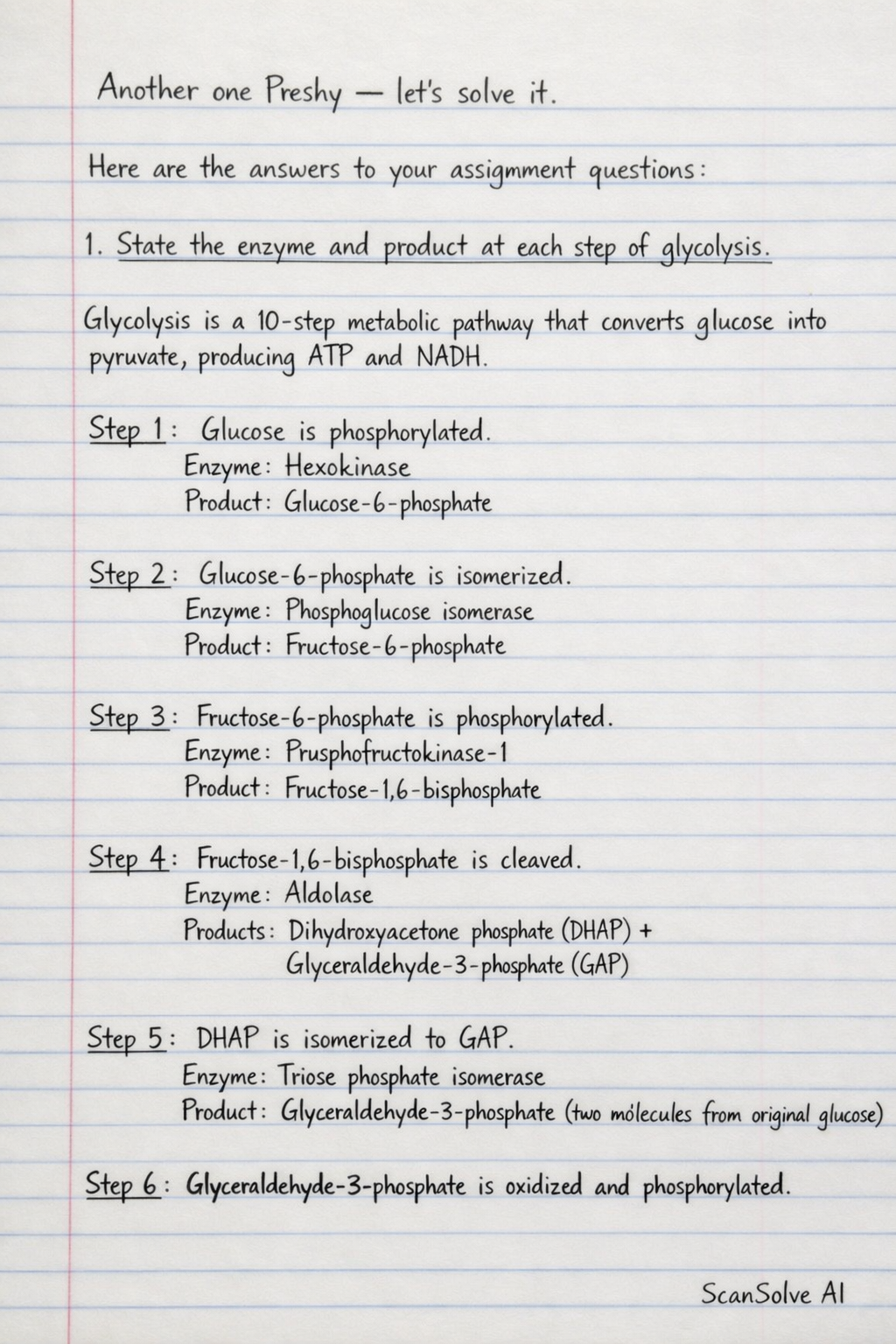
Here are the answers to your assignment questions: 1. State the enzyme and product at each step of glycolysis. Glycolysis is a 10-step metabolic pathway that converts glucose into pyruvate, producing ATP and NADH. Step 1: Glucose is phosphorylated. Enzyme: Hexokinase* Product: Glucose-6-phosphate* Step 2: Glucose-6-phosphate is isomerized. Enzyme: Phosphoglucose isomerase* Product: Fructose-6-phosphate* Step 3: Fructose-6-phosphate is phosphorylated. Enzyme: Phosphofructokinase-1* Product: Fructose-1,6-bisphosphate* Step 4: Fructose-1,6-bisphosphate is cleaved. Enzyme: Aldolase* Products: Dihydroxyacetone phosphate (DHAP) and Glyceraldehyde-3-phosphate (GAP)* Step 5: DHAP is isomerized to GAP. Enzyme: Triose phosphate isomerase* Product: Glyceraldehyde-3-phosphate* (two molecules from original glucose) Step 6: Glyceraldehyde-3-phosphate is oxidized and phosphorylated. Enzyme: Glyceraldehyde-3-phosphate dehydrogenase* Product: 1,3-Bisphosphoglycerate* Step 7: A phosphate group is transferred from 1,3-bisphosphoglycerate to ADP. Enzyme: Phosphoglycerate kinase* Product: 3-Phosphoglycerate and ATP* Step 8: The phosphate group on 3-phosphoglycerate is moved. Enzyme: Phosphoglycerate mutase* Product: 2-Phosphoglycerate* Step 9: 2-Phosphoglycerate is dehydrated. Enzyme: Enolase* Product: Phosphoenolpyruvate (PEP)* Step 10: A phosphate group is transferred from PEP to ADP. Enzyme: Pyruvate kinase* Product: Pyruvate and ATP* 2. Link the process of glycolysis with the Krebs cycle. Glycolysis and the Krebs cycle are linked by an intermediate step called pyruvate oxidation (or the link reaction). After glycolysis, two molecules of pyruvate are produced from one molecule of glucose in the cytoplasm. Pyruvate then moves into the mitochondrial matrix. Here, each pyruvate molecule undergoes oxidative decarboxylation by the pyruvate dehydrogenase complex. This reaction converts pyruvate (a 3-carbon molecule) into acetyl-CoA (a 2-carbon molecule), releasing one molecule of carbon dioxide (CO_2) and reducing one molecule of NAD^+ to NADH. The acetyl-CoA then enters the Krebs cycle by combining with oxaloacetate. 3. Draw and discuss the pathway of the Krebs cycle. The Krebs cycle (also known as the Citric Acid Cycle or Tricarboxylic Acid Cycle) is a central metabolic pathway that occurs in the mitochondrial matrix. It oxidizes acetyl-CoA, producing CO_2, NADH, FADH_2, and ATP (or GTP). Here is a discussion of the pathway: Step 1: Formation of Citrate Reactants:* Acetyl-CoA (2 carbons) and Oxaloacetate (4 carbons) Enzyme: Citrate synthase* Product:* Citrate (6 carbons) Discussion:* Acetyl-CoA condenses with oxaloacetate to form citrate, initiating the cycle. Step 2: Isomerization of Citrate Reactant:* Citrate Enzyme: Aconitase* Product:* Isocitrate (6 carbons) Discussion:* Citrate is isomerized to isocitrate through an intermediate called cis-aconitate. Step 3: Oxidative Decarboxylation of Isocitrate Reactant:* Isocitrate Enzyme: Isocitrate dehydrogenase* Products:* -Ketoglutarate (5 carbons), CO_2, and NADH Discussion:* Isocitrate is oxidized, releasing CO_2 and reducing NAD^+ to NADH. This is the first carbon released from the original glucose. Step 4: Oxidative Decarboxylation of -Ketoglutarate Reactant:* -Ketoglutarate Enzyme: -Ketoglutarate dehydrogenase complex* Products:* Succinyl-CoA (4 carbons), CO_2, and NADH Discussion:* -Ketoglutarate is oxidized, releasing another CO_2 and reducing NAD^+ to NADH. This is the second carbon released. Step 5: Substrate-Level Phosphorylation Reactant:* Succinyl-CoA Enzyme: Succinyl-CoA synthetase* Products:* Succinate (4 carbons) and GTP (which can be converted to ATP) Discussion:* The energy released from the cleavage of the thioester bond in succinyl-CoA is used to synthesize GTP (or ATP) directly. Step 6: Oxidation of Succinate Reactant:* Succinate Enzyme: Succinate dehydrogenase* (part of the electron transport chain) Products:* Fumarate (4 carbons) and FADH_2 Discussion:* Succinate is oxidized to fumarate, and FAD is reduced to FADH_2. Step 7: Hydration of Fumarate Reactant:* Fumarate Enzyme: Fumarase* Product:* Malate (4 carbons) Discussion:* Water is added across the double bond of fumarate, forming malate. Step 8: Oxidation of Malate Reactant:* Malate Enzyme: Malate dehydrogenase* Products:* Oxaloacetate (4 carbons) and NADH Discussion:* Malate is oxidized to regenerate oxaloacetate, which can then combine with another acetyl-CoA to continue the cycle. NAD^+ is reduced to NADH. For each turn of the Krebs cycle, one acetyl-CoA molecule is completely oxidized, producing 2 CO_2, 3 NADH, 1 FADH_2, and 1 ATP (or GTP). 4. Expantiate on the role of NADH and FADH2 in the electron transport chain. NADH and FADH_2 are crucial electron carriers that play a central role in the electron transport chain (ETC), the final stage of aerobic respiration where most of the cell's ATP is generated. Electron Donation: NADH and FADH_2 are generated during glycolysis, pyruvate oxidation, and the Krebs cycle. They carry high-energy electrons to the ETC, which is embedded in the inner mitochondrial membrane. NADH donates its electrons to Complex I, while FADH_2 donates its electrons to Complex II. Proton Pumping: As electrons are passed from one protein complex to the next within the ETC, they move to progressively lower energy levels. The energy released during this electron transfer is used to pump protons (H^+ ions) from the mitochondrial matrix into the intermembrane space. This creates a high concentration of protons in the intermembrane space, establishing an electrochemical proton gradient*. ATP Synthesis: The proton gradient represents a form of stored potential energy. Protons then flow back into the mitochondrial matrix through a specialized enzyme complex called ATP synthase. This flow of protons drives the rotation of a part of ATP synthase, which in turn catalyzes the synthesis of ATP from ADP and inorganic phosphate (P_i) in a process called oxidative phosphorylation*. Final Electron Acceptor: At the end of the ETC, oxygen acts as the final electron acceptor*, combining with electrons and protons to form water (H_2O). This removal of electrons is essential for the continuous flow of electrons through the chain. In summary, NADH and FADH_2 are vital for capturing the energy from glucose breakdown and delivering it to the ETC, where it is ultimately converted into a large amount of ATP, the cell's primary energy currency. Drop the next question.