
We read your photo as:
What does the QRS complex on an ECG represent, what is its typical duration, and what do its constituent waves signify?
Biology
ScanSolve AI Answer
Answer
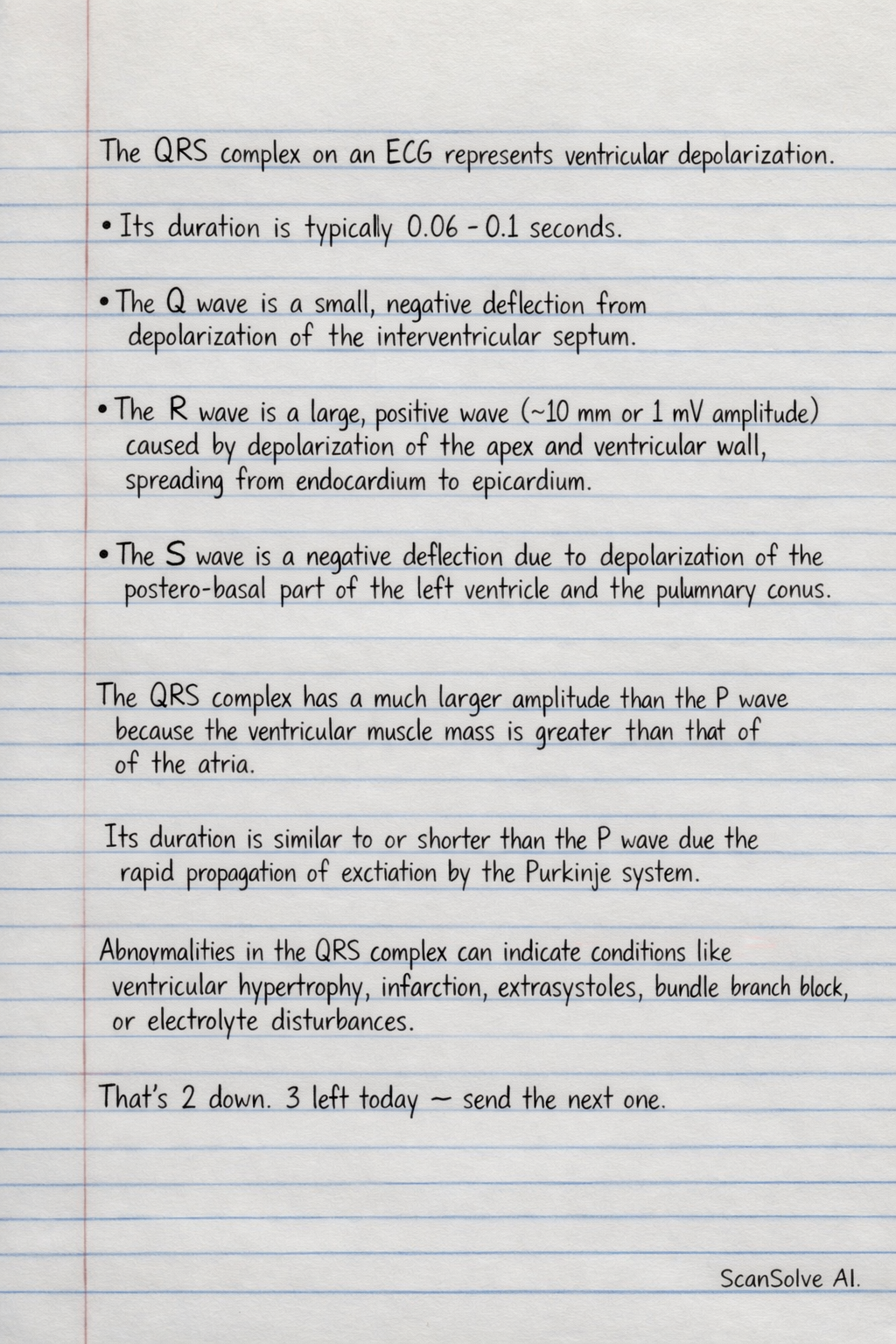
The QRS complex on an ECG represents ventricular depolarization.
- Its duration is typically 0.06-0.1 second.
- The Q wave is a small, normally negative deflection caused by depolarization of the interventricular septum.
- The R wave is a large, positive wave (about 10 mm or 1 mV amplitude) resulting from depolarization of the apex and ventricular wall, proceeding from the endocardium to the epicardium.
- The S wave is a negative deflection due to depolarization of the postero-basal part of the left ventricle and the pulmonary conus.
The QRS complex has a much larger amplitude than the P wave because the ventricular muscle mass is greater than that of the atria. Its duration is similar to or shorter than the P wave due to the rapid propagation of excitation by the Purkinje system. Abnormalities in the QRS complex can indicate conditions like ventricular hypertrophy, infarction, extrasystoles, bundle branch block, or electrolyte disturbances.
Was this helpful?
Still stuck on this one?
Ask a follow-up, and the answer starts from this question.
Got a different question?Ask your own question
More Biology Questions
QDescribe the components of a normal electrocardiogram (ECG), including waves, complexes, segments…QWhat is the P-R interval on an ECG, what is its normal duration, and what conditions can cause it to…QWhy are P, QRS, and T waves inverted in lead aVR on an ECG?QWhat abnormalities can be observed in the T wave of an ECG, and in what conditions do they typically…QIn the given alternating current waveform, what does the segment PQ represent?
Handwritten Step-by-Step Solution
Get this as a handwritten image on WhatsApp — like a tutor wrote it for you.
Try on WhatsApp