
We read your photo as:
Describe the excretory system and plant propagation techniques. 2. Explain the importance of scientific methods and laboratory safety.
ScanSolve AI Answer
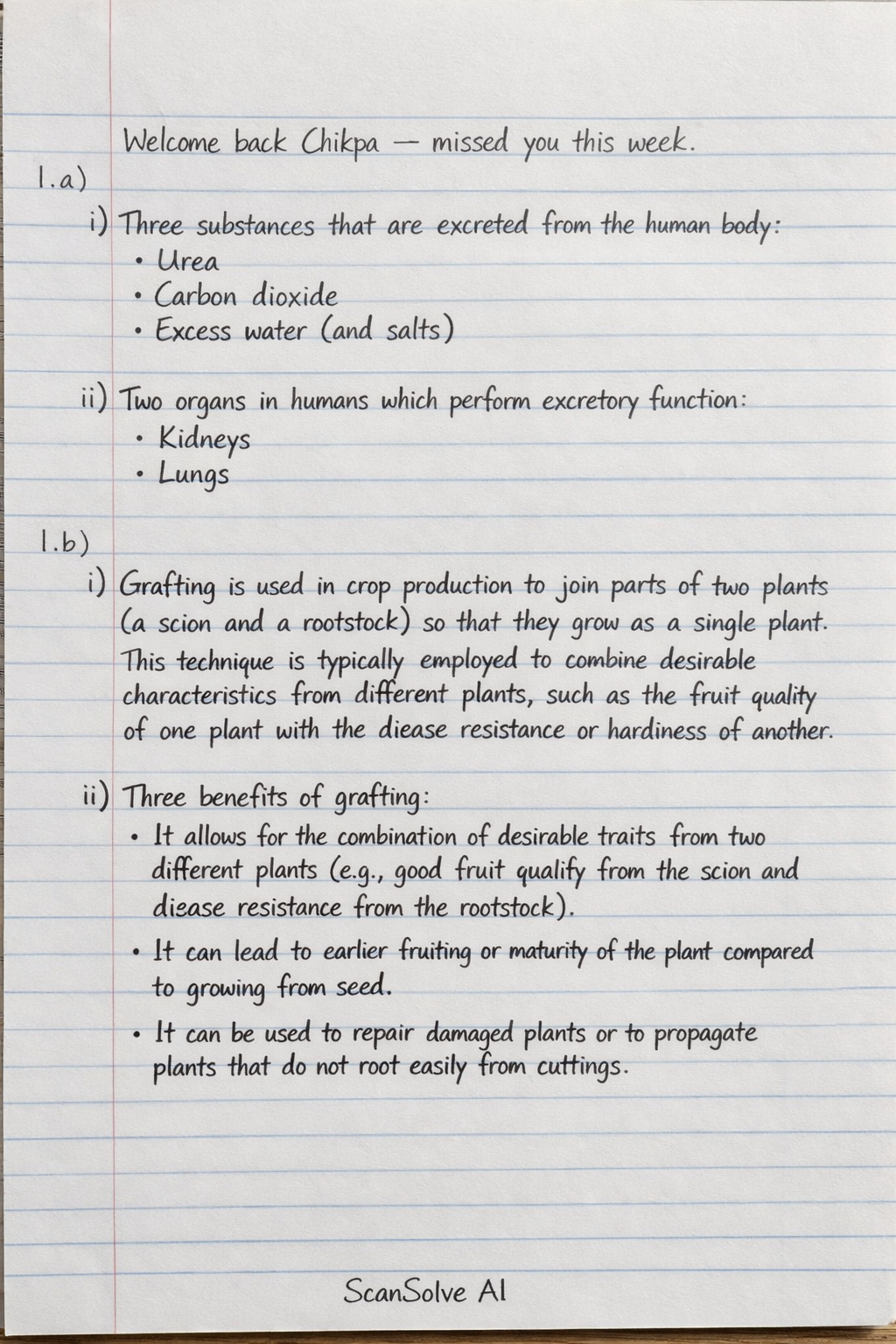
1.a)
i) Three substances that are excreted from the human body:
- Urea
- Carbon dioxide
- Excess water (and salts)
ii) Two organs in humans which perform excretory function:
- Kidneys
- Lungs
1.b)
i) Grafting is used in crop production to join parts of two plants (a scion and a rootstock) so that they grow as a single plant. This technique is typically employed to combine desirable characteristics from different plants, such as the fruit quality of one plant with the disease resistance or hardiness of another.
ii) Three benefits of grafting:
- It allows for the combination of desirable traits from two different plants (e.g., good fruit quality from the scion and disease resistance from the rootstock).
- It can lead to earlier fruiting or maturity of the plant compared to growing from seed.
- It can be used to repair damaged plants or to propagate plants that do not root easily from cuttings.
1.c)
i) Two ways in which scientific methods are important:
- It provides a systematic and logical approach to understanding the natural world, allowing for the formulation and testing of hypotheses.
- It leads to the development of new technologies, medicines, and solutions to practical problems, improving human life and society.
ii) One reason for each of the following laboratory rules:
α) Do not wear rubber slippers to the laboratory: To protect feet from chemical spills, broken glassware, or electrical hazards, as rubber slippers offer inadequate protection and can be slippery.
β) Close all taps before leaving the laboratory: To prevent wastage of water and to avoid potential flooding or water damage in the laboratory.
γ) Spilled liquids must be cleaned immediately: To prevent accidents such as slipping and to avoid contamination of other experiments, equipment, or surfaces.
1.d)
i) Earthing (or grounding) in household wiring is the process of connecting the metal casing of an electrical appliance to the earth using a low-resistance wire. This provides a safe path for current to flow to the ground in the event of a fault (e.g., live wire touching the casing), thereby preventing electric shock to anyone who touches the appliance.
ii) Two sources of electric power generation:
- Hydroelectric power (from moving water)
- Thermal power (from burning fossil fuels like coal, natural gas, or oil)
- Solar power (from sunlight)
- Wind power (from wind turbines)
- Nuclear power (from nuclear fission)
2.a)
Four reasons why farmers should be discouraged from using chemical fertilizers:
- Environmental pollution: Chemical fertilizers can leach into groundwater, contaminating drinking water sources, and run off into rivers and lakes, causing eutrophication (excessive algal growth that depletes oxygen and harms aquatic life).
- Soil degradation: Over-reliance on chemical fertilizers can reduce the soil's natural fertility, destroy beneficial microorganisms, and decrease the organic matter content, leading to poorer soil structure over time.
- Health risks: Farmers handling chemical fertilizers without proper protection can be exposed to harmful chemicals, and residues can sometimes remain in food products, posing potential health risks to consumers.
- Increased costs: Chemical fertilizers can be expensive, increasing the overall production costs for farmers and making them dependent on external inputs.
2.b)
i) Temporary hard water is water that contains dissolved hydrogen carbonates (bicarbonates) of calcium () and magnesium (). This type of hardness can be removed by boiling the water.
ii) Chemical equation to show how temporary hard water can be softened by heating:
2.c)
i) A lever is a simple machine consisting of a rigid bar or beam that pivots around a fixed point called a fulcrum. It is used to multiply force, change the direction of force, or increase the distance over which a force acts.
ii) Explanation of terms as applied to simple machines:
α) Mechanical advantage: Mechanical advantage (MA) is the ratio of the load (output force) to the effort (input force). It indicates how much a machine multiplies the input force to overcome a larger load.
β) Velocity ratio: Velocity ratio (VR), also known as ideal mechanical advantage, is the ratio of the distance moved by the effort to the distance moved by the load in the same amount of time. It is a theoretical value that does not account for friction.
2.d)
i) Food processing involves the transformation of raw agricultural products into food, or the transformation of one form of food into other forms. This can include various physical or chemical methods to prepare food for consumption, storage, or marketing.
ii) State:
α) Two advantages of food processing:
- Increased shelf life: Processing methods like canning, freezing, or drying extend the time food can be stored without spoilage.
- Enhanced convenience: Processed foods are often ready-to-eat or require minimal preparation, saving time for consumers.
- Improved food safety: Processing can eliminate harmful microorganisms and toxins, making food safer for consumption. β) One disadvantage of food processing:
- Loss of nutrients: Some processing methods can reduce the nutritional content (e.g., vitamins, minerals) of food.
- Addition of unhealthy ingredients: Processed foods often contain high levels of sugar, salt, unhealthy fats, and artificial additives.
- Increased cost: Processing can add to the cost of food, making it more expensive than fresh, unprocessed alternatives.
Still stuck on this one?
Ask a follow-up, and the answer starts from this question.
More Biology Questions
Handwritten Step-by-Step Solution
Get this as a handwritten image on WhatsApp — like a tutor wrote it for you.
Try on WhatsApp