
We read your photo as:
Farm animals have sex chromosomes, known as gonosomes, and body chromosomes, known as autosomes. Horses have 64 chromosomes and goats have 60. Indicate EACH of the following: (a) The number of sex chromosomes in goats (b) The number of pairs of autosomes in horses
ScanSolve AI Answer
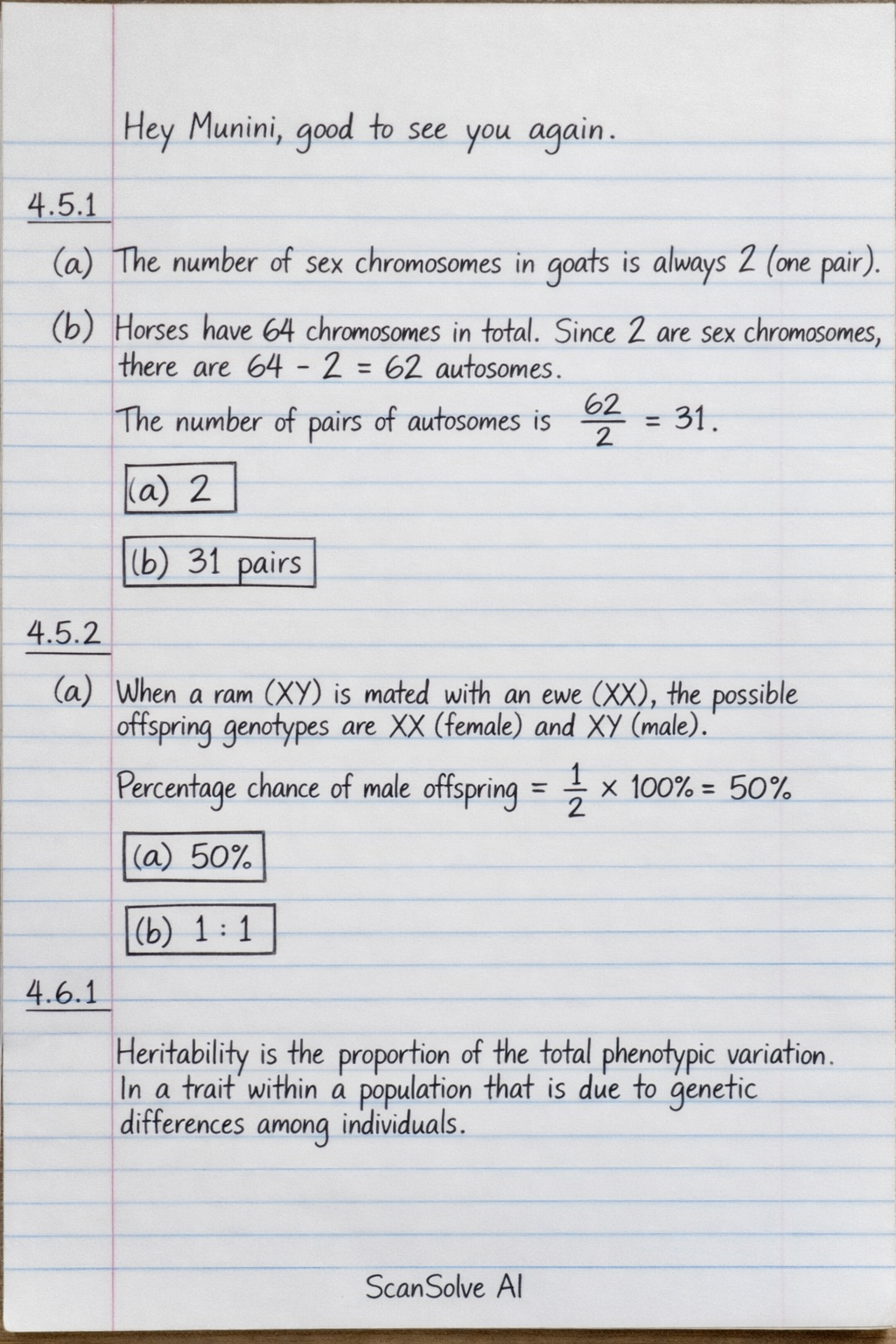
4.5.1
a) The number of sex chromosomes in goats is always 2 (one pair).
b) Horses have 64 chromosomes in total. Since 2 are sex chromosomes, there are autosomes. The number of pairs of autosomes is .
a)
b)
4.5.2
a) When a ram (XY) is mated with an ewe (XX), the possible offspring genotypes are XX (female) and XY (male).
b) The ratio of male to female offspring is 1:1.
a) \boxed{\text{50%}}
b)
4.6.1
Heritability is the proportion of the total phenotypic variation in a trait within a population that is due to genetic differences among individuals.
4.6.2
a) A qualitative characteristic is one that is expressed as a distinct category and is not typically measured numerically.
b) A quantitative characteristic is one that can be measured numerically and shows continuous variation.
a)
b)
4.6.3
The heritability for milk production is 40%. The total variation in a trait is due to genetic and environmental factors.
\boxed{\text{60%}}
4.6.4
Heritability indicates the extent to which a trait is genetically determined. A higher heritability means that the estimated breeding value (EBV) will be a more accurate predictor of an animal's genetic merit for that trait, leading to more effective selection for improvement.
4.7.1
- Genetic modification allows for the introduction of specific genes from any organism, enabling traits not possible through traditional breeding.
- It is generally faster and more precise than traditional breeding, as specific genes can be targeted and inserted without introducing undesirable genes.
4.7.2
- Potential for gene flow to wild relatives, which could lead to the creation of "superweeds" or impact biodiversity.
- Possible harm to non-target organisms (e.g., beneficial insects) due to toxins produced by GM crops.
Still stuck on this one?
Ask a follow-up, and the answer starts from this question.
Handwritten Step-by-Step Solution
Get this as a handwritten image on WhatsApp — like a tutor wrote it for you.
Try on WhatsApp