
We read your photo as:
Define the following (A) Explain the difference between simple and differential staining.
ScanSolve AI Answer
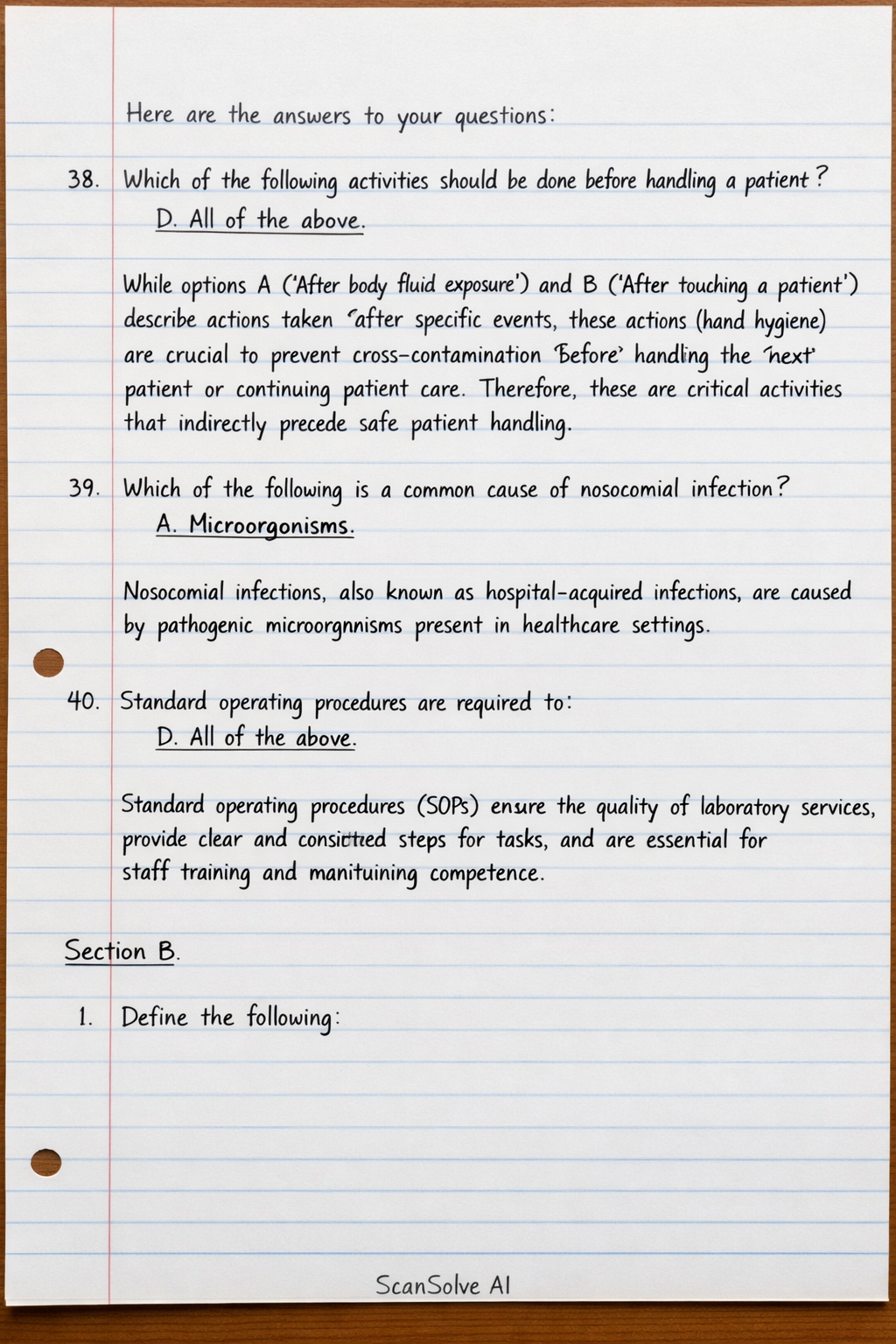
Here are the answers to your questions:
38. Which of the following activities should be done before handling a patient?
- D. All of the above
- While options A ("After body fluid exposure") and B ("After touching a patient") describe actions taken after specific events, these actions (hand hygiene) are crucial to prevent cross-contamination before handling the next patient or continuing patient care. Therefore, these are critical activities that indirectly precede safe patient handling.
39. Which of the following is a common cause of nosocomial infection?
- A. Microorganisms
- Nosocomial infections, also known as hospital-acquired infections, are caused by pathogenic microorganisms present in healthcare settings.
40. Standard operating procedures are required to:
- D. All of the above
- Standard operating procedures (SOPs) ensure the quality of laboratory services, provide clear and consistent steps for tasks, and are essential for staff training and maintaining competence.
Section B
1. Define the following
-
A) Explain the difference between simple and differential staining
- Simple staining uses a single basic dye to color all cells in a sample, making their basic morphology (shape, size, arrangement) visible. It does not distinguish between different types of bacteria. Differential staining, on the other hand, uses two or more dyes and a decolorizing agent to distinguish between different types of bacteria based on their unique cellular components or properties, such as cell wall composition.
-
B) Explain the principles of Ziehl Neelsen staining procedures for mycobacteria
- The Ziehl-Neelsen (ZN) staining procedure is a differential stain used to identify acid-fast bacteria, primarily Mycobacterium species. The principle relies on the high mycolic acid content in the cell walls of these bacteria, which makes them waxy and impermeable. When stained with a primary dye (carbol fuchsin) and heated, the dye penetrates the waxy cell wall. After cooling, the mycolic acid prevents the dye from being washed out by acid-alcohol (decolorizer). Non-acid-fast bacteria lack this waxy layer, so they are decolorized and then pick up a counterstain (e.g., methylene blue). Thus, acid-fast bacteria appear red, and non-acid-fast bacteria appear blue.
2. Give two common methods of sterilization in a microbiology laboratory
- Autoclaving (Moist Heat Sterilization): This method uses saturated steam under pressure, typically at and for minutes, to kill all microorganisms, including bacterial spores. It is commonly used for sterilizing culture media, glassware, and contaminated waste.
- Dry Heat Sterilization: This method involves using hot air ovens at high temperatures (e.g., for hours) to sterilize items that cannot tolerate moisture, such as glassware, metal instruments, and heat-stable powders.
3. Briefly explain the basic dyes use in Ziel Neelsen staining procedure
- Basic dyes are positively charged chromophores that bind to negatively charged components within cells, such as nucleic acids and certain proteins. In the Ziehl-Neelsen staining procedure, Carbol Fuchsin is the primary basic dye. It is a red dye that, with the aid of heat, penetrates the waxy, mycolic acid-rich cell walls of acid-fast bacteria. Once inside, it is strongly retained even after treatment with acid-alcohol. Methylene Blue (or Malachite Green) is the counterstain, also a basic dye, which stains the decolorized non-acid-fast bacteria blue (or green), making them visible.
Still stuck on this one?
Ask a follow-up, and the answer starts from this question.
More Biology Questions
Handwritten Step-by-Step Solution
Get this as a handwritten image on WhatsApp — like a tutor wrote it for you.
Try on WhatsApp