
We read your photo as:
Define the following terms in Biology: Excretion, Osmoregulation, Transpiration, Homeostasis. State and explain 3 factors affecting the rate of Transpiration.
Biology
ScanSolve AI Answer
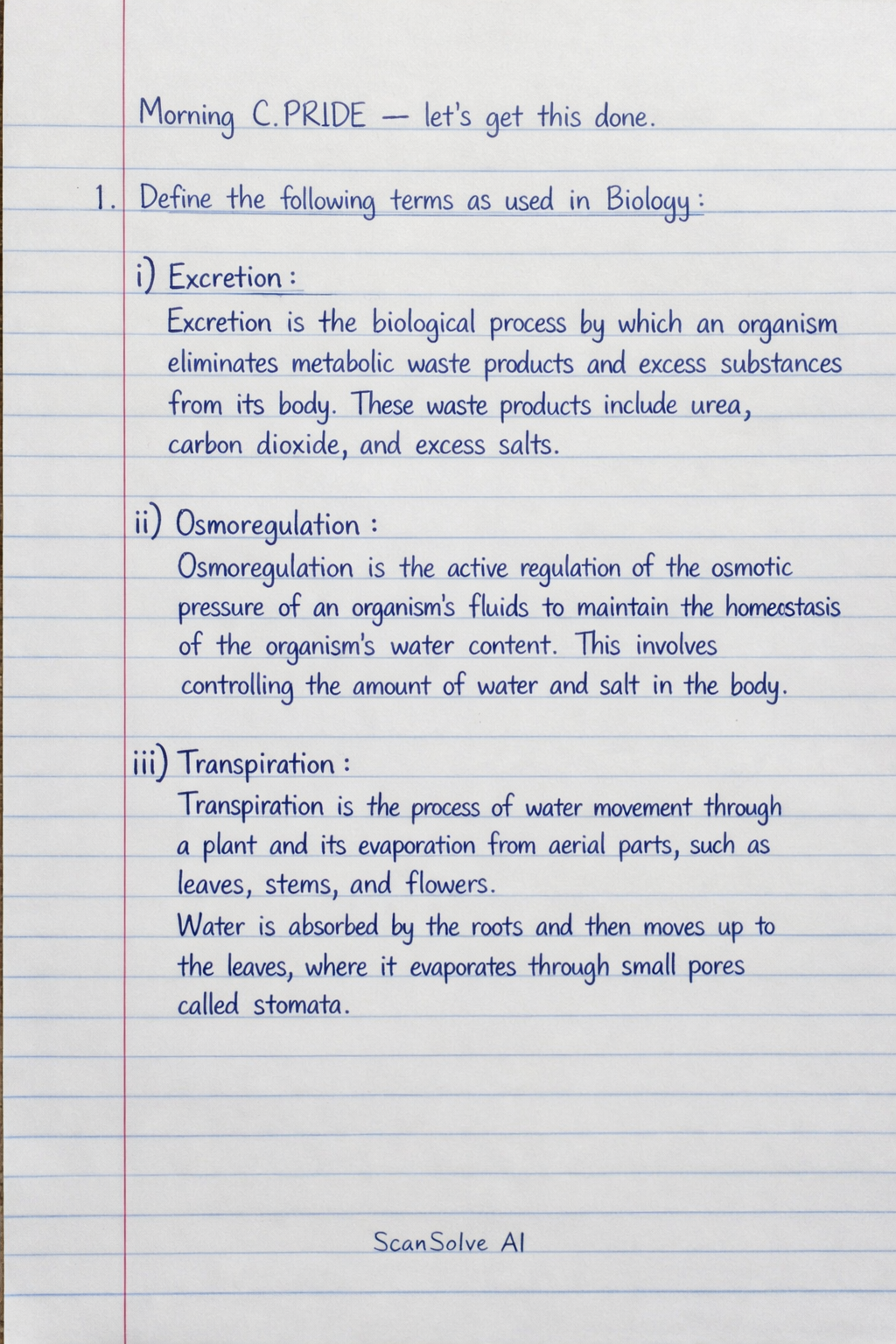
1. Define the following terms as used in Biology:
-
i) Excretion:
- Excretion is the biological process by which an organism eliminates metabolic waste products and excess substances from its body. These waste products include urea, carbon dioxide, and excess salts.
-
ii) Osmoregulation:
- Osmoregulation is the active regulation of the osmotic pressure of an organism's fluids to maintain the homeostasis of the organism's water content. This involves controlling the amount of water and salt in the body.
-
iii) Transpiration:
- Transpiration is the process of water movement through a plant and its evaporation from aerial parts, such as leaves, stems, and flowers. Water is absorbed by the roots and then moves up to the leaves, where it evaporates through small pores called stomata.
-
iv) Homeostasis:
- Homeostasis is the ability of an organism to maintain a stable internal environment despite changes in external conditions. This involves regulating various physiological processes like body temperature, blood glucose levels, and pH.
2. (b) State and explain 3 factors that affect the rate of Transpiration:
-
Temperature:
- Higher temperatures increase the kinetic energy of water molecules, leading to a faster rate of evaporation from the leaf surface. This also increases the water-holding capacity of the air, creating a steeper water potential gradient between the leaf and the atmosphere.
-
Humidity:
- Low humidity means there is less water vapor in the air, creating a steeper water potential gradient between the moist air spaces inside the leaf and the drier external air. This increases the rate of water diffusion out of the stomata, thus increasing transpiration. Conversely, high humidity reduces the rate of transpiration.
-
Wind speed:
- Increased wind speed blows away the layer of humid air that accumulates around the leaf surface. This maintains a steep water potential gradient between the leaf and the surrounding air, thereby increasing the rate of transpiration.
-
Light intensity:
- Light stimulates the opening of stomata, which are the primary sites of transpiration, to allow for carbon dioxide uptake for photosynthesis. Therefore, higher light intensity generally leads to wider stomatal opening and an increased rate of transpiration.
3. Draw a well labelled diagram of a Mammalian Heart:
Since I cannot draw, I will describe the key components that should be clearly labelled in a diagram of a mammalian heart:
A well-labelled diagram of a mammalian heart should include:
- Right Atrium
- Left Atrium
- Right Ventricle
- Left Ventricle
- Tricuspid Valve (between right atrium and right ventricle)
- Bicuspid (Mitral) Valve (between left atrium and left ventricle)
- Pulmonary Artery (carrying deoxygenated blood from right ventricle to lungs)
- Aorta (carrying oxygenated blood from left ventricle to the body)
- Pulmonary Veins (carrying oxygenated blood from lungs to left atrium)
- Vena Cava (Superior and Inferior) (carrying deoxygenated blood from the body to the right atrium)
- Pulmonary Valve (at the base of the pulmonary artery)
- Aortic Valve (at the base of the aorta)
- Septum (the wall dividing the left and right sides of the heart)
- Coronary Arteries and Veins (supplying blood to the heart muscle itself)
Was this helpful?
Still stuck on this one?
Ask a follow-up, and the answer starts from this question.
Got a different question?Ask your own question
More Biology Questions
QPlease define the following biological terms: Excretion, Osmoregulation, Homeostasis, Fertilization…QSECTION A Answer ALL 3 questions Define the following terms. Excretion. (ii) Homeostasis. Describe…QDescribe three factors which influence the uptake and absorption of water from soil to underground…QExplain transpiration and list factors affecting its rate, and discuss its importance to plants.QDescribe the factors that affect the rate of transpiration and explain how they do so. Include how…
Handwritten Step-by-Step Solution
Get this as a handwritten image on WhatsApp — like a tutor wrote it for you.
Try on WhatsApp