
We read your photo as:
Food contains substances called nutrients. The types of nutrients that are found in foods for growth and energy are
Biology
ScanSolve AI Answer
Answer
D
Step-by-step solution
2 stepsThe question asks to identify the types of nutrients found in foods that are primarily responsible for growth and energy.
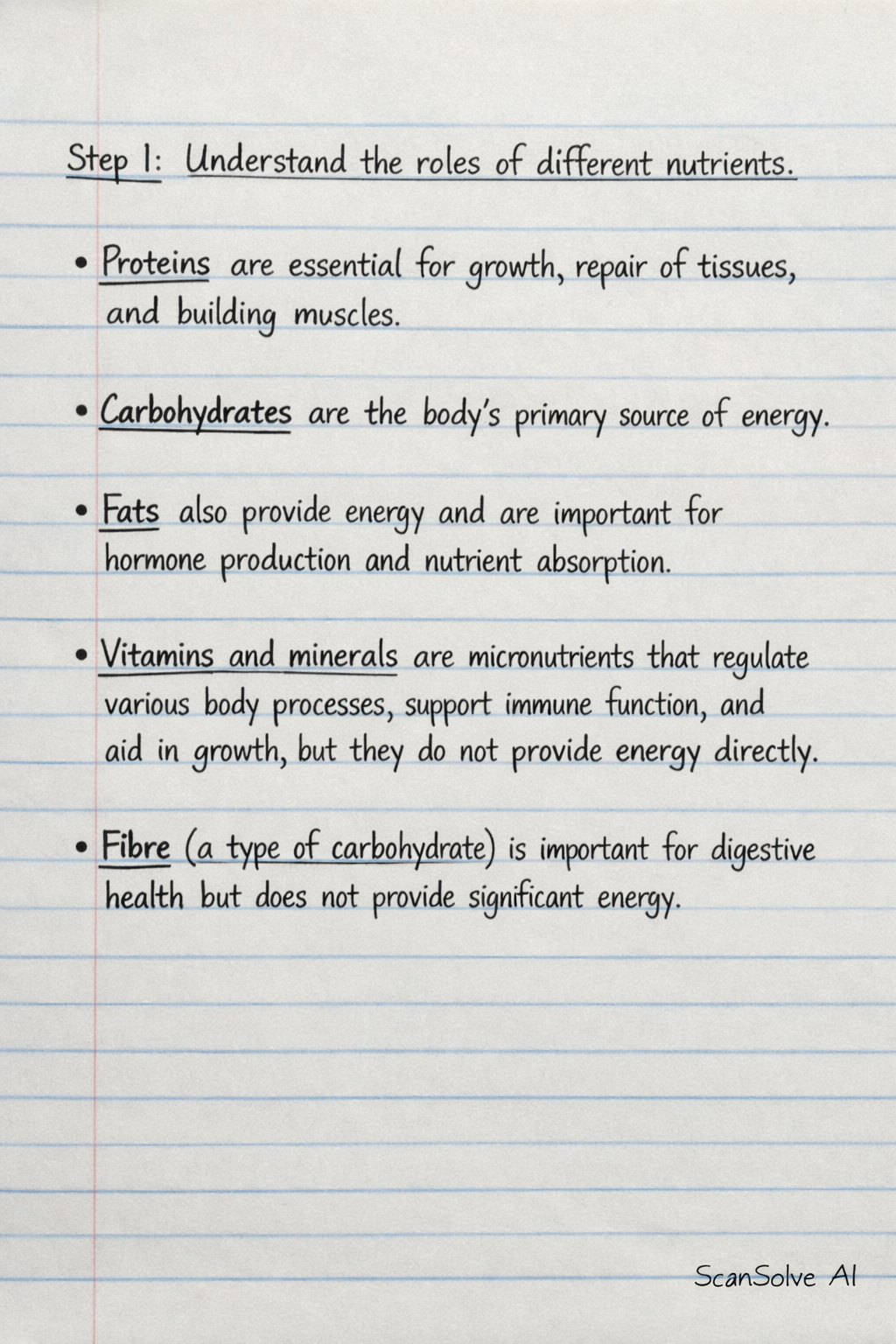
Understand the roles of different nutrients.
- Proteins are essential for growth, repair of tissues, and building muscles.
- Carbohydrates are the body's primary source of energy.
- Fats also provide energy and are important for hormone production and nutrient absorption.
- Vitamins and minerals are micronutrients that regulate various body processes, support immune function, and aid in growth, but they do not provide energy directly.
- Fibre (a type of carbohydrate) is important for digestive health but does not provide significant energy.
Evaluate the given options based on the roles for growth and energy.
- A. Protein and vitamins: Protein is for growth, but vitamins are not a primary source of energy.
- B. Carbohydrates and fibre: Carbohydrates provide energy, but fibre's main role is digestion, not direct energy or growth.
- C. Fibre and minerals: Neither fibre nor minerals are primary sources for growth or energy.
- D. Protein and Carbohydrates: Protein is crucial for growth, and carbohydrates are the main source of energy. This option correctly identifies nutrients for both functions.
The correct option is D.
The types of nutrients that are found in foods for growth and energy are Protein and Carbohydrates.
The final answer is
Was this helpful?
Try one yourself
A new problem that tests the same skill.
Still stuck on this one?
Ask a follow-up, and the answer starts from this question.
Got a different question?Ask your own question
More Biology Questions
QFood provides us with energy, helps us grow, and protects us from diseases.QWhich food group provide energy?QWhich nutrient gives energy? A. Proteins B. Vitamins C. Carbohydrates D. MineralsQWhat are the main functions of food, examples of energy-giving and growth-promoting foods, how flour…QWhich nutrient helps in building and repairing body tissues?
Browse by topic:Nutrition
Handwritten Step-by-Step Solution
Get this as a handwritten image on WhatsApp — like a tutor wrote it for you.
Try on WhatsApp