
We read your photo as:
Define food preservation and food additive. Explain Food, Drugs and Chemical Substances Act, Cap 254, regulations on food safety.
ScanSolve AI Answer
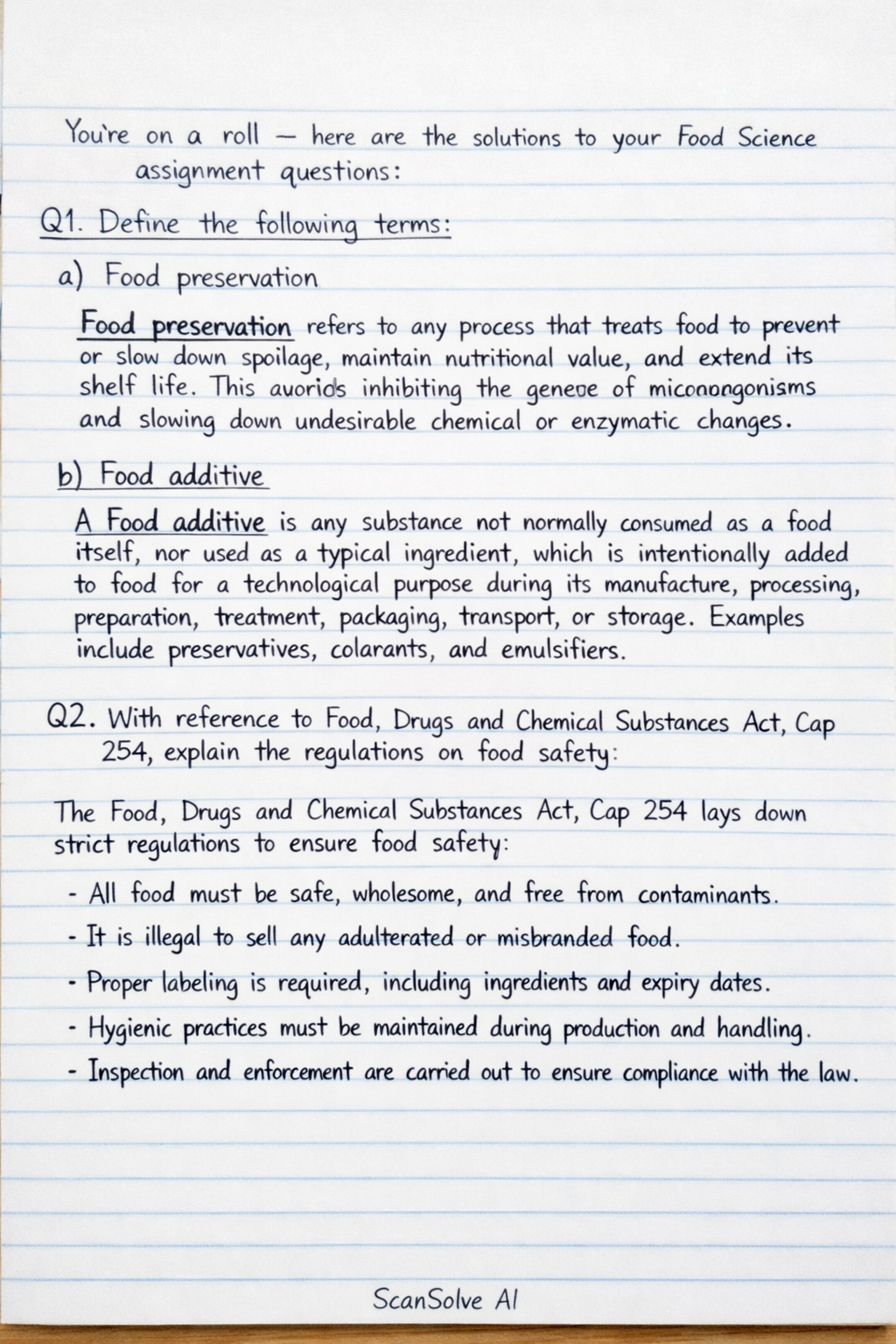
here are the solutions to your Food Science assignment questions:
Q1. Define the following terms:
a) Food preservation
Food preservation refers to any process that treats food to prevent or slow down spoilage, maintain nutritional value, and extend its shelf life. This involves inhibiting the growth of microorganisms and slowing down undesirable chemical or enzymatic changes.
b) Food additive
A food additive is any substance not normally consumed as a food itself, nor used as a typical ingredient, which is intentionally added to food for a technological purpose during its manufacture, processing, preparation, treatment, packaging, transport, or storage. Examples include preservatives, colorants, and emulsifiers.
Q2. With reference to Food, Drugs and Chemical Substances Act, Cap 254, explain the regulations on food safety.
The Food, Drugs and Chemical Substances Act, Cap 254 (of Kenya) is a key legislation governing food safety. It aims to protect public health by regulating the manufacture, sale, and advertisement of food, drugs, and chemical substances. Key regulations on food safety under this Act include:
- Prohibiting the sale of adulterated or unfit food for human consumption.
- Setting standards for the composition, quality, and labeling of food products.
- Requiring food premises to be registered and inspected to ensure hygienic conditions.
- Regulating the use of food additives to ensure they are safe and used within specified limits.
- Empowering public health officers to seize and condemn unsafe food.
Q3. Explain the principles involved in grading of raw food materials.
The principles involved in grading raw food materials aim to classify them based on quality, size, and other characteristics to ensure consistency and fair trade. These principles include:
- Quality assessment: Evaluating attributes like freshness, ripeness, color, texture, and absence of defects (e.g., bruises, insect damage, disease).
- Size and weight uniformity: Sorting materials into specific size or weight ranges to meet market demands and processing requirements.
- Freedom from foreign matter: Ensuring the absence of dirt, stones, leaves, or other extraneous materials.
- Maturity and ripeness: Classifying based on the stage of development to ensure optimal flavor, texture, and shelf life.
- Absence of damage: Identifying and separating materials with physical damage, such as cuts, cracks, or spoilage.
- Sensory evaluation: Using sight, smell, and touch to assess quality attributes that may not be quantifiable by instruments.
Q4. Health concerns and Environmental impacts have been fronted as key reasons for non-adoption of GMO foods. Explain.
Health concerns regarding GMO foods often revolve around potential allergenicity, the transfer of antibiotic resistance genes, and the long-term effects of consuming genetically modified organisms on human health. Critics worry about unforeseen health consequences due to altered genetic material or new proteins produced.
Environmental impacts include concerns about gene flow from GMO crops to wild relatives, potentially creating "superweeds" resistant to herbicides. There are also worries about the impact on biodiversity, non-target organisms (like beneficial insects), and the potential for increased reliance on specific herbicides or pesticides, leading to environmental degradation. These concerns contribute to public skepticism and regulatory hurdles, hindering widespread adoption.
Q5. With examples classify the foods of plant origin into their constituent categories.
Foods of plant origin can be classified into several constituent categories:
- Cereals and Grains: Staple foods rich in carbohydrates. Examples: wheat, rice, maize, oats.
- Legumes (Pulses): High in protein and fiber. Examples: beans, lentils, chickpeas, peas.
- Fruits: Typically sweet, fleshy products of a tree or other plant that contain seeds. Examples: apples, oranges, bananas, berries.
- Vegetables: Edible parts of plants, often categorized by the part consumed (e.g., leafy greens, root vegetables, stem vegetables). Examples: spinach, carrots, potatoes, broccoli.
- Nuts and Seeds: Rich in healthy fats, protein, and fiber. Examples: almonds, walnuts, sunflower seeds, flaxseeds.
- Spices and Herbs: Used for flavoring, often in small quantities. Examples: pepper, cinnamon, basil, rosemary.
Q6. Explain any two physical characteristics associated with foods of the plant origin.
Two physical characteristics associated with foods of plant origin are:
-
Texture: This refers to the feel of the food in the mouth and can range from crisp (e.g., fresh lettuce, apples) to soft (e.g., ripe bananas, cooked potatoes) or fibrous (e.g., celery, some leafy greens). Texture is influenced by cell wall structure, water content, and the presence of components like pectin and cellulose. It significantly impacts consumer acceptability and processing methods.
-
Color: The color of plant foods is primarily due to pigments such as chlorophyll (green), carotenoids (yellow, orange, red), anthocyanins (red, purple, blue), and flavonoids (yellow). Color is a key indicator of ripeness, freshness, and quality. It also plays a crucial role in consumer appeal and can change during processing or spoilage.
Still stuck on this one?
Ask a follow-up, and the answer starts from this question.
More Biology Questions
Handwritten Step-by-Step Solution
Get this as a handwritten image on WhatsApp — like a tutor wrote it for you.
Try on WhatsApp