
We read your photo as:
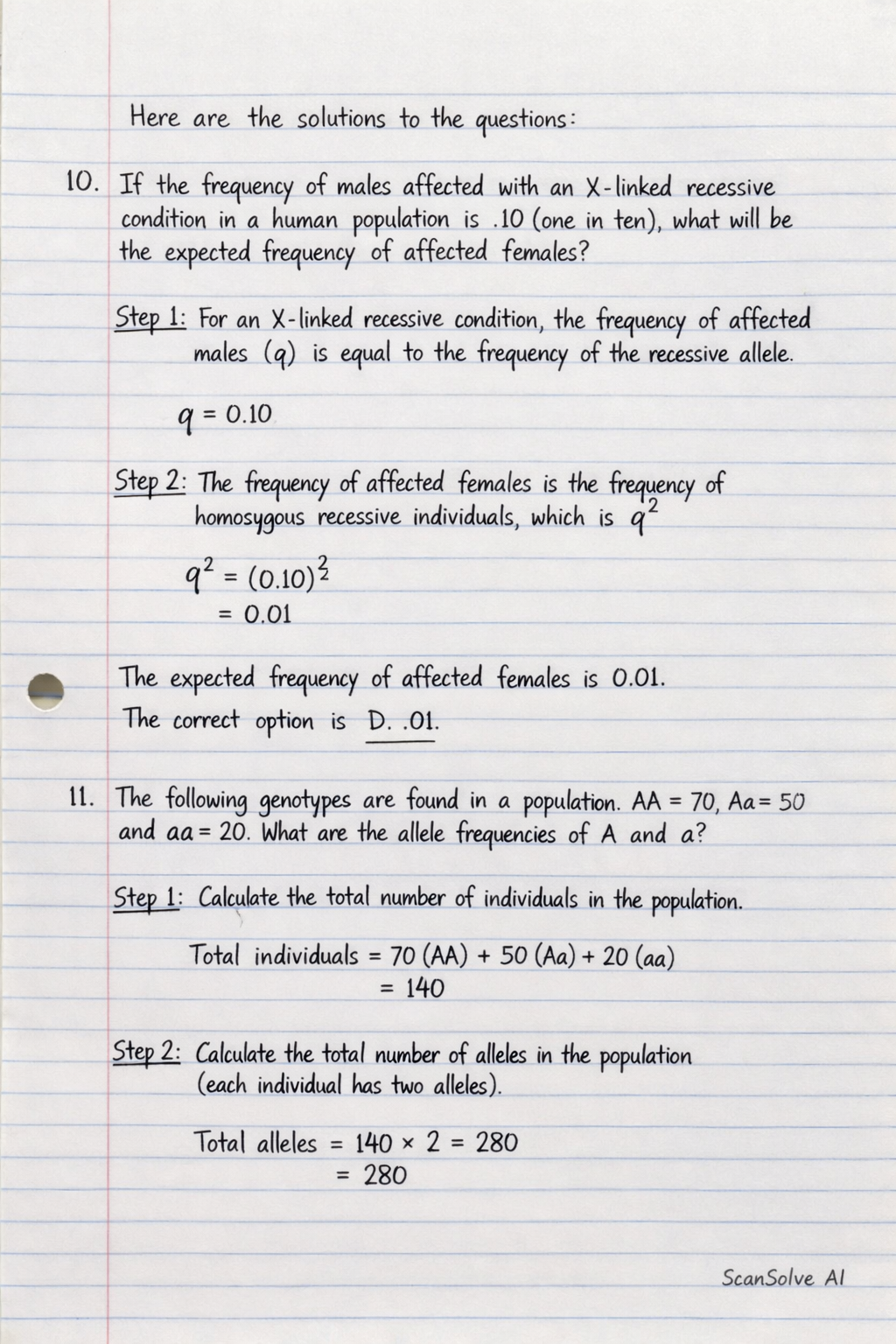
For an X-linked recessive condition, the frequency of affected males (q) is equal to the frequency of the recessive allele.
ScanSolve AI Answer
Answer
01
Step-by-step solution
6 stepsHere are the solutions to the questions:
10. If the frequency of males affected with an X-linked recessive condition in a human population is .10 (one in ten), what will be the expected frequency of affected females?
For an X-linked recessive condition, the frequency of affected males () is equal to the frequency of the recessive allele.
The frequency of affected females is the frequency of homozygous recessive individuals, which is .
The expected frequency of affected females is 0.01.
The correct option is D. .01
11. The following genotypes are found in a population AA= 70, Aa= 50 and aa= 20; What are the allele frequencies of A and a?
Calculate the total number of individuals in the population.
Calculate the total number of alleles in the population (each individual has two alleles).
Calculate the frequency of allele A ().
Each AA individual contributes two A alleles, and each Aa individual contributes one A allele.
Rounding to two decimal places, .
Calculate the frequency of allele a ().
Each aa individual contributes two a alleles, and each Aa individual contributes one a allele. Alternatively, .
Rounding to two decimal places, .
(Alternatively, )The allele frequencies are A = 0.68 and a = 0.32.
The correct option is B. A = 0.68 and a = 0.32
12. The tendency of an offspring to resemble its parent is known as
The tendency of an offspring to resemble its parent is due to the transmission of genetic traits from one generation to the next. This biological process is known as heredity.
The correct option is B. Heredity
13. A person with sickle cell trait, having one S allele and one normal, will be resistant to malaria and eventually develop sickle cell anemia.
Individuals with sickle cell trait (heterozygous, HbAS) possess one allele for normal hemoglobin and one allele for sickle cell hemoglobin. This genotype provides resistance to malaria. However, these individuals typically do not develop severe sickle cell anemia; they are carriers of the trait. Therefore, the statement that they will eventually develop sickle cell anemia is incorrect.
The correct option is B. False
14. For a woman living in the Ghana, which genotype would be the most advantageous to have?
In regions like Ghana where malaria is endemic, the sickle cell trait (heterozygous genotype, HbAS) offers a significant advantage. Individuals with this genotype are resistant to malaria, which is a major cause of mortality, and generally do not suffer from the severe symptoms of sickle cell anemia.
- Homozygous for the sickle cell allele (HbSS) leads to severe sickle cell anemia, which is often fatal.
- Homozygous for the normal hemoglobin allele (HbAA) makes an individual susceptible to malaria.
Therefore, the heterozygous genotype is the most advantageous.
The correct option is B. heterozygous for the sickle cell allele
15. The crossing of F1 to either of the parents is known as
In genetics, a cross between an F1 individual (first filial generation) and either of its parental genotypes is specifically termed a back cross. A test cross is a specific type of back cross where the F1 individual is crossed with a homozygous recessive parent.
The correct option is B. Back cross
Try one yourself
A new problem that tests the same skill.
Still stuck on this one?
Ask a follow-up, and the answer starts from this question.
More Biology Questions
Handwritten Step-by-Step Solution
Get this as a handwritten image on WhatsApp — like a tutor wrote it for you.
Try on WhatsApp