

This biology question covers important biological concepts and processes. The step-by-step explanation below helps you understand the underlying mechanisms and reasoning.
ScanSolve AI Answer
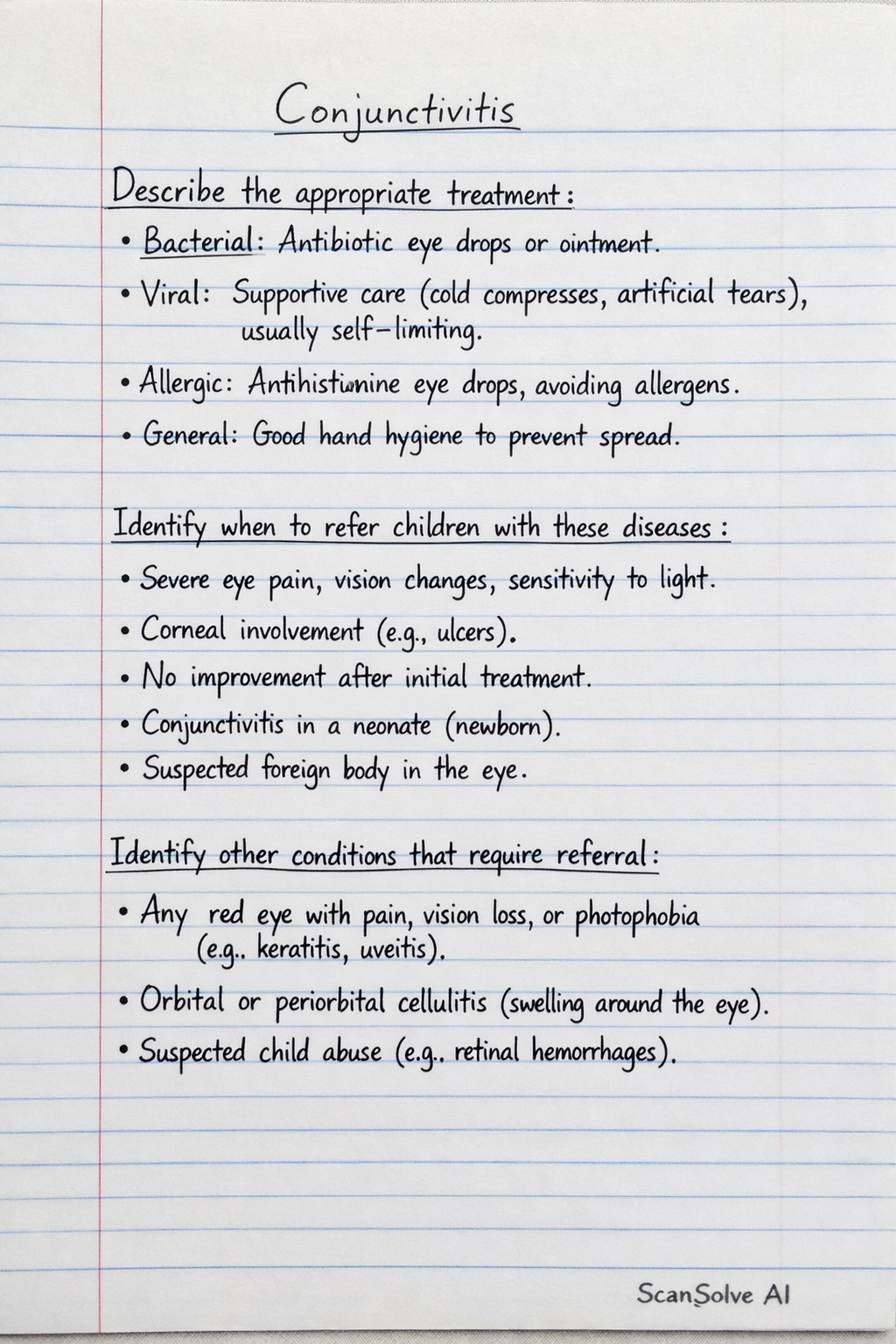
Here are the completed questions for each disease: Conjunctivitis Describe the appropriate treatment. Bacterial:* Antibiotic eye drops or ointment. Viral:* Supportive care (cold compresses, artificial tears), usually self-limiting. Allergic:* Antihistamine eye drops, avoiding allergens. General:* Good hand hygiene to prevent spread. Identify when to refer children with these diseases. Severe eye pain, vision changes, sensitivity to light (photophobia). Corneal involvement (e.g., ulcers). No improvement after initial treatment. Conjunctivitis in a neonate (newborn). Suspected foreign body in the eye. Identify other conditions that require referral. Any red eye* with pain, vision loss, or photophobia (e.g., keratitis, uveitis). Orbital or periorbital cellulitis (swelling around the eye). Suspected child abuse (e.g., retinal hemorrhages). Otitis media (acute and chronic) Describe the appropriate treatment. Acute Otitis Media (AOM):* Pain management (acetaminophen, ibuprofen). Antibiotics (e.g., amoxicillin) for severe cases, infants, or no improvement. Otitis Media with Effusion (OME):* Monitoring for hearing loss; ventilation tubes for persistent OME with hearing loss or recurrent AOM. Identify when to refer children with these diseases. Recurrent AOM (e.g., 3 episodes in 6 months or 4 in 12 months). Persistent OME (e.g., >3 months) with hearing loss or speech delay. Complications such as mastoiditis or facial nerve paralysis. Suspected cholesteatoma. Tympanic membrane perforation that does not heal. Identify other conditions that require referral. Mastoiditis (postauricular swelling, redness, pain). Cholesteatoma (skin growth in the middle ear). Significant hearing loss (sensorineural or conductive). Vertigo or balance issues. Facial nerve weakness or paralysis. Colds and URTI (upper respiratory tract infections) Describe the appropriate treatment. Supportive care: Rest, adequate fluids. Symptom relief: Nasal saline drops/spray for congestion, humidifier, acetaminophen or ibuprofen for fever/pain. Honey for cough in children over 1 year. Avoid cough/cold medications in young children. Identify when to refer children with these diseases. Difficulty breathing (e.g., retractions, rapid breathing, nasal flaring). Persistent high fever, especially in infants. Signs of dehydration (e.g., decreased urination, lethargy). Worsening symptoms or no improvement after several days. Severe sore throat with difficulty swallowing. Lethargy or extreme irritability. Stridor (high-pitched breathing sound). Identify other conditions that require referral. Pneumonia (persistent cough, fever, difficulty breathing). Bronchiolitis (wheezing, rapid breathing in infants). Croup (barking cough, stridor). Asthma exacerbation. Epiglottitis (sudden onset high fever, drooling, difficulty swallowing). Foreign body aspiration. Send me the next one 📸