
We read your photo as:
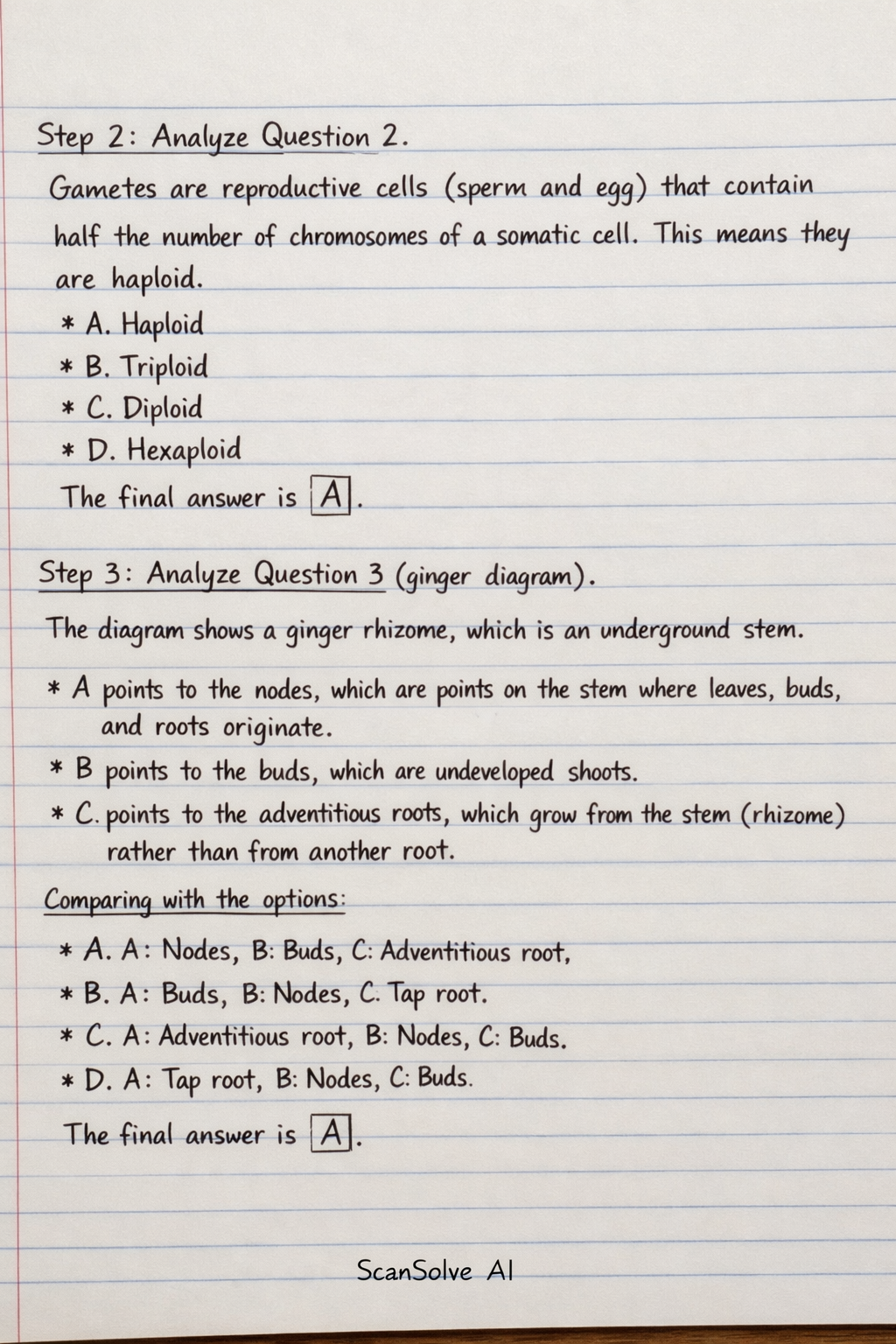
Gametes are reproductive cells (sperm and egg) that contain half the number of chromosomes of a somatic cell. This means they are haploid.
ScanSolve AI Answer
Step-by-step solution
6 stepsAnalyze Question 2.
Gametes are reproductive cells (sperm and egg) that contain half the number of chromosomes of a somatic cell. This means they are haploid.
- A. Haploid
- B. Triploid
- C. Diploid
- D. Hexaploid
The final answer is
Analyze Question 3 (ginger diagram).
The diagram shows a ginger rhizome, which is an underground stem.
- A points to the nodes, which are points on the stem where leaves, buds, and roots originate.
- B points to the buds, which are undeveloped shoots.
- C points to the adventitious roots, which grow from the stem (rhizome) rather than from another root.
Comparing with the options:
- A. A: Nodes, B: Buds, C: Adventitious root
- B. A: Buds, B: Nodes, C: Tap root
- C. A: Adventitious root, B: Nodes, C: Buds
- D. A: Tap root, B: Nodes, C: Buds
The final answer is
Analyze Question 3 (genetics, likely misnumbered).
The question asks what type of gametes will be formed by the genotype RrYy.
This involves two genes, R/r and Y/y, which assort independently. To find the possible gametes, combine one allele from each gene.
Possible combinations:- R with Y RY
- R with y Ry
- r with Y rY
- r with y ry
The possible gametes are RY, Ry, rY, and ry.
Comparing with the options:
- A. RY, Ry, ry, ry
- B. RY, Ry, rY, ry
- C. Ry, Ry, Yy, ry
The final answer is
Analyze Question 4.
The diagram shows a Punnett square for a cross involving two different genes, each with two alleles (e.g., RrYy x RrYy). This type of cross, involving two traits, is known as a dihybrid cross.
- A. Monohybrid cross: Involves one trait.
- B. Test cross: Cross between an individual with an unknown genotype and a homozygous recessive individual.
- C. Back cross: Cross between a hybrid and one of its parents.
- D. Dihybrid cross: Involves two traits.
The final answer is
Analyze Question 6.
The pedigree chart shows an unaffected female mother and an unaffected male father having an affected daughter and an unaffected son.
For a daughter to be affected while both parents are unaffected, the inheritance pattern must be autosomal recessive.- If it were dominant, at least one parent would have to be affected.
- If it were X-linked recessive, an affected daughter (XX) would require an affected father (XY), but the father is shown as unaffected.
- If it were X-linked dominant, an affected daughter would pass the trait to all her sons, and an affected father would pass it to all his daughters. This doesn't fit.
Therefore, the disease 'a' must be an autosomal recessive condition.
Let's check the options:- A. Sickle cell anaemia: Autosomal recessive.
- B. Haemophilia: X-linked recessive.
- C. Thalassemia: Autosomal recessive.
- D. Phenylketonuria: Autosomal recessive.
Since Sickle cell anaemia, Thalassemia, and Phenylketonuria are all autosomal recessive disorders, any of them could fit the pedigree. However, typically in multiple-choice questions, there is one best answer. Sickle cell anaemia is a very common example of an autosomal recessive disorder.
The final answer is
Analyze Question 7.
The diagram shows a DNA double helix and a simplified ladder-like representation of DNA. The label 'a' points to the horizontal rungs connecting the two strands of the DNA ladder. These rungs are formed by complementary nitrogenous bases pairing together (adenine with thymine, guanine with cytosine). These are known as base pairs.
- A. Sugar: Part of the sugar-phosphate backbone.
- B. Phosphate: Part of the sugar-phosphate backbone.
- C. Base pairs: The rungs of the DNA ladder.
- D. Singular bases: 'a' indicates the connection between two bases, not a single base.
The final answer is
Still stuck on this one?
Ask a follow-up, and the answer starts from this question.
More Biology Questions
Handwritten Step-by-Step Solution
Get this as a handwritten image on WhatsApp — like a tutor wrote it for you.
Try on WhatsApp