

This biology question covers important biological concepts and processes. The step-by-step explanation below helps you understand the underlying mechanisms and reasoning.
ScanSolve AI Answer
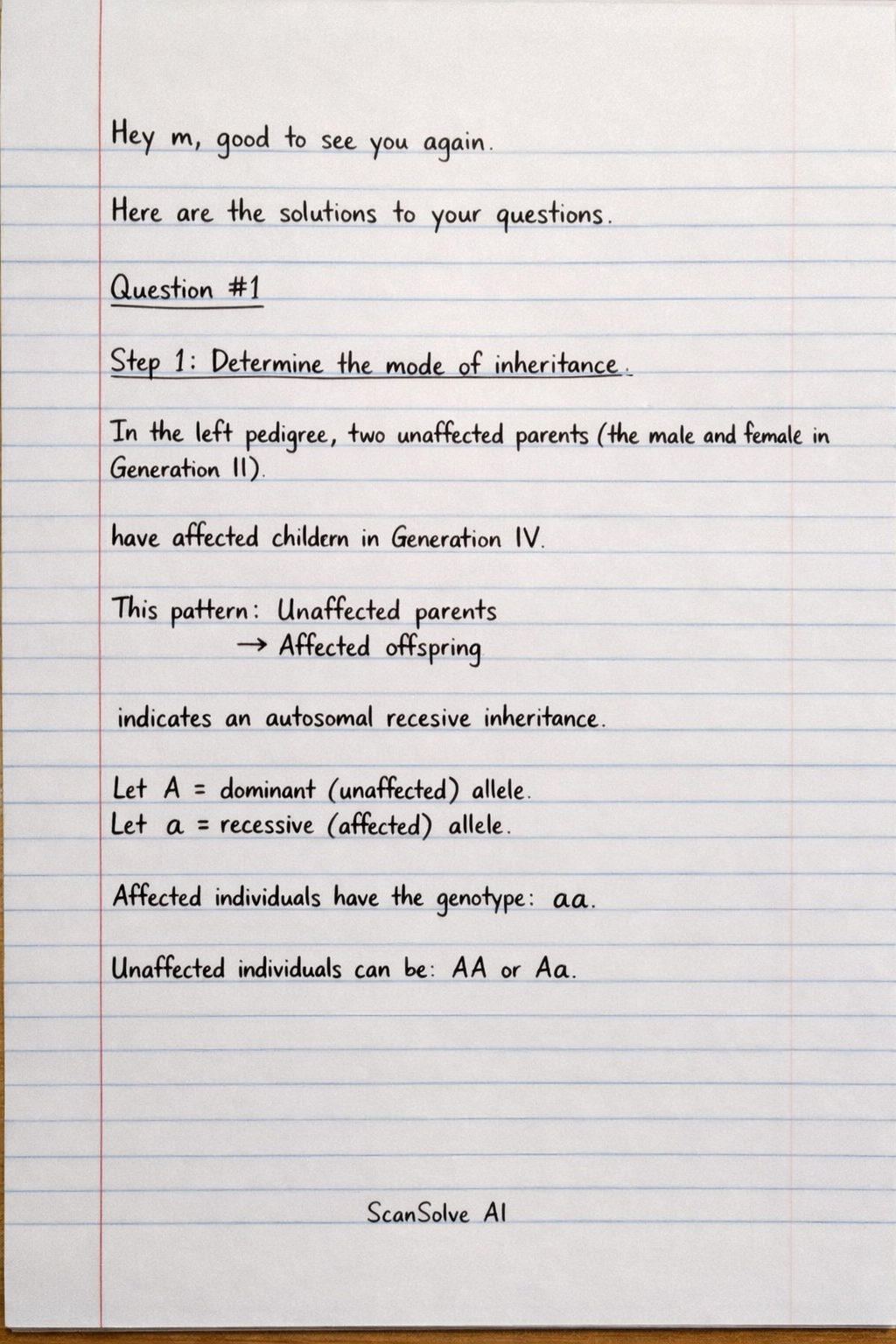
Here are the solutions to your questions. Question #1 Step 1: Determine the mode of inheritance. In the left pedigree, two unaffected parents (the male and female in Generation II who are parents to individuals in Generation III, including the male who marries the female in Generation III and has affected children) have affected children (the male and female in Generation IV). This pattern (unaffected parents having affected offspring) indicates an autosomal recessive inheritance pattern. Let 'A' represent the dominant (unaffected) allele and 'a' represent the recessive (affected) allele. Affected individuals have the genotype 'aa'. Unaffected individuals can be 'AA' or 'Aa'. Step 2: Write the genotypes in every possible place. Left Pedigree: Generation I: Male (unaffected, left): A_ Female (affected, right): aa Generation II: (Children of A_ and aa) Male (1st from left): Aa Male (2nd from left): Aa Female (3rd from left): Aa Generation III: Female (1st from left): A_ Female (2nd from left): A_ Individual #1 (male): AA or Aa (unaffected child of Aa x Aa parents) Female (4th from left): AA or Aa (unaffected child of Aa x Aa parents) Male (5th from left): Aa (unaffected, but has affected children) Female (6th from left, wife of 5th male): Aa (unaffected, but has affected children) Generation IV: Male (affected, left): aa Female (affected, right): aa Right Pedigree: Generation I: Male (unaffected, left): A_ Female (unaffected, right): A_ Generation II: Female (1st from left): Aa (unaffected, but has an affected child) Male (2nd from left): Aa (unaffected, but has an affected child) Male (3rd from left): Aa (unaffected, child of aa and A_) Female (4th from left): Aa (unaffected, child of aa and A_) Generation III: Male (1st from left): AA or Aa (unaffected child of Aa x Aa parents) Individual #2 (male): AA or Aa (unaffected child of Aa x Aa parents) Male (3rd from left, affected): aa Female (4th from left): AA or Aa (unaffected child of Aa x Aa parents) Step 3: Determine the probability that individual #1 is a carrier (Aa). Individual #1's parents are both 'Aa' (the second male and third female in Generation II of the left pedigree). The cross is Aa × Aa, which produces offspring in the ratio 1 AA : 2 Aa : 1 aa. Since individual #1 is unaffected, his genotype is either 'AA' or 'Aa'. Among the unaffected genotypes (AA and Aa), the probability of being 'Aa' is (2)/(3). P(#1 is Aa) = (2)/(3) Step 4: Determine the probability that individual #2 is a carrier (Aa). Individual #2's parents are both 'Aa' (the first female and first male in Generation II of the right pedigree). The cross is Aa × Aa, which produces offspring in the ratio 1 AA : 2 Aa : 1 aa. Since individual #2 is unaffected, his genotype is either 'AA' or 'Aa'. Among the unaffected genotypes (AA and Aa), the probability of being 'Aa' is (2)/(3). P(#2 is Aa) = (2)/(3) Step 5: Calculate the probability that their first child will be sick (aa). For their child to be sick ('aa'), both individuals #1 and #2 must be carriers ('Aa'), and they must pass on the 'a' allele to their child. The probability of an 'Aa' x 'Aa' cross producing an 'aa' child is (1)/(4). P(child is sick) = P(#1 is Aa) × P(#2 is Aa) × P(child is aa | both parents are Aa) P(child is sick) = (2)/(3) × (2)/(3) × (1)/(4) P(child is sick) = (4)/(9) × (1)/(4) P(child is sick) = (4)/(36) = (1)/(9) The probability that their first child will be sick is (1)/(9). Question #2 Step 1: Define alleles and mode of inheritance. PKU is an autosomal recessive disease. Let 'P' be the dominant allele (normal) and 'p' be the recessive allele (PKU). Affected individuals have genotype 'pp'. Unaffected individuals can be 'PP' or 'Pp'. Step 2: Determine the probability that the man is a carrier (Pp). The man's sister has PKU (pp). This means both of their parents must be carriers (Pp). The man himself is unaffected. From a Pp × Pp cross, the offspring genotypes are 1 PP : 2 Pp : 1 pp. Since the man is unaffected, his genotype is either 'PP' or 'Pp'. Among the unaffected genotypes (PP and Pp), the probability of being 'Pp' is (2)/(3). P(man is Pp) = (2)/(3) Step 3: Determine the probability that the woman is a carrier (Pp). The woman's brother has PKU (pp). This means both of their parents must be carriers (Pp). The woman herself is unaffected. From a Pp × Pp cross, the offspring genotypes are 1 PP : 2 Pp : 1 pp. Since the woman is unaffected, her genotype is either 'PP' or 'Pp'. Among the unaffected genotypes (PP and Pp), the probability of being 'Pp' is (2)/(3). P(woman is Pp) = (2)/(3) Step 4: Calculate the probability that their first child will have PKU (pp). For their child to have PKU ('pp'), both the man and the woman must be carriers ('Pp'), and they must pass on the 'p' allele to their child. The probability of a Pp × Pp cross producing a 'pp' child is (1)/(4). P(child has PKU) = P(man is Pp) × P(woman is Pp) × P(child is pp | both parents are Pp) P(child has PKU) = (2)/(3) × (2)/(3) × (1)/(4) P(child has PKU) = (4)/(9) × (1)/(4) P(child has PKU) = (4)/(36) = (1)/(9) The probability that their first child will have PKU is (1)/(9). Drop the next question 📸