

This biology question covers important biological concepts and processes. The step-by-step explanation below helps you understand the underlying mechanisms and reasoning.
ScanSolve AI Answer
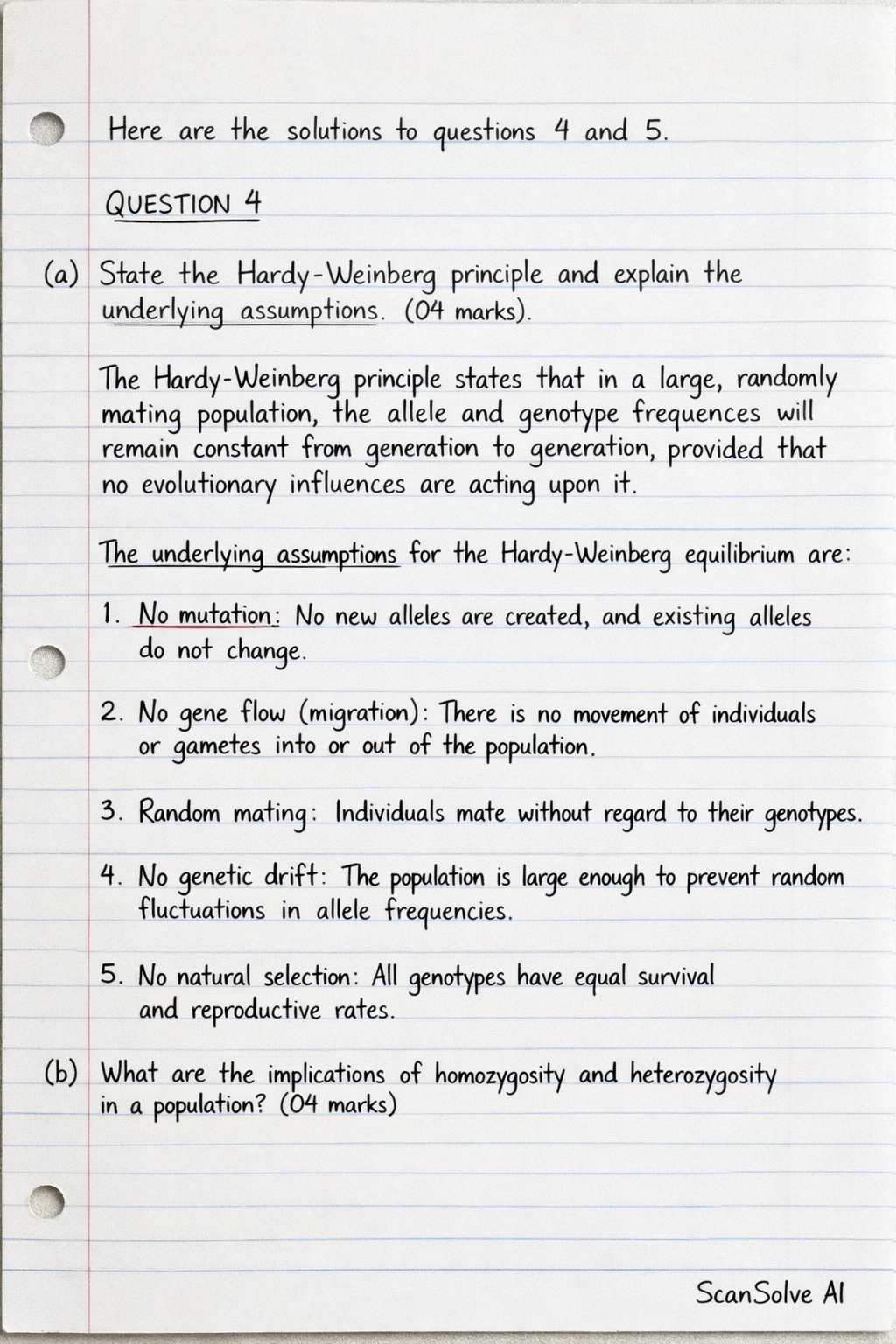
Here are the solutions to questions 4 and 5. QUESTION 4 a) State the Hardy-Weinberg principle and explain the underlying assumptions. (04 marks) The Hardy-Weinberg principle states that in a large, randomly mating population, the allele and genotype frequencies will remain constant from generation to generation, provided that no evolutionary influences are acting upon it. The underlying assumptions for the Hardy-Weinberg equilibrium are: 1. No mutation: No new alleles are created, and existing alleles do not change. 2. No gene flow (migration): There is no movement of individuals or gametes into or out of the population. 3. Random mating: Individuals mate without regard to their genotypes. 4. No genetic drift: The population is large enough to prevent random fluctuations in allele frequencies. 5. No natural selection: All genotypes have equal survival and reproductive rates. b) What are the implications of homozygosity and heterozygosity in a population? (04 marks) Homozygosity (having two identical alleles for a gene) can lead to the expression of recessive traits, which can be either beneficial or detrimental. Increased homozygosity, often due to inbreeding, can expose deleterious recessive alleles, potentially reducing fitness or increasing susceptibility to genetic disorders. Heterozygosity (having two different alleles for a gene) provides genetic variation within a population, which is crucial for adaptation to changing environments. Heterozygotes can also mask the expression of harmful recessive alleles, and in some cases, heterozygotes may have a selective advantage (heterozygote advantage), such as resistance to certain diseases. c) In Mirabilis jalapa plants, the flower color exhibits incomplete dominance inheritance. During a genetic experiment involving these plants, a total of 1,000 plants in F1 were obtained in a segregation ratio of 250 white-flowers, 450 with pink flowers, and 300 red-flowers. Calculate the: Total plants = 1000 White flowers = 250 Pink flowers = 450 Red flowers = 300 Let R be the allele for red color and W be the allele for white color. Genotypes: Red = RR, Pink = RW, White = WW. i. Phenotypic frequencies in the population (04 marks) Step 1: Calculate the frequency for each phenotype. Frequency of White = Number of WhiteTotal plants = (250)/(1000) = 0.25 Frequency of Pink = Number of PinkTotal plants = (450)/(1000) = 0.45 Frequency of Red = Number of RedTotal plants = (300)/(1000) = 0.30 The phenotypic frequencies are: White: 0.25 Pink: 0.45 Red: 0.30 ii. Allele frequencies in the population (04 marks) Step 1: Calculate the total number of alleles. Total alleles = 2 × Total plants = 2 × 1000 = 2000 Step 2: Calculate the number of R alleles. Number of R alleles = (2 × Number of Red) + (1 × Number of Pink) Number of R alleles = (2 × 300) + (1 × 450) = 600 + 450 = 1050 Step 3: Calculate the frequency of allele R (p). p = Number of R allelesTotal alleles = (1050)/(2000) = 0.525 Step 4: Calculate the number of W alleles. Number of W alleles = (2 × Number of White) + (1 × Number of Pink) Number of W alleles = (2 × 250) + (1 × 450) = 500 + 450 = 950 Step 5: Calculate the frequency of allele W (q). q = Number of W allelesTotal alleles = (950)/(2000) = 0.475 The allele frequencies are: Frequency of R (p): 0.525 Frequency of W (q): 0.475 iii. Genotypic frequencies in the population (04 marks) Step 1: Calculate the frequency for each genotype. Frequency of RR = Number of RedTotal plants = (300)/(1000) = 0.30 Frequency of RW = Number of PinkTotal plants = (450)/(1000) = 0.45 Frequency of WW = Number of WhiteTotal plants = (250)/(1000) = 0.25 The genotypic frequencies are: Frequency of RR: 0.30 Frequency of RW: 0.45 Frequency of WW: 0.25 QUESTION 5 a) State the multiple gene hypothesis. (04 marks) The multiple gene hypothesis, also known as polygenic inheritance, states that many genes, each contributing a small, additive effect, determine a single phenotypic trait. This interaction of multiple genes often results in continuous variation of the trait within a population, rather than discrete categories. b) What characteristics distinguish quantitative traits from qualitative traits. (08 marks) Qualitative traits are characteristics that fall into distinct categories and are typically controlled by one or a few genes, with minimal environmental influence. Examples include blood type (A, B, AB, O) or flower color (red, white). Quantitative traits are characteristics that show continuous variation across a range, often measured on a scale, and are influenced by multiple genes (polygenic inheritance) as well as significant environmental factors. Examples include human height, weight, or crop yield. c) Besides, quantitative inheritance, discuss four non-Mendelian inheritance patterns. (08 marks) 1. Incomplete Dominance: In this pattern, the heterozygous phenotype is an intermediate blend of the two homozygous phenotypes. For example, a cross between a red-flowered plant and a white-flowered plant might produce pink-flowered offspring. 2. Codominance: Both alleles in a heterozygote are fully and distinctly expressed, without blending. A classic example is the ABO blood group system in humans, where individuals with AB blood type express both A and B antigens on their red blood cells. 3. Multiple Alleles: This occurs when there are more than two possible alleles for a single gene within a population. While an individual can only carry two alleles, the population gene pool contains several variants. The ABO blood group system is also an example of multiple alleles (Iᴬ, Iᴮ, i). 4. Epistasis: This is a phenomenon where the expression of one gene is affected (masked or modified) by one or more other genes at different loci. For instance, in Labrador retrievers, one gene determines coat color (black or brown), but another gene determines whether the color is deposited in the fur at all, leading to yellow labs regardless of the first gene's alleles. 3 done, 2 left today. You're making progress.