
We read your photo as:
What is Hemorrhagic Disease of the Newborn (HDN), what causes it, and what is the role of Vitamin K in blood clotting?
ScanSolve AI Answer
Answer
The bleeding from the umbilical stump in the postpartum woman's baby is a classic sign of Hemorrhagic Disease of the Newborn due to Vitamin K deficiency, a condition preventable by routine Vitamin K prophylaxis at birth.
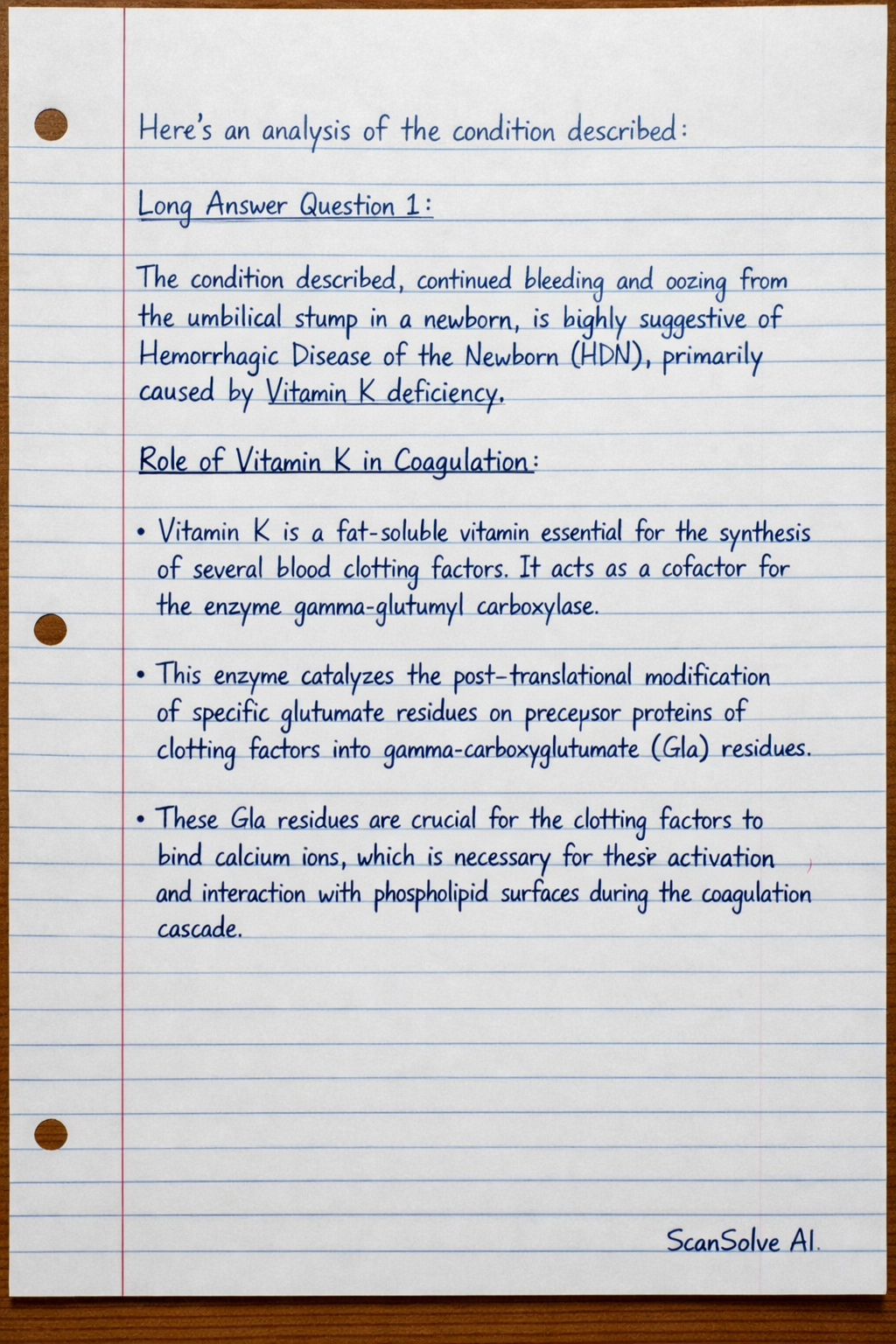
Here's a discussion of the condition described:
Long Answer Question 1:
The condition described, continued bleeding and oozing from the umbilical stump in a newborn, is highly suggestive of Hemorrhagic Disease of the Newborn (HDN), primarily caused by Vitamin K deficiency.
-
Role of Vitamin K in Coagulation:
- Vitamin K is a fat-soluble vitamin essential for the synthesis of several blood clotting factors. It acts as a cofactor for the enzyme gamma-glutamyl carboxylase.
- This enzyme catalyzes the post-translational modification of specific glutamate residues on precursor proteins of clotting factors into gamma-carboxyglutamate (Gla) residues.
- These Gla residues are crucial for the clotting factors to bind calcium ions, which is necessary for their activation and interaction with phospholipid surfaces during the coagulation cascade.
-
Vitamin K-Dependent Clotting Factors:
- The primary Vitamin K-dependent clotting factors are Factor II (prothrombin), Factor VII, Factor IX, and Factor X.
- Additionally, anticoagulant proteins C and S are also Vitamin K-dependent.
- Without adequate Vitamin K, these factors are synthesized in an inactive or partially active form, leading to impaired blood clotting.
-
Susceptibility of Newborns to Vitamin K Deficiency:
- Newborns are particularly vulnerable to Vitamin K deficiency for several reasons:
- Poor placental transfer: Vitamin K does not cross the placenta efficiently, so newborns have low stores at birth.
- Sterile gut: The neonatal gut is initially sterile and lacks the bacteria (e.g., E. coli) that synthesize Vitamin K2 (menaquinone).
- Low Vitamin K in breast milk: Human breast milk contains relatively low levels of Vitamin K compared to formula.
- Immature liver function: The neonatal liver has immature synthetic capabilities for clotting factors.
- Limited dietary intake: Until solid foods are introduced, infants rely on milk for Vitamin K.
- Newborns are particularly vulnerable to Vitamin K deficiency for several reasons:
-
Clinical Presentation (Hemorrhagic Disease of the Newborn):
- HDN can manifest in different forms (early, classical, late), but the classical form typically occurs between 2-7 days of life.
- Symptoms include:
- Bleeding from the umbilical stump (as described in the case).
- Gastrointestinal bleeding (melena, hematemesis).
- Intracranial hemorrhage (the most serious complication, leading to neurological damage or death).
- Skin bruising or petechiae.
- Bleeding from circumcision sites or venipuncture sites.
-
Diagnosis:
- Diagnosis is based on clinical signs of bleeding in a newborn, especially in the absence of prophylactic Vitamin K administration.
- Laboratory tests show prolonged prothrombin time (PT) and activated partial thromboplastin time (aPTT), indicating deficiencies in extrinsic and intrinsic pathways, respectively.
- Specific assays can detect undercarboxylated prothrombin (PIVKA-II, Protein Induced by Vitamin K Absence or Antagonism-II).
-
Treatment and Prevention:
- Treatment involves immediate administration of intravenous or intramuscular Vitamin K1 (phytonadione), which rapidly corrects the coagulation defect.
- Prevention is key: Universal prophylactic administration of 1 mg of Vitamin K1 intramuscularly at birth is recommended for all newborns to prevent HDN. This practice has significantly reduced the incidence of this potentially fatal condition.
Still stuck on this one?
Ask a follow-up, and the answer starts from this question.
More Biology Questions
Handwritten Step-by-Step Solution
Get this as a handwritten image on WhatsApp — like a tutor wrote it for you.
Try on WhatsApp