
We read your photo as:
I need help answering questions about biological specimens A-H for my exam. I need to identify their phylum, class, habitat, construct a dichotomous key, and draw a floral diagram and formula for spec
ScanSolve AI Answer
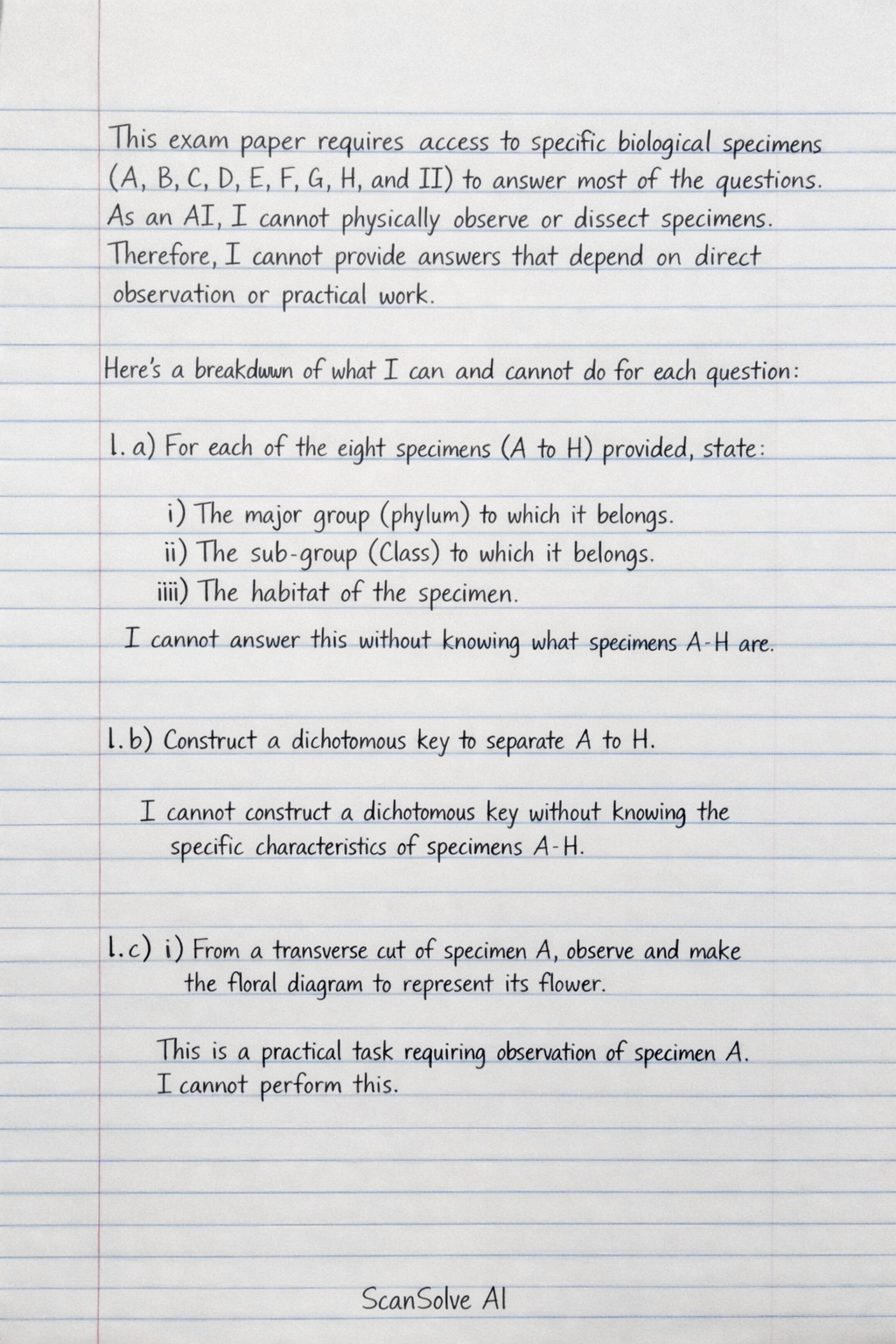
This exam paper requires access to specific biological specimens (A, B, C, D, E, F, G, H, and II) to answer most of the questions. As an AI, I cannot physically observe or dissect specimens. Therefore, I cannot provide answers that depend on direct observation or practical work.
Here's a breakdown of what I can and cannot do for each question:
-
1. a) For each of the eight specimens (A to H) provided, state:
- i. The major group (phylum) to which it belongs.
- ii. The sub-group (Class) to which it belongs.
- iii. The habitat of the specimen.
- I cannot answer this without knowing what specimens A-H are.
-
1. b) Construct a dichotomous key to separate A to H.
- I cannot construct a dichotomous key without knowing the specific characteristics of specimens A-H.
-
1. c) i) From a transverse cut of specimen A, observe and make the floral diagram to represent its flower.
- This is a practical task requiring observation of specimen A. I cannot perform this.
-
1. c) ii) From the diagram, write down the floral formula of the flower of specimen A.
- I cannot provide the floral formula without the floral diagram from 1.c.i, which requires observing specimen A.
-
2. a) Make a large labelled drawing of specimen G.
- This is a practical task requiring observation of specimen G. I cannot perform this.
-
2. b) Differentiate between specimen D and G.
- I cannot differentiate between specimens D and G without knowing their specific characteristics.
-
2. c) How is specimen B adapted to its mode of life in its habitat?
- I cannot answer this without knowing what specimen B is and its specific habitat.
-
2. d) State the ways in which specimen E affects its environment.
- I cannot answer this without knowing what specimen E is.
Still stuck on this one?
Ask a follow-up, and the answer starts from this question.
More Biology Questions
Handwritten Step-by-Step Solution
Get this as a handwritten image on WhatsApp — like a tutor wrote it for you.
Try on WhatsApp