

This biology question covers important biological concepts and processes. The step-by-step explanation below helps you understand the underlying mechanisms and reasoning.
ScanSolve AI Answer
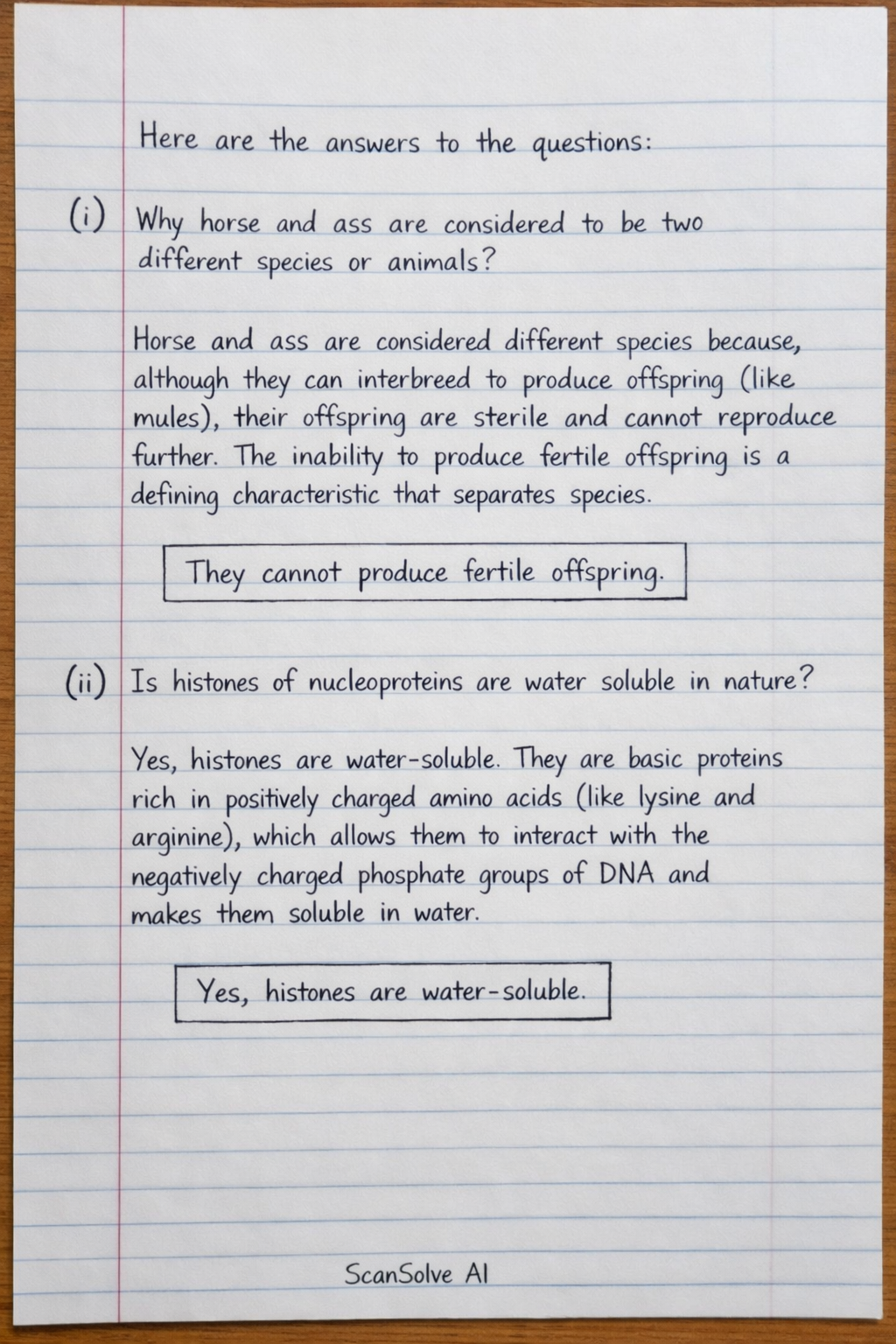
Here are the answers to the questions: (i) Why horse and ass are considered to be two different species or animals? Horse and ass are considered different species because, although they can interbreed to produce offspring (like mules), their offspring are sterile and cannot reproduce further. The inability to produce fertile offspring is a defining characteristic that separates species. They cannot produce fertile offspring. (ii) Is histones of nucleoproteins are water soluble in nature? Yes, histones are water-soluble. They are basic proteins rich in positively charged amino acids (like lysine and arginine), which allows them to interact with the negatively charged phosphate groups of DNA and makes them soluble in water. Yes, histones are water-soluble. (iii) What are the components of Periderm? The periderm is the protective tissue that replaces the epidermis in plants undergoing secondary growth. Its components are the cork (phellem), the cork cambium (phellogen), and the secondary cortex (phelloderm). Cork (phellem), cork cambium (phellogen), and secondary cortex (phelloderm). (iv) What are the main parts of leaf? The main parts of a typical leaf are the leaf blade (lamina), the petiole (leaf stalk), and sometimes stipules at the base of the petiole. Leaf blade (lamina), petiole, and stipules. (v) What is termed as absorption spectrum? An absorption spectrum is a graph that plots the amount of light absorbed by a pigment or substance against the wavelength of light. It shows which wavelengths of light are absorbed and which are reflected or transmitted. A graph showing light absorption vs. wavelength by a substance. (vi) How is Acetyl CoA formed after Glycolysis? After glycolysis, the two molecules of pyruvate enter the mitochondria. Each pyruvate undergoes oxidative decarboxylation, where a carboxyl group is removed as carbon dioxide, and the remaining two-carbon fragment is oxidized to an acetyl group. This acetyl group then combines with coenzyme A to form Acetyl CoA, with the reduction of NAD^+ to NADH. Pyruvate undergoes oxidative decarboxylation to form Acetyl CoA. (vii) Muscularis layer in stomach is thicker than that in intestine. Why is it so? The muscularis layer in the stomach is significantly thicker than in the intestine because the stomach needs to perform vigorous churning and mixing movements to mechanically digest food and mix it thoroughly with gastric juices. The intestine primarily focuses on absorption and peristalsis, requiring less forceful contractions. For vigorous churning and mechanical digestion of food. (viii) Can you compare bone, muscle and joint which help in locomotion with any of simple machines you have studied earlier? Yes, the musculoskeletal system involved in locomotion can be compared to simple machines, specifically levers. In this analogy: Bones act as the rigid levers*. Joints act as the fulcrums* (pivot points). Muscles provide the effort* (force) to move the levers. Yes, they can be compared to levers.