
We read your photo as:
Identify and describe parts of the female reproductive system, including the uterus and uterine tubes.
Biology
ScanSolve AI Answer
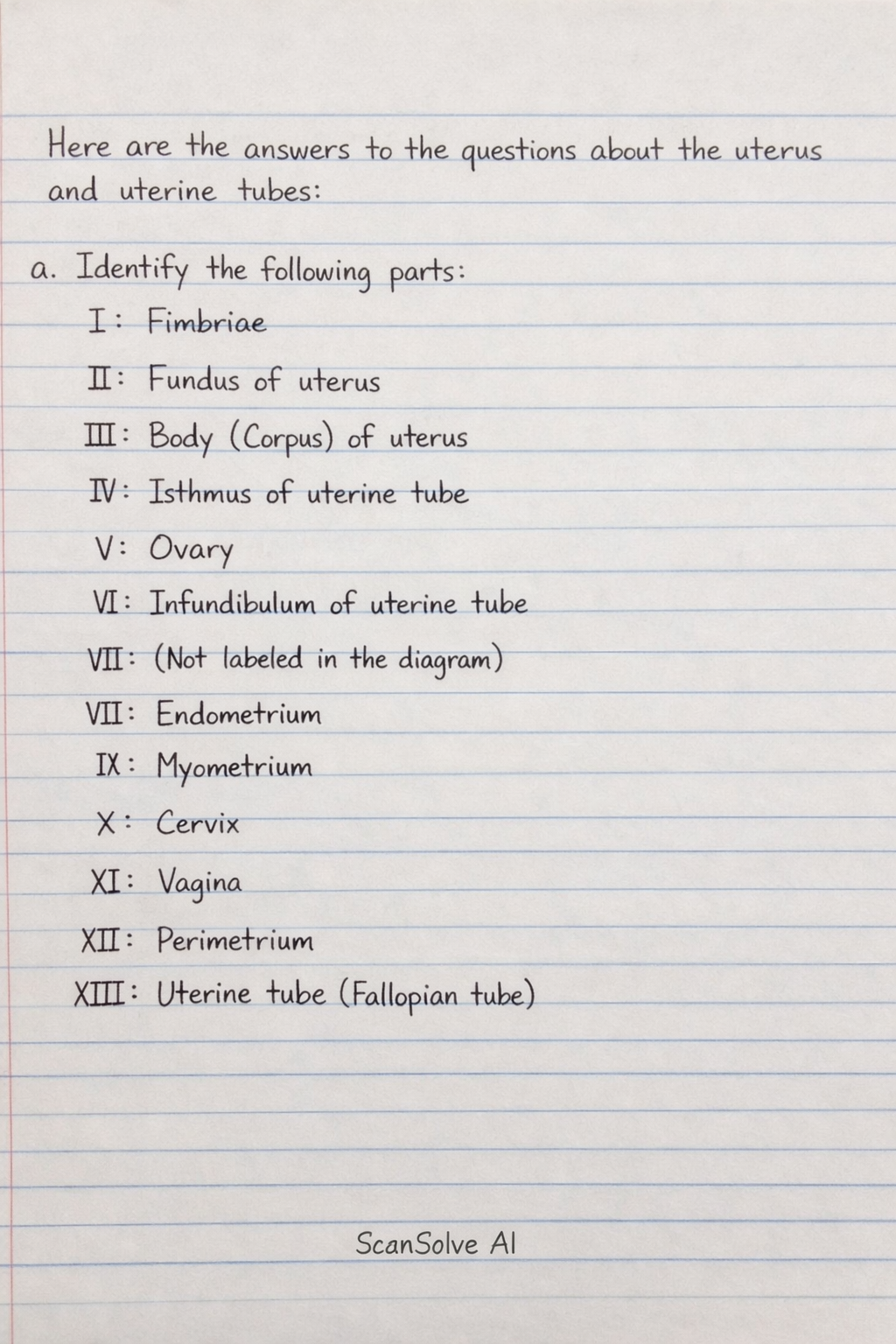
Here are the answers to the questions about the uterus and uterine tubes:
a. Identify the following parts:
- I: Fimbriae
- II: Fundus of uterus
- III: Body (Corpus) of uterus
- IV: Isthmus of uterine tube
- V: Ovary
- VI: Infundibulum of uterine tube
- VII: (Not labeled in the diagram)
- VIII: Endometrium
- IX: Myometrium
- X: Cervix
- XI: Vagina
- XII: Perimetrium
- XIII: Uterine tube (Fallopian tube)
b. Describe the uterus in terms of:
- Size: The non-gravid (non-pregnant) uterus is a pear-shaped organ, typically measuring about 7.5 cm (3 inches) long, 5 cm (2 inches) wide, and 2.5 cm (1 inch) thick. Its size significantly increases during pregnancy.
- Mucosa: The inner lining of the uterus is called the endometrium. It is a mucous membrane rich in glands and blood vessels. The endometrium undergoes cyclical changes each month in response to hormones, preparing for potential embryo implantation. If implantation does not occur, the superficial layer of the endometrium is shed during menstruation.
- Muscularity: The wall of the uterus is predominantly composed of a thick layer of smooth muscle called the myometrium. This muscular layer is arranged in three indistinct layers (longitudinal, circular, and oblique) and is responsible for the powerful contractions during childbirth, which expel the fetus. It also contracts during menstruation to help shed the endometrial lining.
Was this helpful?
Still stuck on this one?
Ask a follow-up, and the answer starts from this question.
Got a different question?Ask your own question
More Biology Questions
QIdentify and describe parts of the male and female reproductive systems.QDescribe the structure and functions of the Ovary, Fallopian tubes (Oviduct), and Uterus (Womb)…QComplete the sentences about the female reproductive system.QIdentify and explain the functions of parts of the male and female reproductive systems, and the…QIdentify the labeled parts of the female and male reproductive systems, describe their functions…
Handwritten Step-by-Step Solution
Get this as a handwritten image on WhatsApp — like a tutor wrote it for you.
Try on WhatsApp