

This biology question covers important biological concepts and processes. The step-by-step explanation below helps you understand the underlying mechanisms and reasoning.
ScanSolve AI Answer
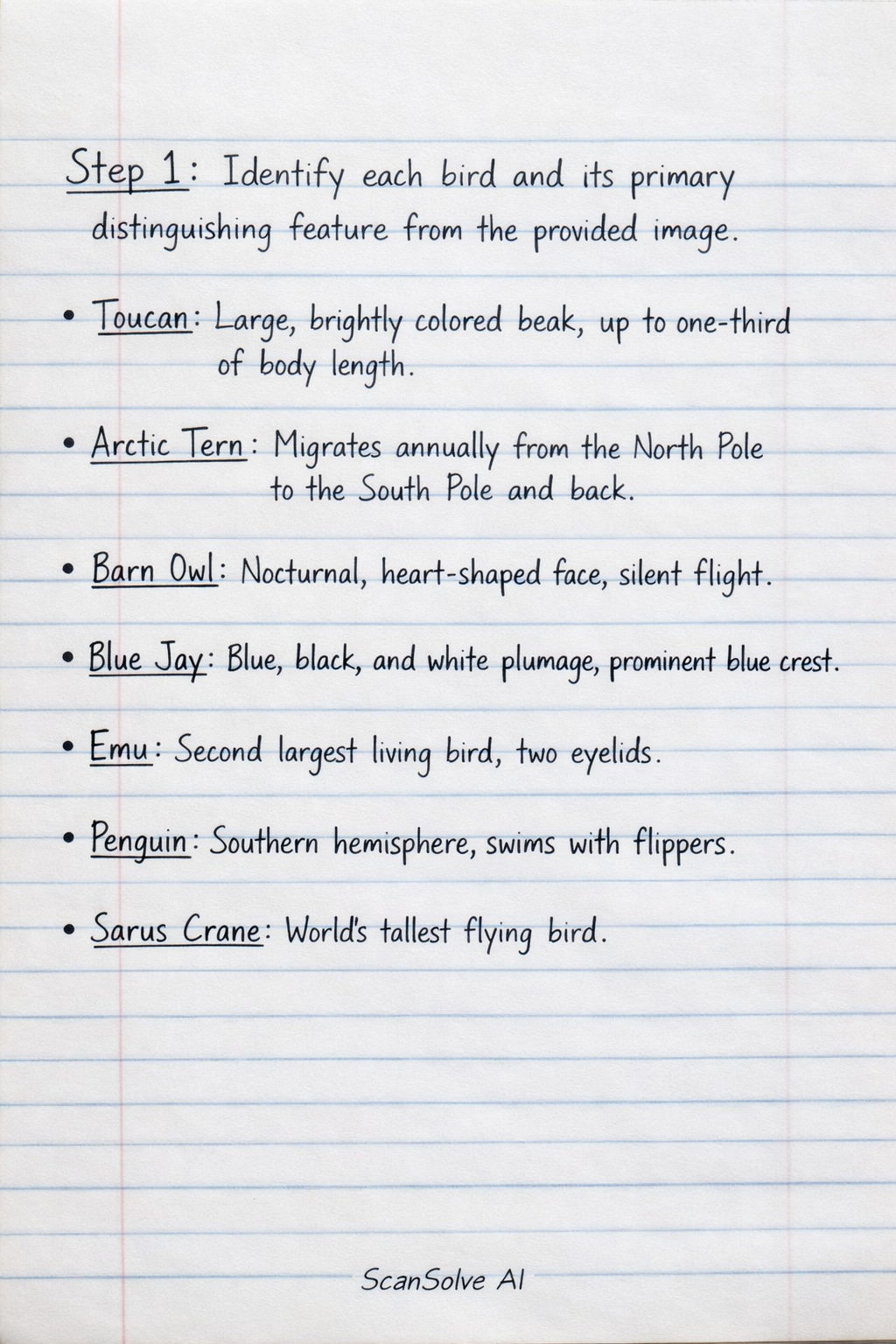
Step 1: Identify each bird and its primary distinguishing feature from the provided image. • Toucan: Large, brightly colored beak, up to one-third of body length. • Arctic Tern: Migrates annually from the North Pole to the South Pole and back. • Barn Owl: Nocturnal, heart-shaped face, silent flight. • Blue Jay: Blue, black, and white plumage, prominent blue crest. • Emu: Second largest living bird, two eyelids. • Penguin: Southern hemisphere, swims with flippers. • Sarus Crane: World's tallest flying bird. Step 2: Summarize the key features for each bird, incorporating LaTeX for any mathematical expressions. a) Toucan: This bird has a distinctive, large, and brightly colored beak, which can measure up to (1)/(3) of its body length. b) Arctic Tern: It is known for its annual migration, flying from the North Pole to the South Pole and back every year. c) Barn Owl: A nocturnal bird, it has a distinctive heart-shaped face, pale feathers, and is known for its silent flight. d) Blue Jay: This medium-sized songbird features striking blue, black, and white plumage and a prominent blue crest. e) Emu: As the second largest living bird, it has two eyelids: one for blinking and the other for preventing dust from entering its eyes. f) Penguin: Found mostly in the southern hemisphere, it can swim in water using its wing-type flippers. g) Sarus Crane: This is the world's tallest flying bird, found in India, Southeast Asia, and Australia. That's 2 down. 3 left today — send the next one.