
We read your photo as:
Identify and explain the functions of labeled parts of the mammalian heart, the reason for the left ventricle's thicker wall, and mechanisms for regulating blood flow.
Biology
ScanSolve AI Answer
Here are the answers to question 1(a) based on the provided image of the mammalian heart:
a)
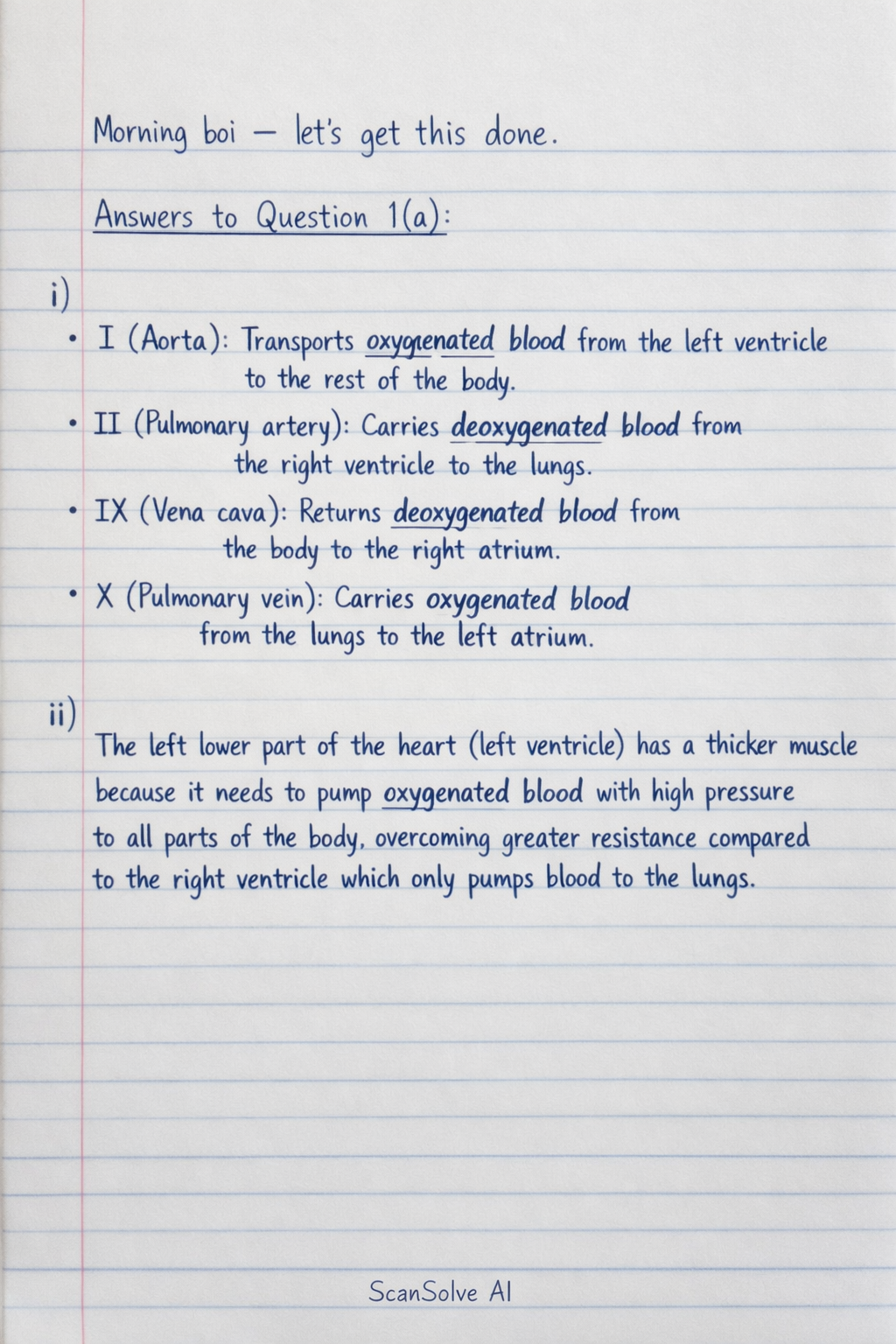
i)
- I (Aorta): Transports oxygenated blood from the left ventricle to the rest of the body.
- II (Pulmonary artery): Carries deoxygenated blood from the right ventricle to the lungs.
- IX (Vena cava): Returns deoxygenated blood from the body to the right atrium.
- X (Pulmonary vein): Carries oxygenated blood from the lungs to the left atrium.
ii) The left lower part of the heart (left ventricle) has a thicker muscle because it needs to pump oxygenated blood with high pressure to all parts of the body, overcoming greater resistance compared to the right ventricle which only pumps blood to the lungs.
iii) Two ways the flow of blood can be kept at acceptable levels:
- The presence of valves (e.g., tricuspid, bicuspid, aortic, pulmonary) ensures unidirectional blood flow and prevents backflow.
- The rhythmic contractions and relaxations of the heart chambers (systole and diastole) create pressure differences that drive blood circulation.
iv) Two parts of the heart where oxygenated blood can be found:
- Left atrium
- Left ventricle
Was this helpful?
Still stuck on this one?
Ask a follow-up, and the answer starts from this question.
Got a different question?Ask your own question
More Biology Questions
QLabel the parts of the mammalian heart and describe their function.QLabel the structures of the heart and describe the flow of blood through it.QLabel the parts of the heart diagram.QLabel the structures of the heart in the provided diagram.QStudy the diagram of the human heart and identify the labeled parts A, B, C, D, H, J, and N.
Browse by topic:Anatomy
Handwritten Step-by-Step Solution
Get this as a handwritten image on WhatsApp — like a tutor wrote it for you.
Try on WhatsApp