
We read your photo as:
Identify molecules P and R, describe the function of mRNA in protein synthesis, and explain the impact of a mutation on protein synthesis.
ScanSolve AI Answer
Step-by-step solution
4 stepslet's tackle this one.
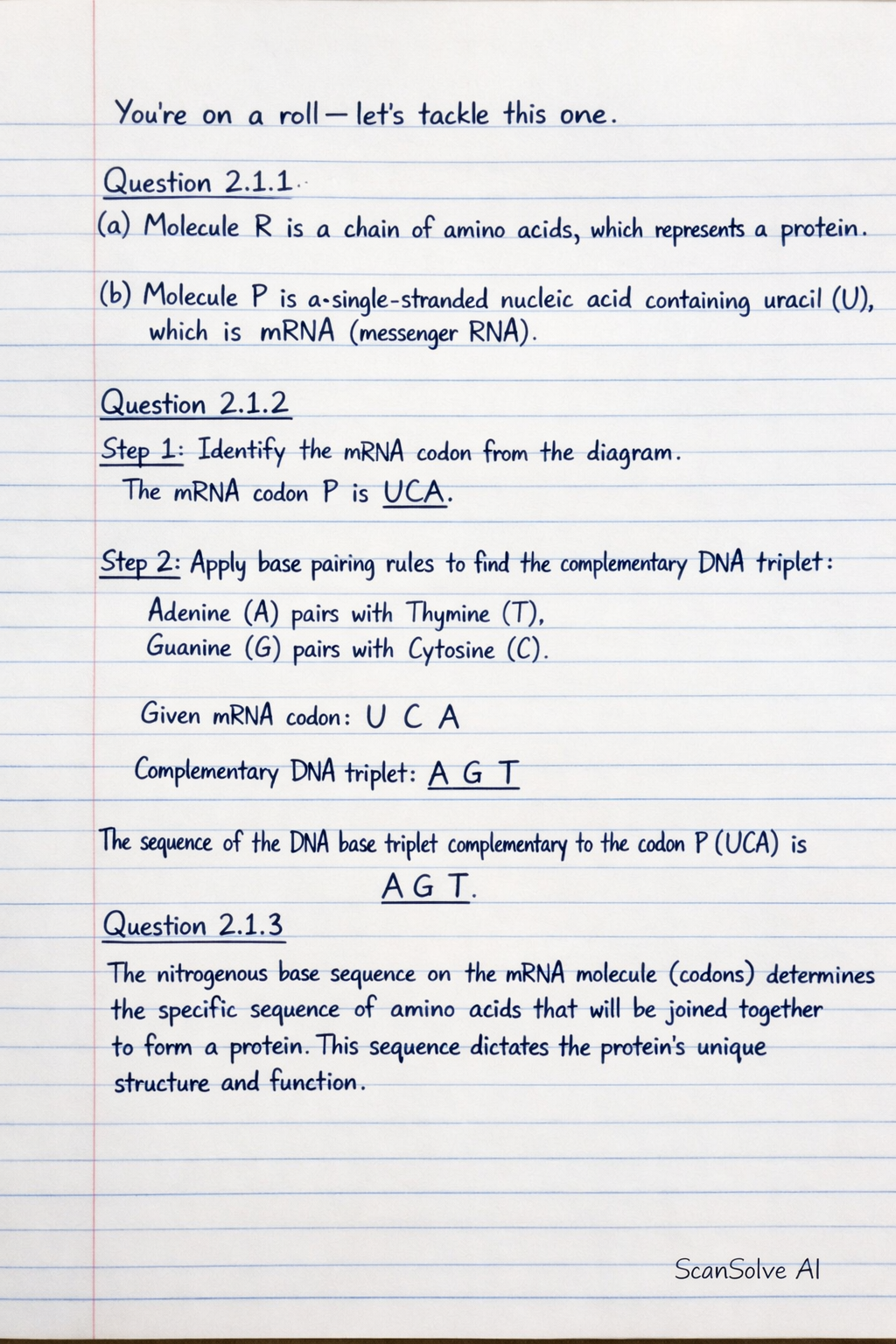
Question 2.1.1
a) Molecule R is a chain of amino acids, which represents a protein.
b) Molecule P is a single-stranded nucleic acid containing uracil (U), which is mRNA (messenger RNA).
Question 2.1.2
Identify the mRNA codon from the diagram.
The mRNA codon P is UCA.
Apply base pairing rules to find the complementary DNA triplet.
In DNA, Adenine (A) pairs with Thymine (T), and Guanine (G) pairs with Cytosine (C). When transcribing from DNA to mRNA, Adenine (A) in DNA pairs with Uracil (U) in mRNA, and Thymine (T) in DNA pairs with Adenine (A) in mRNA.
Given mRNA codon: U C A
Complementary DNA triplet: A G TThe sequence of the DNA base triplet complementary to the codon P (UCA) is AGT.
Question 2.1.3
The nitrogenous base sequence on the mRNA molecule (codons) determines the specific sequence of amino acids that will be joined together to form a protein. This sequence dictates the protein's unique structure and function.
Question 2.1.4
Understand the effect of a change in DNA sequence.
A change in the DNA base triplet (a gene mutation) would lead to a change in the complementary mRNA codon during transcription.
Explain the consequence for protein synthesis.
This altered mRNA codon might then code for a different amino acid during translation. A change in the amino acid sequence can alter the protein's primary structure, which can subsequently affect its three-dimensional folding and ultimately its function.
Question 2.1.5
The organelle where proteins are synthesised in a plant cell is the ribosome.
Still stuck on this one?
Ask a follow-up, and the answer starts from this question.
More Biology Questions
Handwritten Step-by-Step Solution
Get this as a handwritten image on WhatsApp — like a tutor wrote it for you.
Try on WhatsApp