

This biology question covers important biological concepts and processes. The step-by-step explanation below helps you understand the underlying mechanisms and reasoning.
ScanSolve AI Answer
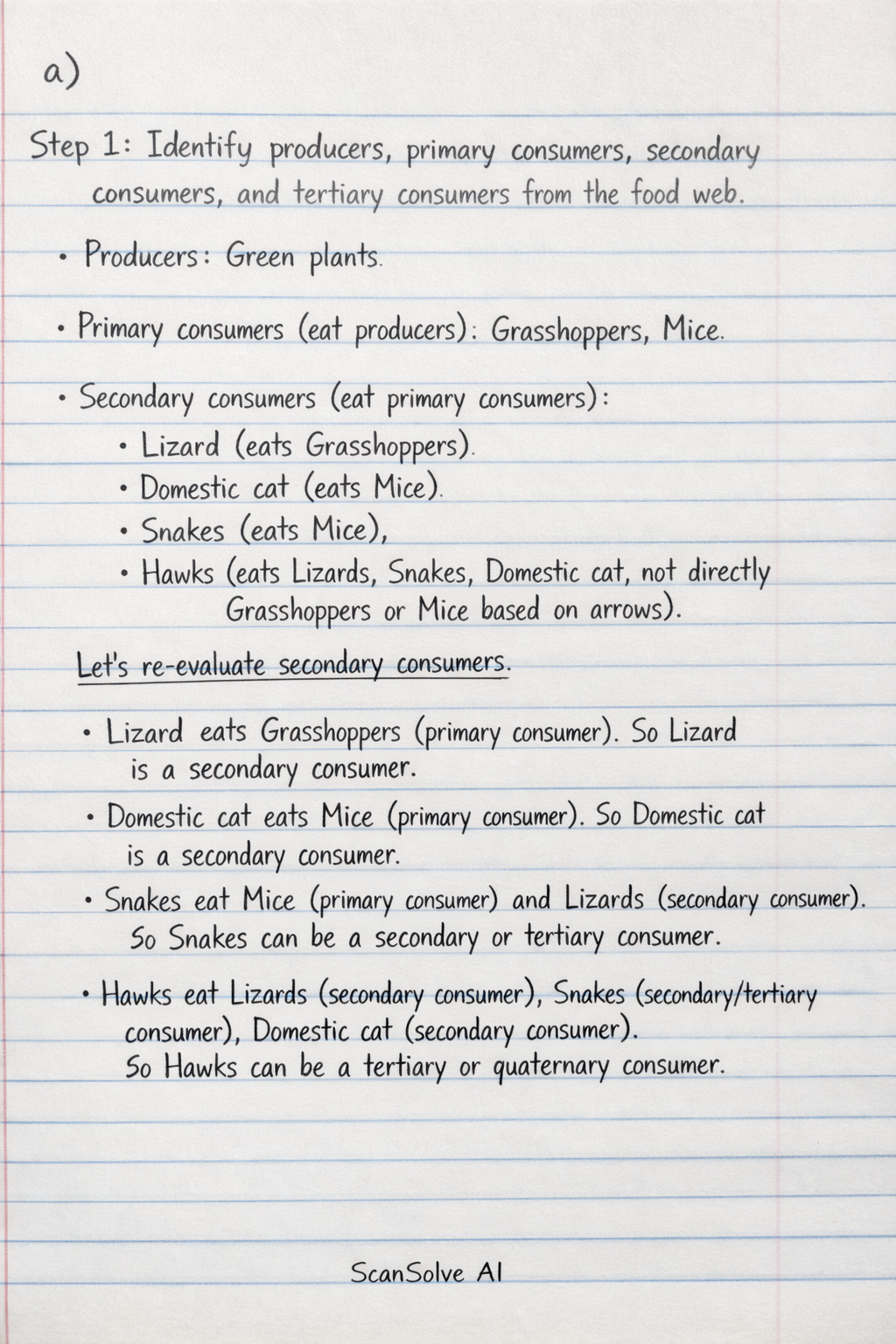
a) Step 1: Identify producers, primary consumers, secondary consumers, and tertiary consumers from the food web. • Producers: Green plants • Primary consumers (eat producers): Grasshoppers, Mice • Secondary consumers (eat primary consumers): Lizard (eats Grasshoppers), Domestic cat (eats Mice), Snakes (eats Mice), Hawks (eats Grasshoppers, Mice - Correction: Hawks eat Lizards, Snakes, Domestic cat, not directly Grasshoppers or Mice based on arrows). Let's re-evaluate secondary consumers. Lizard eats Grasshoppers (primary consumer). So Lizard is a secondary consumer. Domestic cat eats Mice (primary consumer). So Domestic cat is a secondary consumer. Snakes eat Mice (primary consumer) and Lizards (secondary consumer). So Snakes can be a secondary or tertiary consumer. Hawks eat Lizards (secondary consumer), Snakes (secondary/tertiary consumer), Domestic cat (secondary consumer). So Hawks can be a tertiary or quaternary consumer. Step 2: Construct two food chains that end with a tertiary consumer. A tertiary consumer is the third consumer in the chain (fourth trophic level). Food Chain 1: Green plants → Grasshoppers → Lizard → Snakes (Producer → Primary Consumer → Secondary Consumer → Tertiary Consumer) Food Chain 2: Green plants → Mice → Snakes → Hawks (Producer → Primary Consumer → Secondary Consumer → Tertiary Consumer) b) Step 1: Identify all predators for each organism in the food web by looking at the arrows pointing to that organism. • Green plants: No predators shown. • Grasshoppers: Eaten by Lizard (1 predator). • Mice: Eaten by Domestic cat, Snakes, Hawks (3 predators). • Lizard: Eaten by Snakes, Hawks (2 predators). • Snakes: Eaten by Hawks (1 predator). • Domestic cat: Eaten by Hawks (1 predator). • Hawks: No predators shown. Step 2: Compare the number of predators for each organism. Mice have 3 predators, which is the highest variety. The organism with the highest variety of predators is Mice. c) A prolonged drought would significantly reduce the availability of water, which is essential for the growth of green plants. One way the ecosystem would be affected is: • The population of green plants would decrease due to lack of water. This would lead to a reduction in the food available for primary consumers (Grasshoppers and Mice), causing their populations to decline. This decline would then affect the populations of secondary and tertiary consumers throughout the food web due to a lack of food.