
We read your photo as:
Identify the labeled structures (a), (b), and (c).
ScanSolve AI Answer
Answer
Step-by-step solution
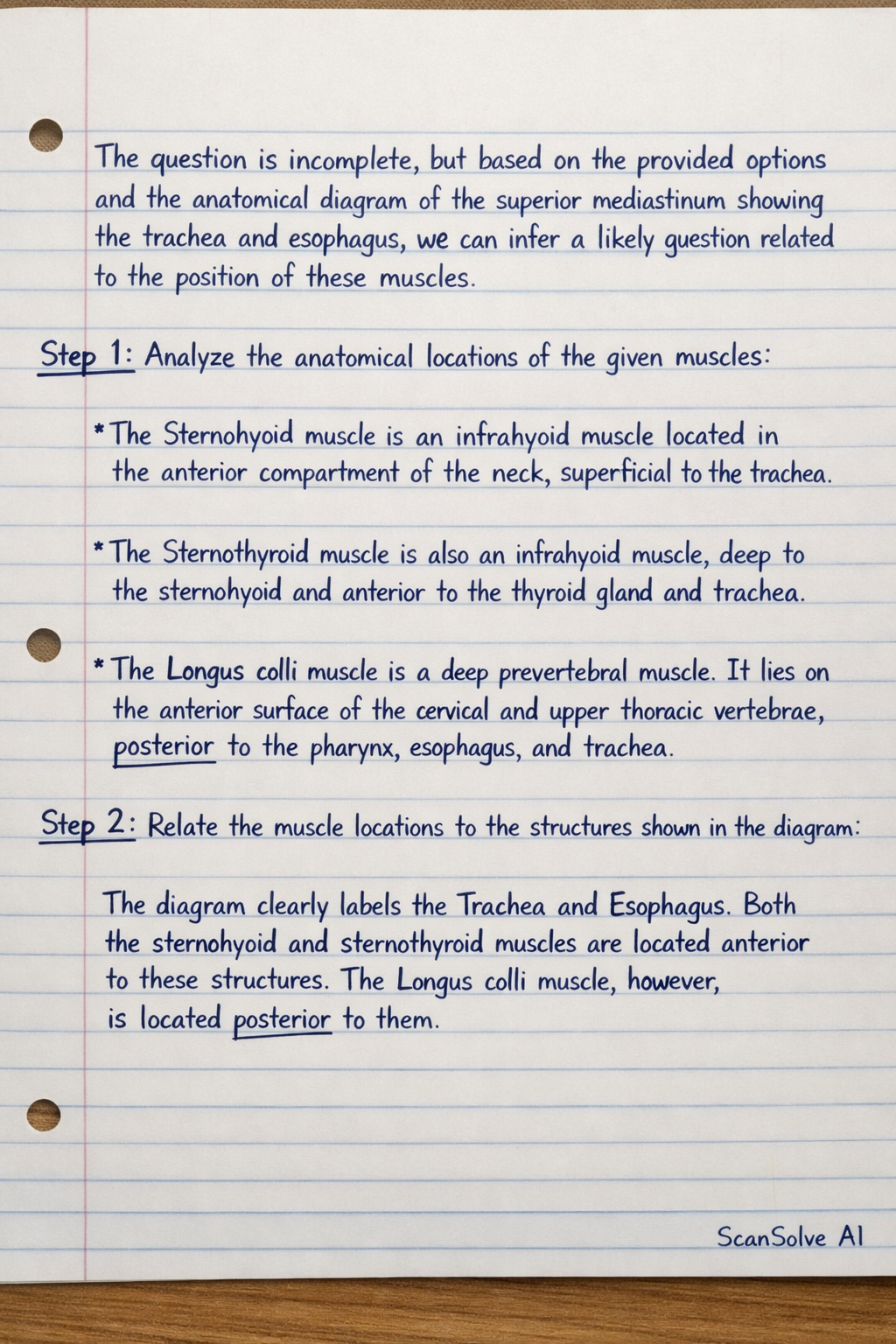
3 stepsThe question is incomplete, but based on the provided options and the anatomical diagram of the superior mediastinum showing the trachea and esophagus, we can infer a likely question related to the position of these muscles.
Analyze the anatomical locations of the given muscles.
- The Sternohyoid muscle is an infrahyoid muscle located in the anterior compartment of the neck, superficial to the trachea.
- The Sternothyroid muscle is also an infrahyoid muscle, deep to the sternohyoid and anterior to the thyroid gland and trachea.
- The Longus colli muscle is a deep prevertebral muscle. It lies on the anterior surface of the cervical and upper thoracic vertebrae, posterior to the pharynx, esophagus, and trachea.
Relate the muscle locations to the structures shown in the diagram.
The diagram clearly labels the Trachea and Esophagus. Both the sternohyoid and sternothyroid muscles are located anterior to these structures. The Longus colli muscle, however, is located posterior to them.
Infer the most probable question.
Given the options are muscles and the diagram shows the trachea and esophagus, a common anatomical question would ask about the relative position of these muscles to the major visceral structures of the neck/superior mediastinum. The Longus colli muscle is uniquely positioned posterior to the trachea and esophagus among the given options. The fragment "nerves (right and left)" is too incomplete to integrate directly with the muscle options, but the sympathetic trunks (right and left) lie on the Longus colli muscle, which could be a subtle connection.
Therefore, assuming the question asks to identify a muscle located posterior to the trachea and esophagus in this region, Longus colli is the correct answer.
The correct option is (c).
- (c) Longus colli
Try one yourself
A new problem that tests the same skill.
Still stuck on this one?
Ask a follow-up, and the answer starts from this question.
More Biology Questions
Handwritten Step-by-Step Solution
Get this as a handwritten image on WhatsApp — like a tutor wrote it for you.
Try on WhatsApp