
We read your photo as:
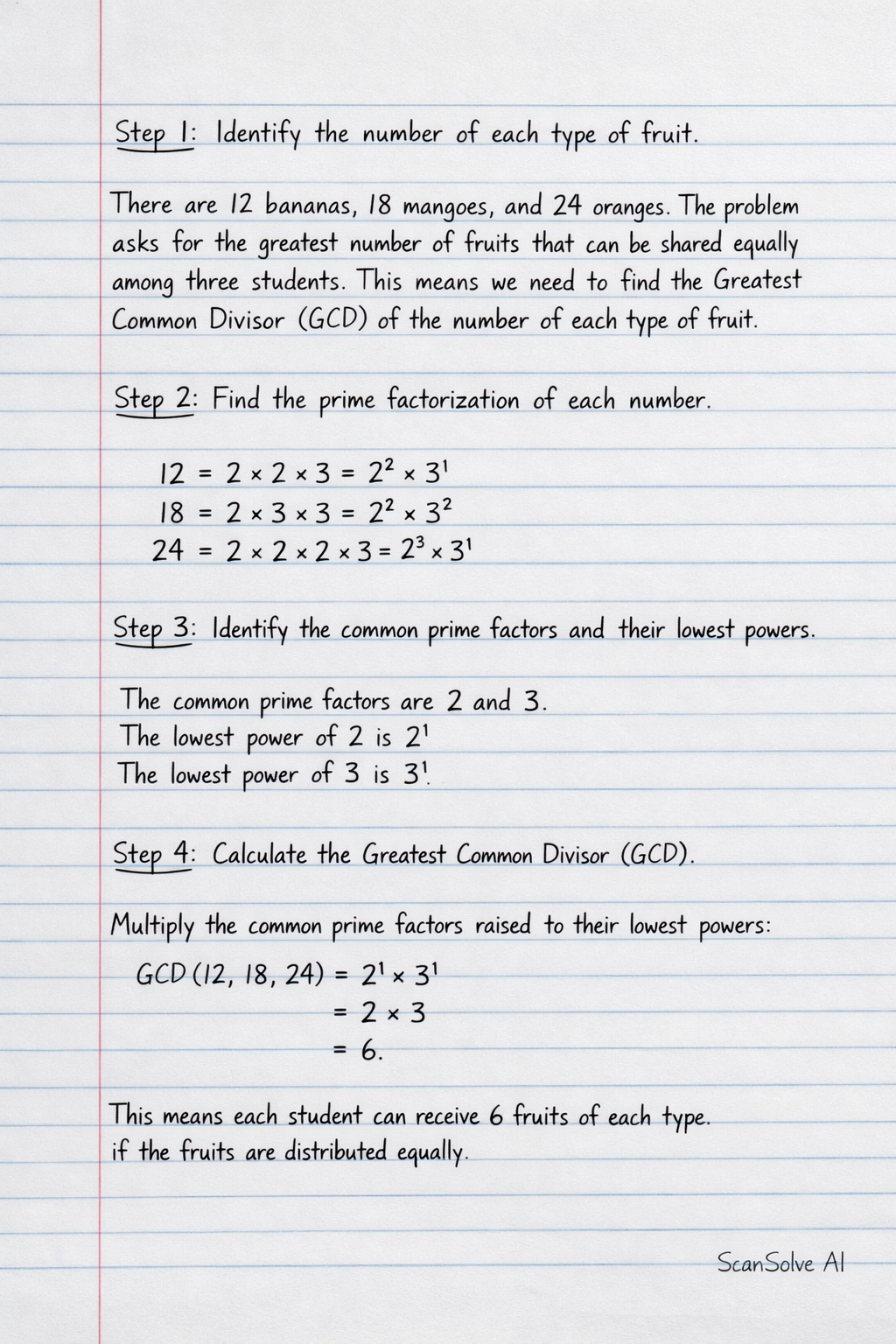
Identify the number of each type of fruit.
ScanSolve AI Answer
Step-by-step solution
11 stepsIdentify the number of each type of fruit.
There are 12 bananas, 18 mangoes, and 24 oranges. The problem asks for the greatest number of fruits that can be shared equally among three students. This means we need to find the Greatest Common Divisor (GCD) of the number of each type of fruit.
Find the prime factorization of each number.
Identify the common prime factors and their lowest powers.
The common prime factors are 2 and 3.
The lowest power of 2 is .
The lowest power of 3 is .Calculate the Greatest Common Divisor (GCD).
Multiply the common prime factors raised to their lowest powers:
This means each student can receive 6 fruits of each type if the fruits are distributed equally.
Determine the greatest number of fruits eaten by three students.
The GCD represents the greatest number of sets of fruits that can be made, where each set contains an equal number of bananas, mangoes, and oranges. If the question implies the greatest number of total fruits each student can eat, it would be the sum of the fruits in one such set. However, the phrasing "greatest number of fruits eaten by three students" usually refers to the greatest number of identical portions that can be made from each type of fruit. In this context, the GCD is the number of fruits per student for each type of fruit, if the question implies the greatest number of identical portions of fruit each student can receive.
If the question means "What is the greatest number of total fruits that each of the three students can eat, such that they all eat the same number of bananas, the same number of mangoes, and the same number of oranges?", then the GCD is the number of portions each student gets.
Each student would get:
bananas
mangoes
oranges
Total fruits per student = fruits.The question asks "What is the greatest number of fruits eaten by three students?". This is ambiguous. It could mean:
a) The greatest number of identical portions of fruit each student can eat (which is 9 fruits per student, as calculated above).
b) The greatest number of total fruits that can be distributed among the three students such that each student gets an equal share of each type of fruit. In this case, the GCD (6) represents the number of groups of fruits that can be made. Since there are 3 students, this interpretation doesn't directly lead to a single number of fruits eaten by three students.
Given the phrasing "greatest number of fruits eaten by three students", it is most likely asking for the greatest number of total fruits that each student can eat, assuming an equal distribution of each fruit type.
The GCD of 12, 18, and 24 is 6. This means we can divide the fruits into 6 equal groups.
Each group would contain:
bananas
mangoes
oranges
So, each group has fruits.
Since there are 3 students, and we have 6 such groups, this interpretation doesn't fit the "three students" part directly.Let's re-read: "What is the greatest number of fruits eaten by three students?"
This implies that the fruits are to be shared among the three students. If they share equally, then the number of fruits of each type must be divisible by 3.
Number of bananas per student =
Number of mangoes per student =
Number of oranges per student =
Total fruits per student = fruits.However, the question asks for the greatest number of fruits eaten by three students. This is still ambiguous. If it means the greatest number of fruits each student can eat, given that they share equally, then the total number of fruits is . If these 54 fruits are shared equally among 3 students, each student gets fruits. This assumes all fruits are pooled and then divided.
If the question implies finding the largest possible identical portion of each type of fruit that can be given to each student, such that the total number of fruits given to each student is maximized, this is a GCD problem. The GCD (6) means that the fruits can be divided into 6 identical "packages".
Each package contains 2 bananas, 3 mangoes, and 4 oranges (total 9 fruits).
If there are 3 students, and we have 6 such packages, then each student can get packages.
So, each student would eat fruits.
This aligns with the simple division of total fruits.The phrasing "greatest number of fruits eaten by three students" is still tricky. It could mean the greatest number of fruits in total that the three students collectively eat, which would be 54 if they eat all of them. But that doesn't make sense with "greatest number".
Let's assume the question means: "What is the greatest number of fruits each of the three students can eat, such that each student receives an equal share of each type of fruit?"
In this case, we need to find the GCD of the number of fruits, and then divide the total number of fruits by the number of students.Let's consider the most common interpretation for "greatest number" in sharing problems: finding the largest possible equal groups.
The GCD of 12, 18, and 24 is 6. This means the fruits can be divided into 6 identical groups.
Each group contains:
bananas
mangoes
oranges
So, each group has fruits.If there are 3 students, and we have 6 such groups, then each student can receive of these groups.
Therefore, each student eats fruits.The question asks for the "greatest number of fruits eaten by three students". This could be interpreted as the total number of fruits eaten by all three students combined, if they eat all the fruits and share them equally.
Total fruits = .
If these 54 fruits are eaten by three students, and assuming they share equally, then each student eats fruits.
The "greatest number" part implies that there might be a way to eat fewer, but we want the maximum. If they eat all the fruits, that's the maximum.Let's consider the phrasing "greatest number of fruits eaten by three students". This could also be interpreted as the greatest number of fruits that can be given to each of the three students, such that the distribution is fair (equal number of each type of fruit).
If we want to find the greatest number of fruits each student can eat, such that they all get the same number of bananas, mangoes, and oranges, we first find the GCD of the fruit counts.
GCD(12, 18, 24) = 6.
This means we can make 6 identical "fruit baskets". Each basket contains 2 bananas, 3 mangoes, and 4 oranges.
Total fruits in one basket = fruits.
Since there are 3 students, and we have 6 baskets, each student can receive baskets.
So, each student eats fruits.The question is phrased as "greatest number of fruits eaten by three students", not "by each student". This implies the total number of fruits eaten by the group of three. If they eat all the fruits, then the total is 54. If the question implies that they share the fruits equally, and we want the maximum number of fruits per student, then it's 18.
Let's assume the question is asking for the greatest number of fruits each student can eat, given that the fruits are shared equally among the three students, and each student receives the same number of bananas, mangoes, and oranges.
Calculate the total number of fruits.
Total fruits = .
Divide the total number of fruits equally among the three students.
Number of fruits per student =
Number of fruits per student = fruits.This interpretation assumes that "greatest number of fruits eaten by three students" refers to the maximum number of fruits each student can eat when sharing all available fruits equally. The "greatest" part implies maximizing the individual share.
If the question meant "What is the greatest number of total fruits that can be eaten by three students?", and they eat all of them, the answer would be 54. But the phrasing "greatest number of fruits eaten by three students" usually implies a fair distribution and maximizing the individual share.
Let's stick to the interpretation that each student gets an equal share of each type of fruit, and we want to find the total number of fruits each student eats.
Find the Greatest Common Divisor (GCD) of the number of each type of fruit.
The number of bananas is 12.
The number of mangoes is 18.
The number of oranges is 24.
We need to find the GCD of 12, 18, and 24.
Prime factorization:
The common prime factors are 2 and 3.
The lowest power of 2 is .
The lowest power of 3 is .
.Determine how many fruits of each type each student receives.
The GCD (6) represents the number of identical "sets" of fruits that can be made.
Each set contains:
bananas
mangoes
oranges
So, each set contains fruits.Distribute these sets among the three students.
Since there are 6 identical sets and 3 students, each student can receive sets.
Calculate the total number of fruits eaten by each student.
Each student eats 2 sets, and each set has 9 fruits.
Total fruits per student = fruits.This interpretation makes sense for "greatest number of fruits eaten by three students" if it implies "greatest number of fruits per student when shared equally and fairly (same number of each type of fruit)".
If the question is literally asking for the greatest number of fruits eaten by the three students combined, and they eat all the fruits, then it's 54. But "greatest number" usually implies a choice or a maximum possible value under certain constraints, not just the total.
Let's consider the phrasing "greatest number of fruits eaten by three students". This could be interpreted as the maximum number of fruits that can be distributed to the three students such that each student gets an equal share of each type of fruit.
If each student gets bananas, mangoes, and oranges, then , , .
To maximize the total fruits per student (), we should maximize .
bananas
mangoes
oranges
So, each student gets fruits.
The total fruits eaten by the three students would be .The phrasing "What is the greatest number of fruits eaten by three students?" is still ambiguous.
- Is it the total number of fruits eaten by all three students combined? If they eat all the fruits, it's 54.
- Is it the greatest number of fruits each student can eat, given equal sharing of each type of fruit? This is 18.
In typical math problems of this nature, when "greatest number" is used in a sharing context, it often refers to the largest possible equal share for each individual, or the largest possible grouping that can be made.
If the question meant "What is the greatest number of fruits each of the three students can eat?", the answer would be 18.
If it meant "What is the greatest number of fruits in total that the three students can eat?", and they eat all of them, the answer is 54.Let's re-evaluate the GCD approach. The GCD (6) means we can make 6 identical packages of fruits.
Each package has 2 bananas, 3 mangoes, 4 oranges (total 9 fruits).
If there are 3 students, and we have 6 packages, each student can take packages.
So, each student eats fruits.
The total fruits eaten by the three students would be .The question is "What is the greatest number of fruits eaten by three students?". This is asking for a single number.
If it's asking for the total number of fruits eaten by the group of three students, and they eat all the fruits, then it's 54.
If it's asking for the greatest number of fruits per student, then it's 18.Given the context of "greatest number" often implying GCD, the GCD of 12, 18, 24 is 6. This 6 represents the largest number of identical groups of fruits that can be formed.
Each group contains:
bananas
mangoes
oranges
So, each group has fruits.Now, these 6 groups are to be shared among 3 students.
Each student gets groups.
Since each group has 9 fruits, each student eats fruits.The question is "What is the greatest number of fruits eaten by three students?". This phrasing is still problematic.
If it means "What is the greatest number of fruits in total that the three students can eat, given they share equally?", then it's 54.
If it means "What is the greatest number of fruits each student can eat, given they share equally?", then it's 18.Let's consider the most straightforward interpretation of "greatest number of fruits eaten by three students" in a context where fruits are shared. It usually refers to the total number of fruits available if they are all consumed by the three students. The "greatest number" part would then imply that they eat all the fruits.
Total fruits = .
If these 54 fruits are eaten by three students, and assuming they eat all of them, then the greatest number of fruits
Still stuck on this one?
Ask a follow-up, and the answer starts from this question.
More Biology Questions
Handwritten Step-by-Step Solution
Get this as a handwritten image on WhatsApp — like a tutor wrote it for you.
Try on WhatsApp