
We read your photo as:
Identify the problems this biotechnological process of cassava to garri transformation will solve, justifying with statistical or empirical evidence.
ScanSolve AI Answer
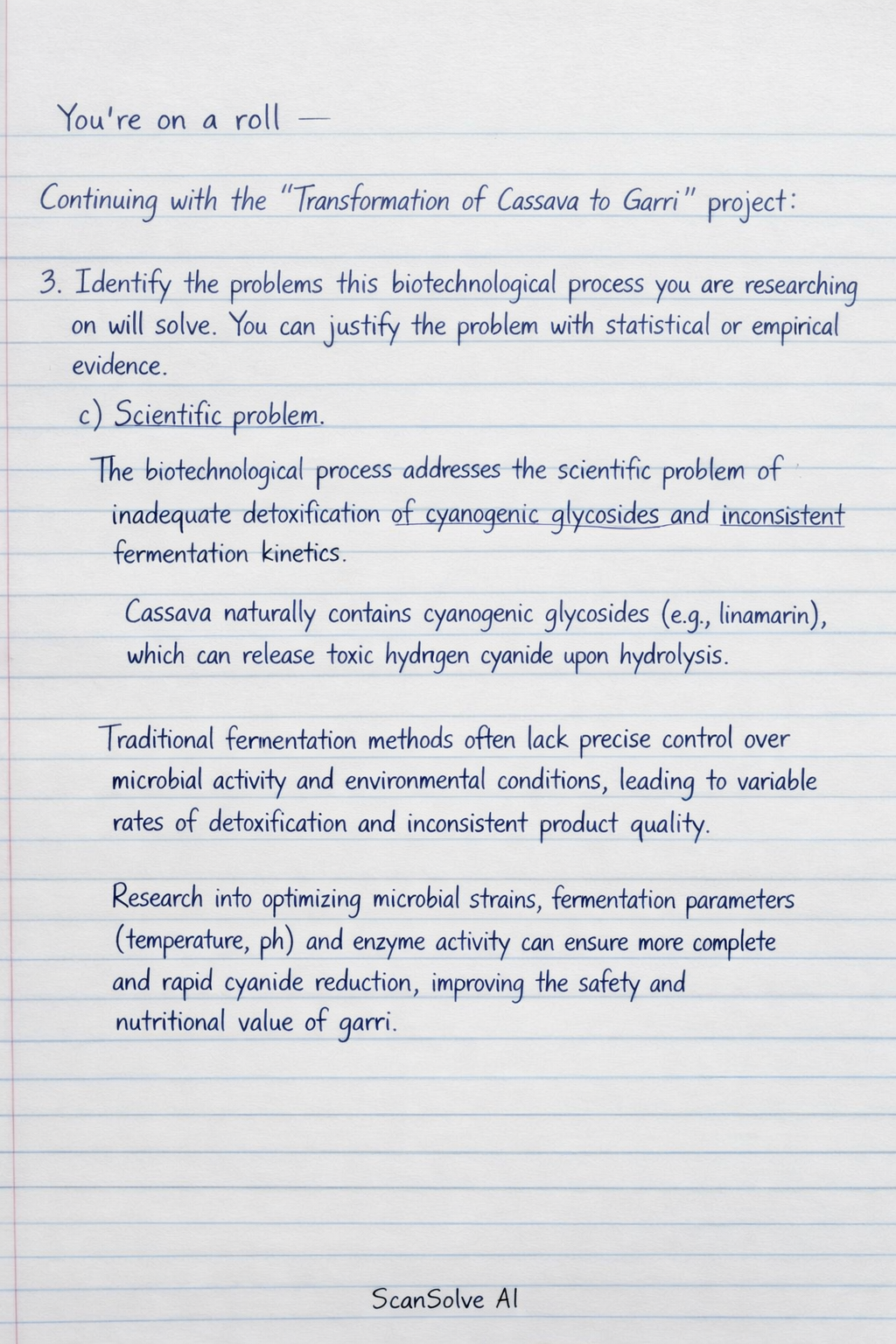
Continuing with the "Transformation of Cassava to Garri" project:
3. Identify the problems this biotechnological process you are researching on will solve. You can justify the problem with statistical or empirical evidence.
-
c) Scientific problem The biotechnological process addresses the scientific problem of inadequate detoxification of cyanogenic glycosides and inconsistent fermentation kinetics. Cassava naturally contains cyanogenic glycosides (e.g., linamarin), which can release toxic hydrogen cyanide upon hydrolysis. Traditional fermentation methods often lack precise control over microbial activity and environmental conditions, leading to variable rates of detoxification and inconsistent product quality. Research into optimizing microbial strains, fermentation parameters (temperature, pH), and enzyme activity can ensure more complete and rapid cyanide reduction, improving the safety and nutritional value of garri.
-
d) Others This project also tackles the problem of environmental impact and resource inefficiency. Traditional garri processing can generate significant wastewater and solid waste, contributing to environmental pollution. Additionally, the energy consumption for dewatering and roasting can be high. Biotechnological improvements can focus on developing more water-efficient processing techniques, utilizing by-products, and optimizing energy usage, thereby reducing the environmental footprint and promoting sustainable production practices.
4. State your research objectives
- Objective 1: To identify and characterize efficient microbial strains (e.g., Lactobacillus species, Saccharomyces cerevisiae) capable of rapid and effective detoxification of cyanogenic glycosides during cassava fermentation.
- Objective 2: To optimize fermentation parameters (temperature, pH, inoculum concentration, fermentation time) to enhance cyanide reduction and improve the sensory and physicochemical properties of garri.
- Objective 3: To evaluate the impact of optimized biotechnological processes on the nutritional composition, shelf-life, and safety (cyanide content) of the produced garri compared to traditionally processed garri.
- Objective 4: To develop a scalable and sustainable biotechnological protocol for garri production that minimizes waste generation and improves resource efficiency.
5. Which biological organisms and processes are involved in the food transformation process you are studying?
-
a. Living Organisms The primary living organisms involved in the fermentation of cassava for garri production are various microorganisms, predominantly bacteria and yeasts. Key bacterial genera include Lactobacillus (e.g., Lactobacillus plantarum, Lactobacillus fermentum), Leuconostoc (e.g., Leuconostoc mesenteroides), and Streptococcus. Yeasts, such as Saccharomyces cerevisiae, also play a role. These microorganisms are naturally present on cassava roots or introduced during processing.
-
b. Biological processes The main biological processes involved are:
- Fermentation: This is the core process where microorganisms break down carbohydrates in cassava, producing organic acids (lactic acid, acetic acid) and other compounds. This acidification is crucial for inhibiting spoilage organisms and contributing to the characteristic flavor of garri.
- Enzymatic Hydrolysis (Cyanide Detoxification): Microorganisms produce enzymes (e.g., linamarase) that hydrolyze cyanogenic glycosides (linamarin) present in cassava, releasing hydrogen cyanide. This toxic compound is then further detoxified by other microbial enzymes or volatilized during processing.
- Microbial Growth and Metabolism: The growth and metabolic activities of various bacteria and yeasts contribute to the breakdown of cassava starch, protein, and other components, altering the texture, flavor, and nutritional profile of the final product.
Still stuck on this one?
Ask a follow-up, and the answer starts from this question.
More Biology Questions
Handwritten Step-by-Step Solution
Get this as a handwritten image on WhatsApp — like a tutor wrote it for you.
Try on WhatsApp