
We read your photo as:
Identify the rabbit and its parts, explain the functions of its fur and ears, discuss sexing, name an endo-parasite, and list reasons for rearing rabbits.
ScanSolve AI Answer
Step-by-step solution
4 stepsIdentify the animal and its labeled parts.
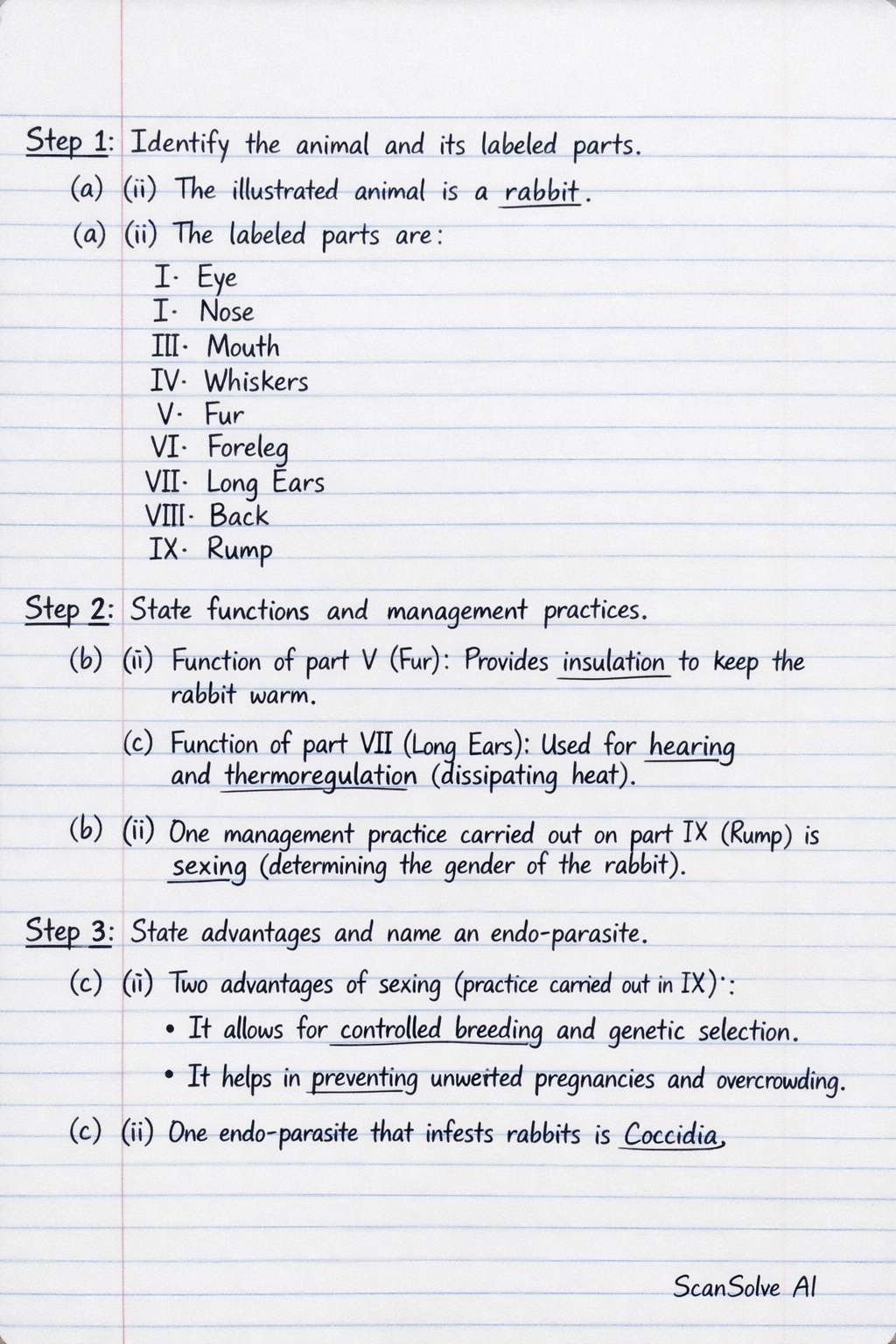
a) (i) The illustrated animal is a rabbit.
a) (ii) The labeled parts are:
I: Eye
II: Nose
III: Mouth
IV: Whiskers
V: Fur
VI: Foreleg
VII: Long Ears
VIII: Back
IX: RumpState functions and management practices.
b) (i)
- Function of part V (Fur): Provides insulation to keep the rabbit warm.
- Function of part VII (Long Ears): Used for hearing and thermoregulation (dissipating heat).
b) (ii) One management practice carried out on part IX (Rump) is sexing (determining the gender of the rabbit).
State advantages and name an endo-parasite.
c) (i) Two advantages of sexing (practice carried out in IX):
- It allows for controlled breeding and genetic selection.
- It helps in preventing unwanted pregnancies and overcrowding.
c) (ii) One endo-parasite that infests rabbits is Coccidia.
State control methods and reasons for rearing.
d) (i) One way of controlling Coccidia is by administering anti-coccidial drugs or maintaining strict hygiene.
d) (ii) Two reasons why rabbits are reared:
- For meat production, as rabbit meat is a good source of protein.
- For fur production, which can be used in textiles.
Still stuck on this one?
Ask a follow-up, and the answer starts from this question.
More Biology Questions
Handwritten Step-by-Step Solution
Get this as a handwritten image on WhatsApp — like a tutor wrote it for you.
Try on WhatsApp