
We read your photo as:
Identify the types of fruits A, B, and C, and explain the adaptations of each for dispersal.
Biology
ScanSolve AI Answer
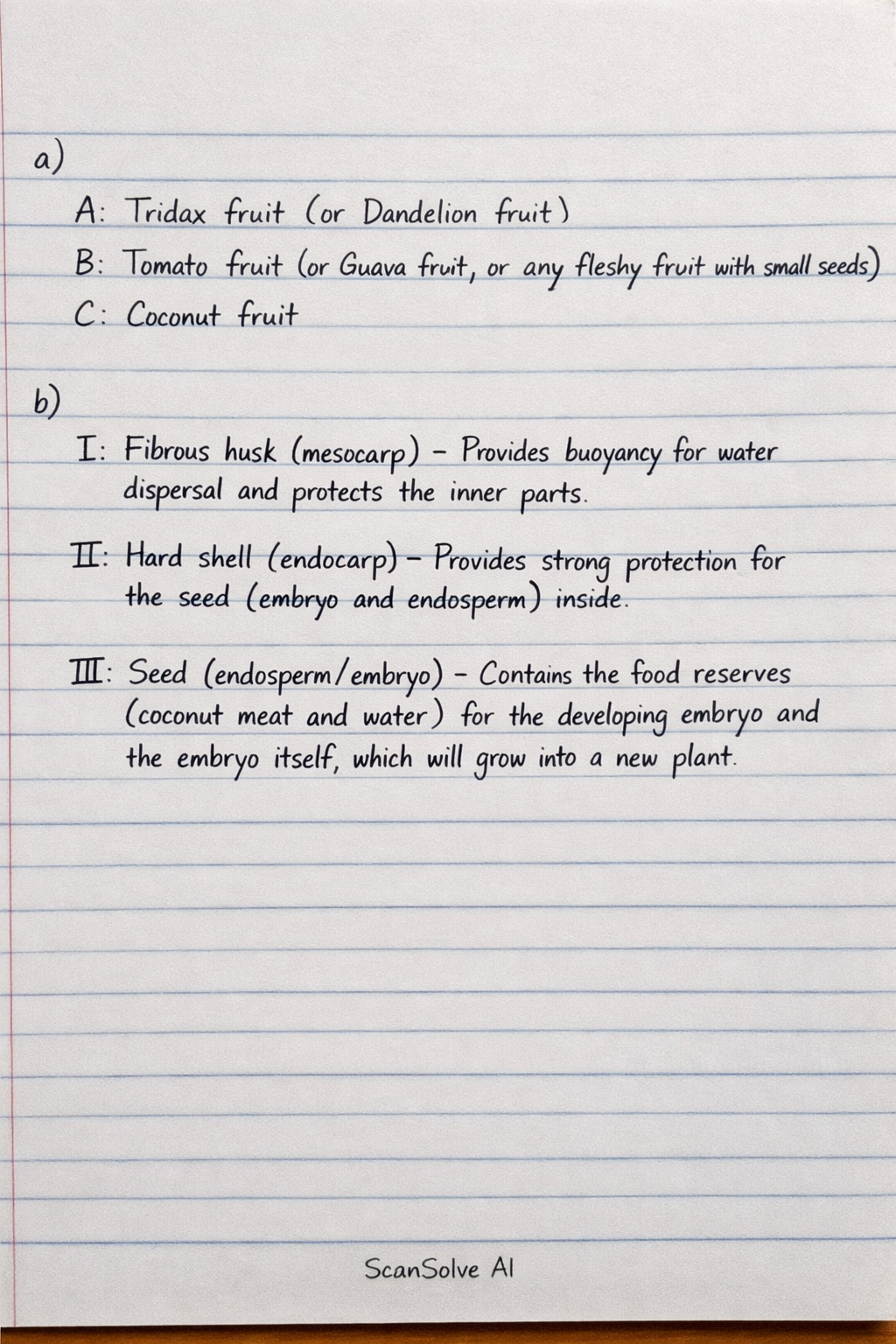
a)
- A: Tridax fruit (or Dandelion fruit)
- B: Tomato fruit (or Guava fruit, or any fleshy fruit with small seeds)
- C: Coconut fruit
b)
- I: Fibrous husk (mesocarp) - Provides buoyancy for water dispersal and protects the inner parts.
- II: Hard shell (endocarp) - Provides strong protection for the seed (embryo and endosperm) inside.
- IV: Seed (endosperm/embryo) - Contains the food reserves (coconut meat and water) for the developing embryo and the embryo itself, which will grow into a new plant.
c)
- A (Tridax fruit - Wind dispersal):
- It is lightweight to be easily carried by wind.
- It has a pappus (feathery hairs) that acts like a parachute, increasing its surface area and allowing it to float in the air.
- B (Tomato fruit - Animal dispersal):
- It has a fleshy and succulent pericarp that is edible and attracts animals.
- It is often brightly colored to attract animals visually.
- C (Coconut fruit - Water dispersal):
- It has a fibrous husk (mesocarp) with air spaces, making it buoyant to float on water.
- It has a waterproof outer layer (exocarp) to prevent water from entering and damaging the seed during long periods of floating.
Was this helpful?
Still stuck on this one?
Ask a follow-up, and the answer starts from this question.
Got a different question?Ask your own question
More Biology Questions
QA) Name the fruits labelled A, B and C. b) State the function of each of the parts labelled I, II…QDispersal of seeds and fruitsQIdentify the number of each type of fruit.QIdentify the parts of the pistil labeled A, B, C, and D in the diagram, and determine the most…QIdentify the parts labeled A, B, and C in the given diagram of a microsporangium.
Handwritten Step-by-Step Solution
Get this as a handwritten image on WhatsApp — like a tutor wrote it for you.
Try on WhatsApp