
We read your photo as:
Identify tissue 1.
ScanSolve AI Answer
Step-by-step solution
10 steps7.3.1:
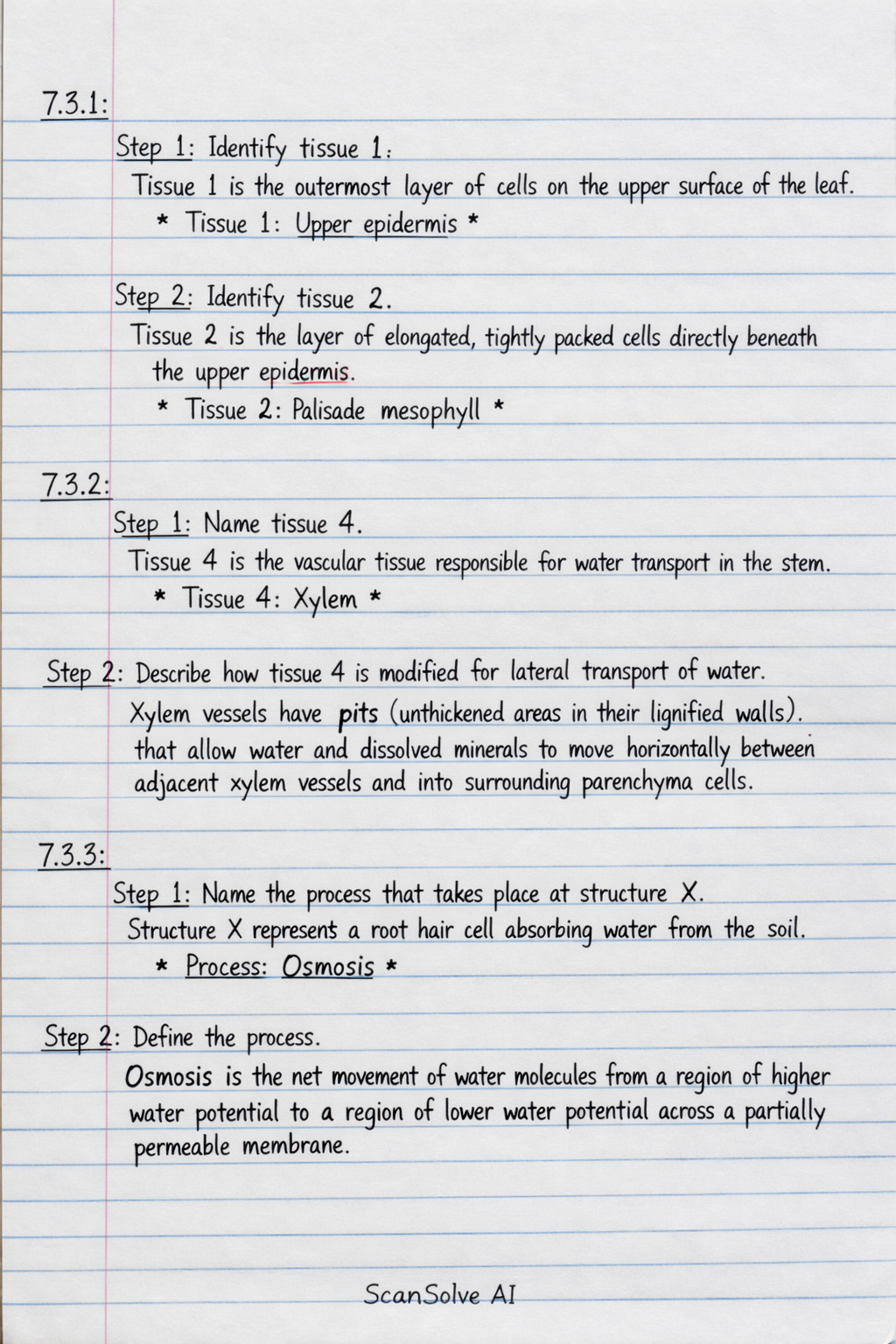
Identify tissue 1.
Tissue 1 is the outermost layer of cells on the upper surface of the leaf.
- Tissue 1: Upper epidermis
Identify tissue 2.
Tissue 2 is the layer of elongated, tightly packed cells directly beneath the upper epidermis.
- Tissue 2: Palisade mesophyll
7.3.2:
Name tissue 4.
Tissue 4 is the vascular tissue responsible for water transport in the stem.
- Tissue 4: Xylem
Describe how tissue 4 is modified for lateral transport of water.
Xylem vessels have pits (unthickened areas in their lignified walls) that allow water and dissolved minerals to move horizontally between adjacent xylem vessels and into surrounding parenchyma cells.
7.3.3:
Name the process that takes place at structure X.
Structure X represents a root hair cell absorbing water from the soil.
- Process: Osmosis
Define the process.
Osmosis is the net movement of water molecules from a region of higher water potential to a region of lower water potential across a partially permeable membrane.
7.3.4:
Explain the influence of rainy conditions on osmosis (water uptake by roots).
Rainy conditions lead to a higher water potential in the soil.
Describe the effect on water absorption.
This increases the water potential gradient between the soil and the root cells, causing increased water absorption by the roots through osmosis.
7.3.5:
Identify the cells numbered 3.
The cells numbered 3, indicated by the arrow pointing to the opening, are the guard cells and surrounding epidermal cells that form a stoma.
Describe the surface view of these cells.
A labeled drawing of the surface view of cells numbered 3 would show:
- Two bean-shaped guard cells surrounding a central pore called the stoma.
- The guard cells contain chloroplasts.
- These guard cells are surrounded by irregularly shaped epidermal cells.
Still stuck on this one?
Ask a follow-up, and the answer starts from this question.
More Biology Questions
Handwritten Step-by-Step Solution
Get this as a handwritten image on WhatsApp — like a tutor wrote it for you.
Try on WhatsApp