
We read your photo as:
Define immunity, describe natural defence mechanisms against pathogens, and explain the significance of differences between adult and foetal circulatory systems.
ScanSolve AI Answer
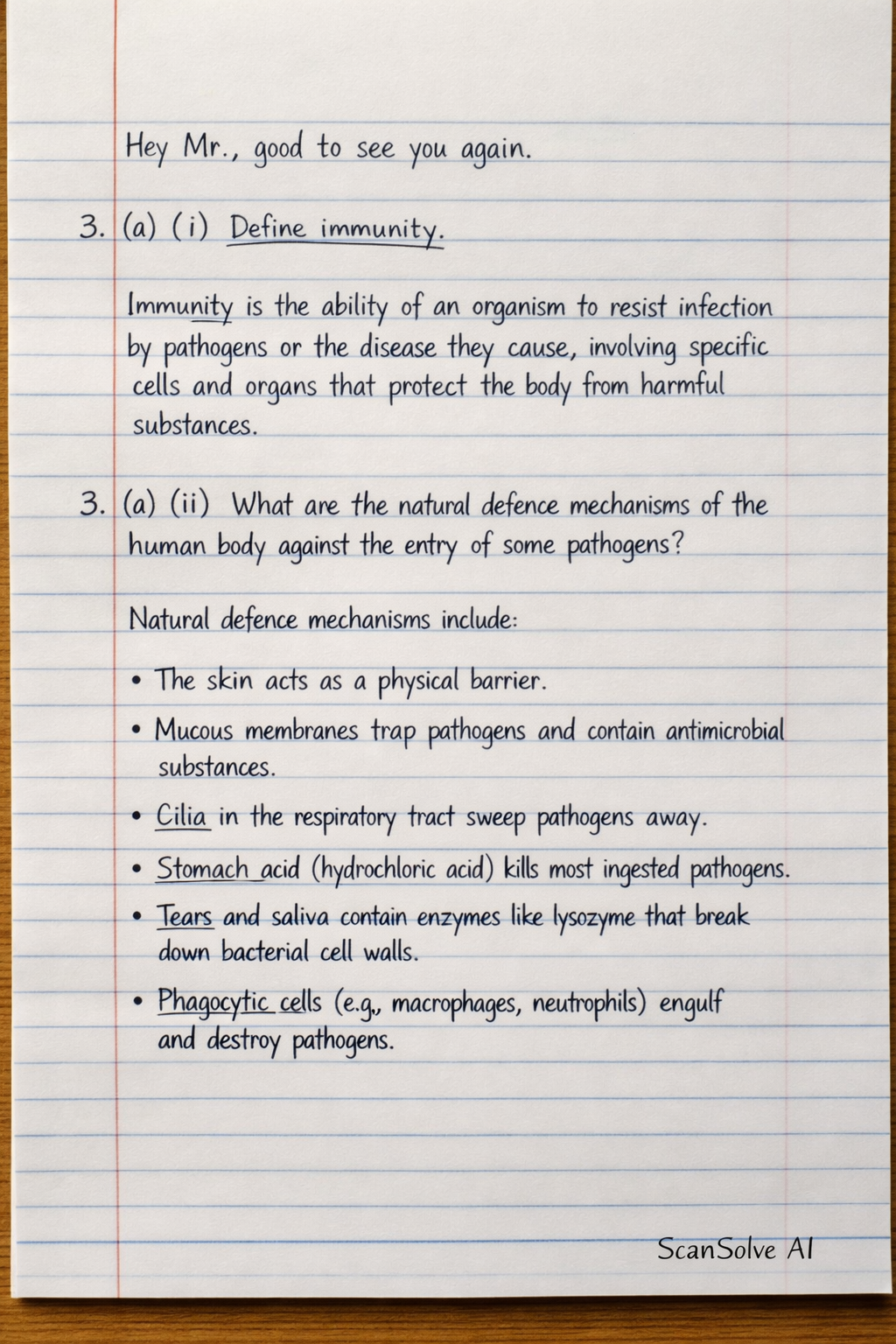
3. (a) (i) Define immunity.
Immunity is the ability of an organism to resist infection by pathogens or the disease they cause, involving specific cells and organs that protect the body from harmful substances.
3. (a) (ii) What are the natural defence mechanisms of the human body against the entry of some pathogens?
Natural defence mechanisms include:
- The skin acts as a physical barrier.
- Mucous membranes trap pathogens and contain antimicrobial substances.
- Cilia in the respiratory tract sweep pathogens away.
- Stomach acid (hydrochloric acid) kills most ingested pathogens.
- Tears and saliva contain enzymes like lysozyme that break down bacterial cell walls.
- Phagocytic cells (e.g., macrophages, neutrophils) engulf and destroy pathogens.
3. (a) (iii) Give the significance of the differences between adult and foetal circulatory systems.
The differences in foetal circulation are significant because they allow the foetus to obtain oxygen and nutrients from the mother's blood via the placenta, bypassing its own non-functional lungs and digestive system. Structures like the foramen ovale and ductus arteriosus shunt blood away from the lungs, while the ductus venosus bypasses the liver, ensuring efficient delivery of oxygenated blood to the foetal body.
3. (b) (i) Describe how auto digestion is prevented in the human gut.
Auto digestion is prevented in the human gut through several mechanisms:
- The stomach lining is protected by a thick layer of alkaline mucus that neutralizes acid and shields cells from digestive enzymes.
- Digestive enzymes like pepsin are secreted in an inactive form (pepsinogen) and only activated in the stomach lumen.
- The pancreas secretes bicarbonate ions into the small intestine to neutralize acidic chyme from the stomach, protecting the intestinal lining.
- Proteases in the small intestine are also secreted as inactive zymogens (e.g., trypsinogen) and activated only when needed by specific enzymes like enteropeptidase.
3. (b) (ii) Why is gaseous exchange more effective in Tilapia than in a Dog fish?
Gaseous exchange is more effective in Tilapia (bony fish) than in Dogfish (cartilaginous fish) primarily due to the presence of an operculum in Tilapia. The operculum allows Tilapia to use a buccal pump mechanism, creating a continuous, unidirectional flow of water over the gills even when the fish is stationary. This constant flow maintains a steep concentration gradient for oxygen, maximizing efficiency. Dogfish lack an operculum and often rely on ram ventilation (swimming with mouth open) or less efficient muscular contractions, leading to a less continuous and less effective water flow over their gills.
Still stuck on this one?
Ask a follow-up, and the answer starts from this question.
More Biology Questions
Handwritten Step-by-Step Solution
Get this as a handwritten image on WhatsApp — like a tutor wrote it for you.
Try on WhatsApp