
We read your photo as:
In burn patients, what are the key nursing interventions to prevent kidney failure and infection, and what is the focus of patient education post-gastrectomy?
Biology
ScanSolve AI Answer
Answer
C
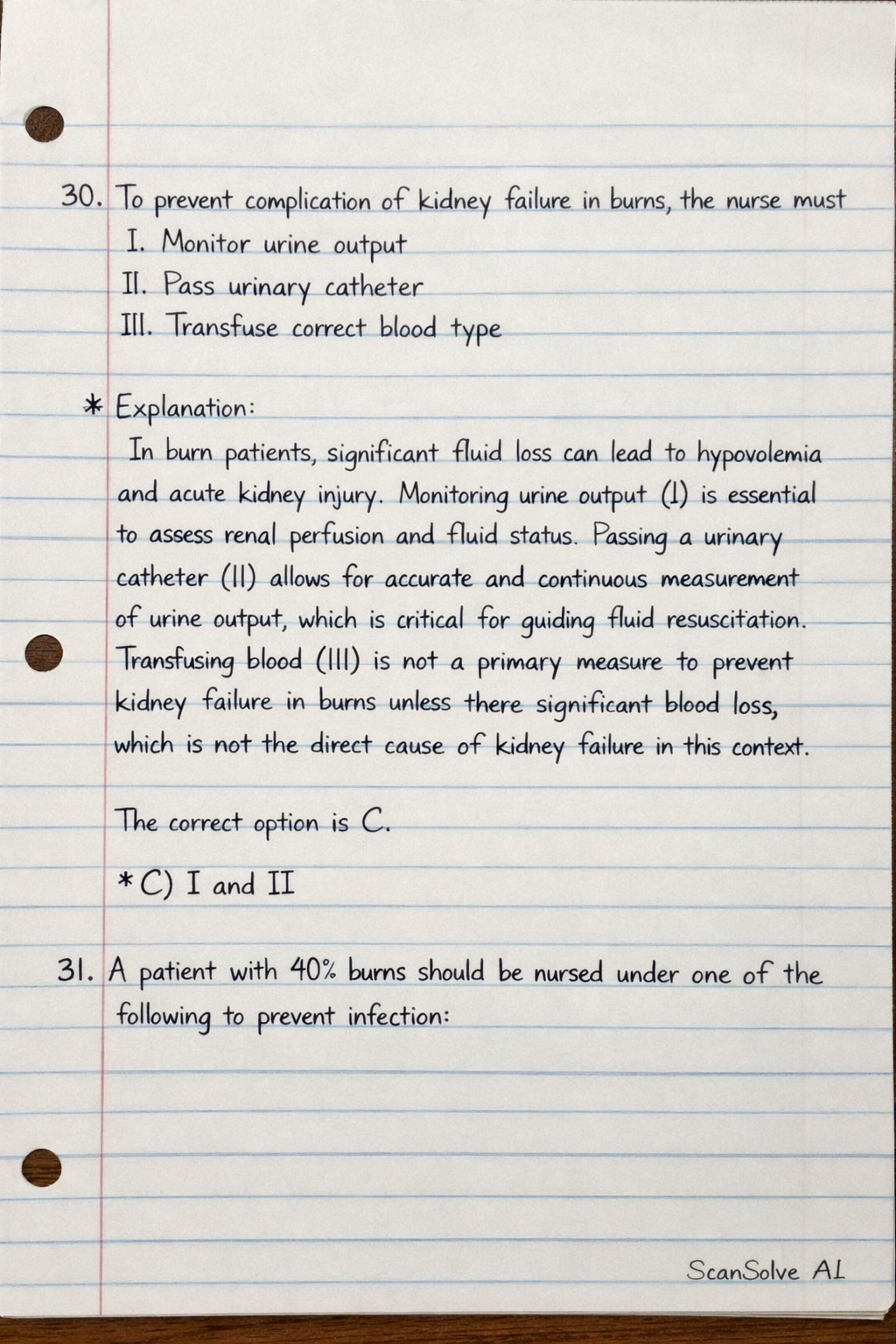
- To prevent complication of kidney failure in burns, the nurse must I. Monitor urine output II. Pass urinary catheter III. Transfuse correct blood type
- Explanation: In burn patients, significant fluid loss can lead to hypovolemia and acute kidney injury. Monitoring urine output (I) is essential to assess renal perfusion and fluid status. Passing a urinary catheter (II) allows for accurate and continuous measurement of urine output, which is critical for guiding fluid resuscitation. Transfusing blood (III) is not a primary measure to prevent kidney failure in burns unless there is significant blood loss, which is not the direct cause of kidney failure in this context.
The correct option is C.
C) I and II
- A patient with 40% burns should be nursed under one of the following to prevent infection
- Explanation: Patients with extensive burns have a severely compromised skin barrier, making them highly susceptible to infection. Reverse barrier nursing (also known as protective isolation) is a technique used to protect immunocompromised patients from pathogens in the environment. This involves strict aseptic techniques by healthcare providers to prevent introducing infections to the patient.
The correct option is C.
C) Reverse barrier
- Education of patient after gastrectomy should focus on
- Explanation: A gastrectomy involves the removal of part or all of the stomach, which significantly alters the digestive process. Patients often experience changes in digestion, nutrient absorption, and may develop conditions like dumping syndrome. Therefore, dietary education is crucial to help patients adapt to their altered digestive system, manage symptoms, and maintain adequate nutrition.
The correct option is A.
A) Dietary
Was this helpful?
Try one yourself
A new problem that tests the same skill.
Still stuck on this one?
Ask a follow-up, and the answer starts from this question.
Got a different question?Ask your own question
More Biology Questions
QIn the initial management of a patient with severe burns, the primary concern is to prevent…QWrite on the procedures involved in gastrectomyQWhat are the answers to the following multiple-choice questions about post-operative care and…QDiscuss the pre-operative and post-operative nursing management of patients undergoing Ear, Nose and…QWhat are the nursing interventions for a patient experiencing weakness?
Handwritten Step-by-Step Solution
Get this as a handwritten image on WhatsApp — like a tutor wrote it for you.
Try on WhatsApp