
We read your photo as:
In humans, haemophilia is a sex-linked recessive trait. What are the possible genotypes and phenotypes of offspring from a haemophiliac female and a normal male?
ScanSolve AI Answer
Step-by-step solution
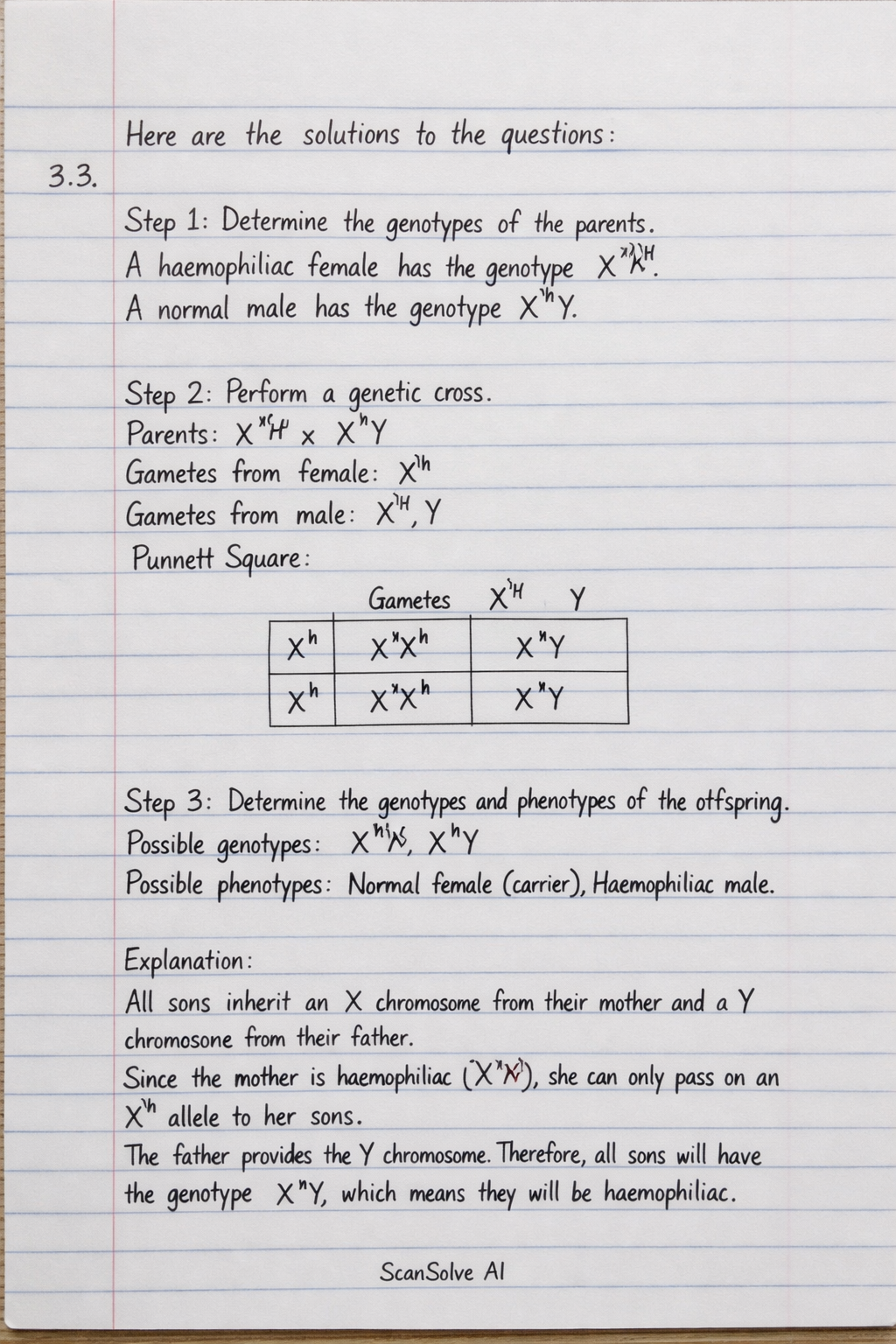
11 stepsHere are the solutions to the questions:
3.3
Determine the genotypes of the parents.
A haemophiliac female has the genotype .
A normal male has the genotype .Perform a genetic cross.
Parents:
Gametes from female:
Gametes from male: ,Punnett Square:
Determine the genotypes and phenotypes of the offspring.
Possible genotypes: ,
Possible phenotypes: Normal female (carrier), Haemophiliac maleExplanation:
All sons inherit an X chromosome from their mother and a Y chromosome from their father. Since the mother is haemophiliac (), she can only pass on an allele to her sons. The father provides the Y chromosome. Therefore, all sons will have the genotype , which means they will be haemophiliac.2.4.1
Determine the genotypes of the parents.
A man suffering from haemophilia has the genotype .
A woman who is a carrier has the genotype .Perform a genetic cross.
Parents:
Gametes from male: ,
Gametes from female: ,Punnett Square:
Determine the possible genotypes and phenotypes of the children.
Possible genotypes: , , ,
Possible phenotypes:- : Normal female (carrier)
- : Haemophiliac female
- : Normal male
- : Haemophiliac male
2.4.2
Haemophilia affects mostly males because it is a sex-linked recessive disorder on the X chromosome. Males have only one X chromosome (). If a male inherits the recessive allele () on his single X chromosome, he will express the disorder () because there is no dominant allele on a second X chromosome to mask it. Females have two X chromosomes (), so they must inherit two copies of the recessive allele () to express the disorder. If a female inherits only one recessive allele (), she will be a carrier but will not show symptoms due to the presence of a dominant normal allele ().2.1.1
Determine the genotypes of the parents.
A normal father has the genotype .
A heterozygous mother (carrier) has the genotype .Represent the genetic cross.
Parents:
Gametes from father: ,
Gametes from mother: ,Punnett Square:
Determine the possible genotypes and phenotypes of the children.
Possible genotypes: , , ,
Possible phenotypes:- : Normal female
- : Normal female (carrier)
- : Normal male
- : Haemophiliac male
2.1.2
Identify the genotype for a haemophiliac male from the Punnett square in 2.1.1.
The genotype for a haemophiliac male is .
Calculate the chances.
From the Punnett square, there is 1 out of 4 possible offspring genotypes that results in a haemophiliac male.
The chances are or 25%.The chances of the parents having a child that will be a haemophiliac male are
\boxed{\text{25%}}.2.1.3
Males have only one X chromosome (). Haemophilia is a recessive disorder on the X chromosome. If a male inherits the recessive allele () on his single X chromosome, he will express the disorder () because there is no second X chromosome with a dominant normal allele to mask it. A carrier is an individual who possesses a recessive allele but does not express the trait. Therefore, a male cannot be a carrier for haemophilia; he either has the disorder or he does not.
Still stuck on this one?
Ask a follow-up, and the answer starts from this question.
More Biology Questions
Handwritten Step-by-Step Solution
Get this as a handwritten image on WhatsApp — like a tutor wrote it for you.
Try on WhatsApp