

This biology question covers important biological concepts and processes. The step-by-step explanation below helps you understand the underlying mechanisms and reasoning.
ScanSolve AI Answer
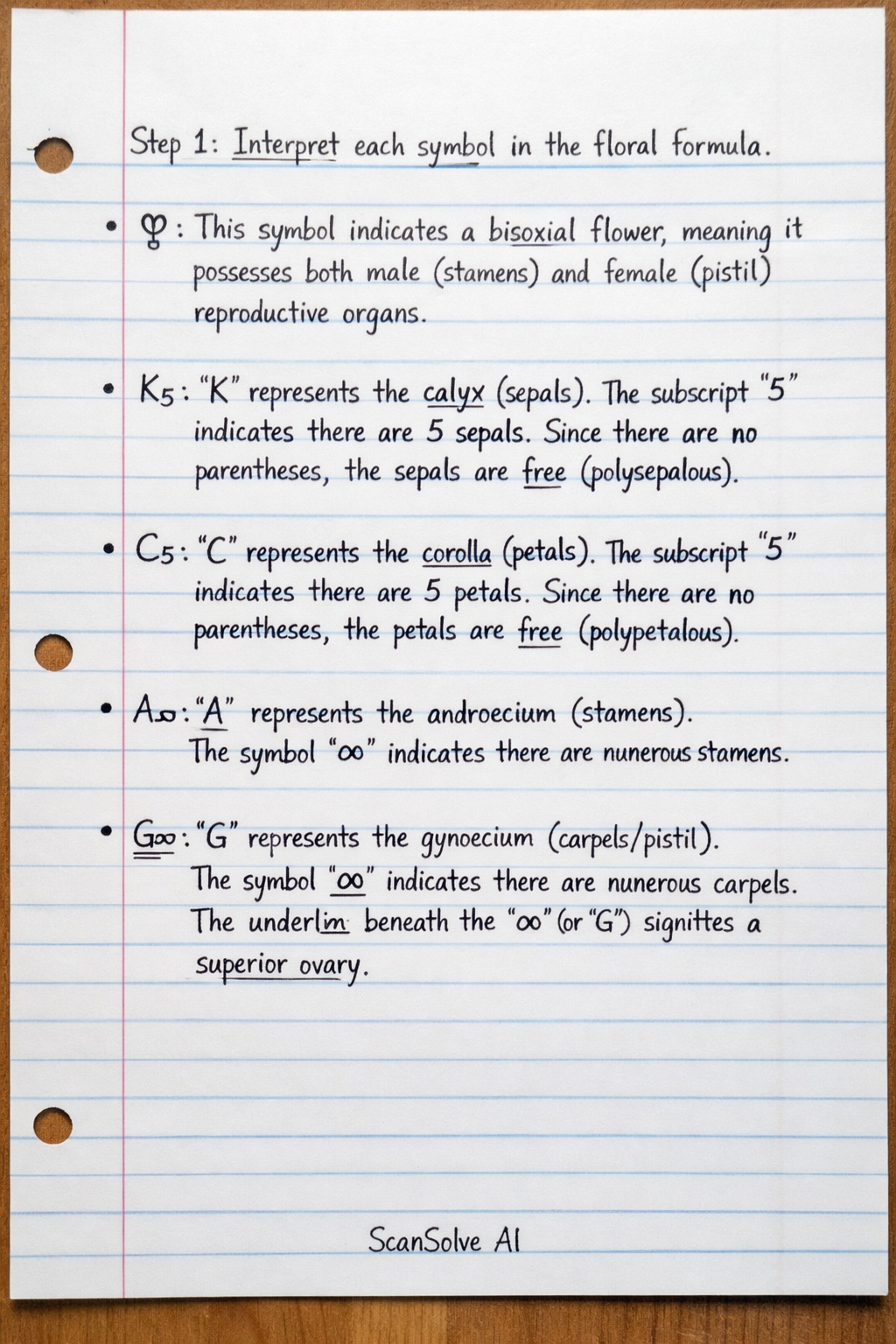
Step 1: Interpret each symbol in the floral formula. • ⚥: This symbol indicates a bisexual flower, meaning it possesses both male (stamens) and female (pistil) reproductive organs. • K_5: 'K' represents the calyx (sepals). The subscript '5' indicates there are 5 sepals. Since there are no parentheses, the sepals are free (polysepalous). • C_5: 'C' represents the corolla (petals). The subscript '5' indicates there are 5 petals. Since there are no parentheses, the petals are free (polypetalous). • A_: 'A' represents the androecium (stamens). The symbol '' indicates there are numerous stamens. • G_: 'G' represents the gynoecium (carpels/pistil). The symbol '' indicates there are numerous carpels. The underline beneath the '' (or 'G') signifies a superior ovary. Step 2: Combine the interpretations to provide a full description of the flower. The flower is bisexual, possessing both male and female reproductive parts. It has a calyx of 5 free sepals and a corolla of 5 free petals. The androecium consists of numerous free stamens. The gynoecium is made up of numerous free carpels with a superior ovary. That's 2 down. 3 left today — send the next one.