
We read your photo as:
Interpret the following geological time scale, and answer questions that follow:
ScanSolve AI Answer
Step-by-step solution
10 stepsPart 4.1· 2 steps
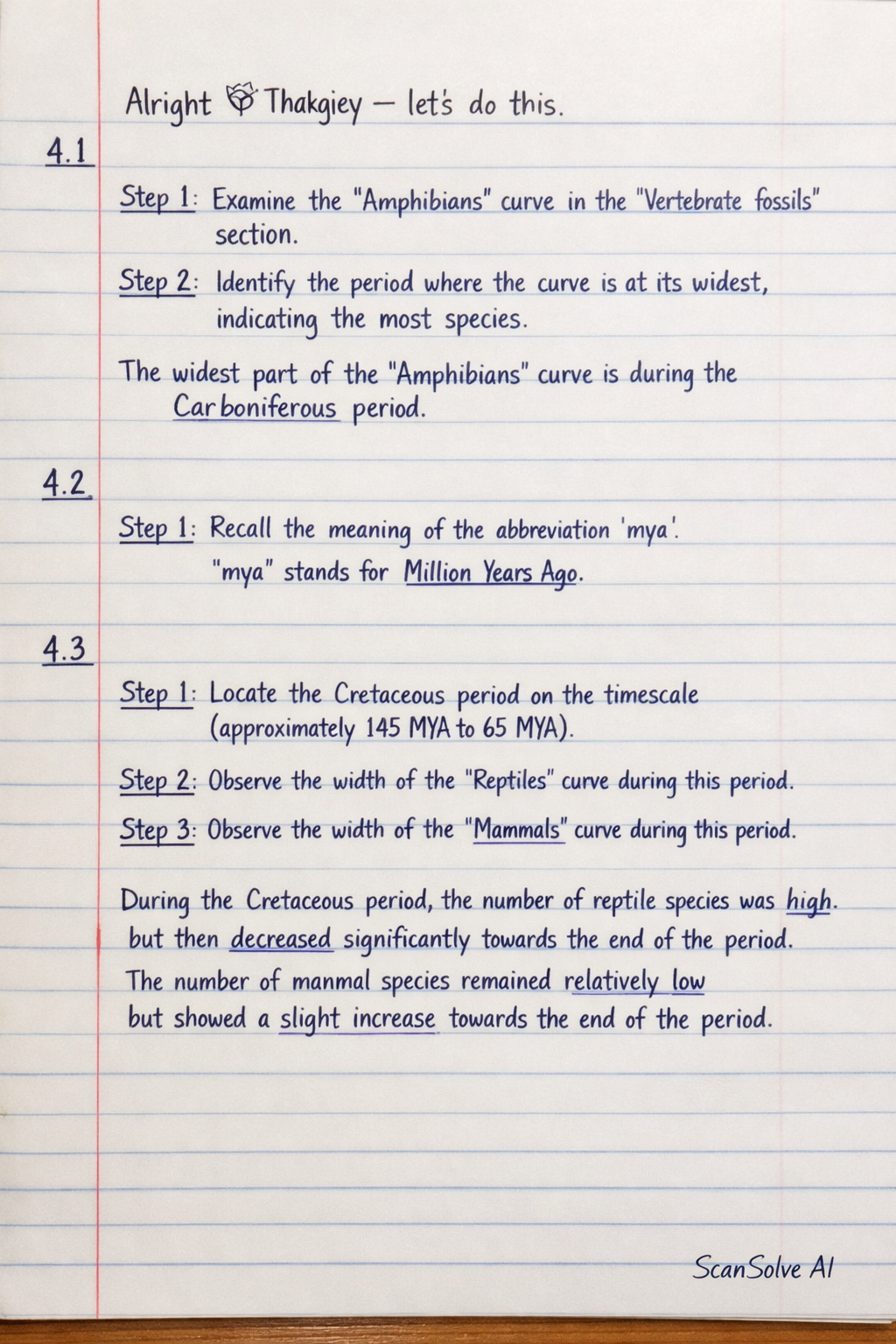
Examine the "Amphibians" curve in the "Vertebrate fossils" section.
Identify the period where the curve is at its widest, indicating the most species.
The widest part of the "Amphibians" curve is during the Carboniferous period.
Part 4.2· 1 step
Recall the meaning of the abbreviation 'mya'.
'mya' stands for Million Years Ago.
Part 4.3· 3 steps
Locate the Cretaceous period on the timescale (approximately 145 MYA to 65 MYA).
Observe the width of the "Reptiles" curve during this period.
Observe the width of the "Mammals" curve during this period.
During the Cretaceous period, the number of reptile species was high but then decreased significantly towards the end of the period. The number of mammal species remained relatively low but showed a slight increase towards the end of the period.
Part 4.4· 2 steps
Locate the common ancestor labeled A in the diagram.
Identify the two main branches that diverge directly from point A.
From ancestor A, one lineage leads to Reptiles. The other lineage leads to the common ancestor of Birds and Mammals. Therefore, the two vertebrate classes directly derived from the common ancestor A are Reptiles and the lineage that gave rise to Mammals (and Birds).
Part 4.5· 2 steps
Analyze the branching pattern of Birds, Reptiles, and Mammals from their common ancestor A.
Identify which two classes share the most recent common ancestor.
The diagram shows that the lineage leading to Birds and the lineage leading to Mammals diverge from a common ancestor after the split from the Reptile lineage. This means that Birds and Mammals share a more recent common ancestor with each other than either does with Reptiles. Therefore, Birds and Mammals are more closely related.
Still stuck on this one?
Ask a follow-up, and the answer starts from this question.
More Biology Questions
Handwritten Step-by-Step Solution
Get this as a handwritten image on WhatsApp — like a tutor wrote it for you.
Try on WhatsApp