
We read your photo as:
Interpret the following spirometry results: FVC: 1.70L (Pred: 2.98L, LLN: 2.28L), FEV1: 1.19L (Pred: 2.40L, LLN: 1.82L), FEV1/FVC: 70% (Pred: 81%, LLN: 70%), PEFR: 4.97 L/s.
ScanSolve AI Answer
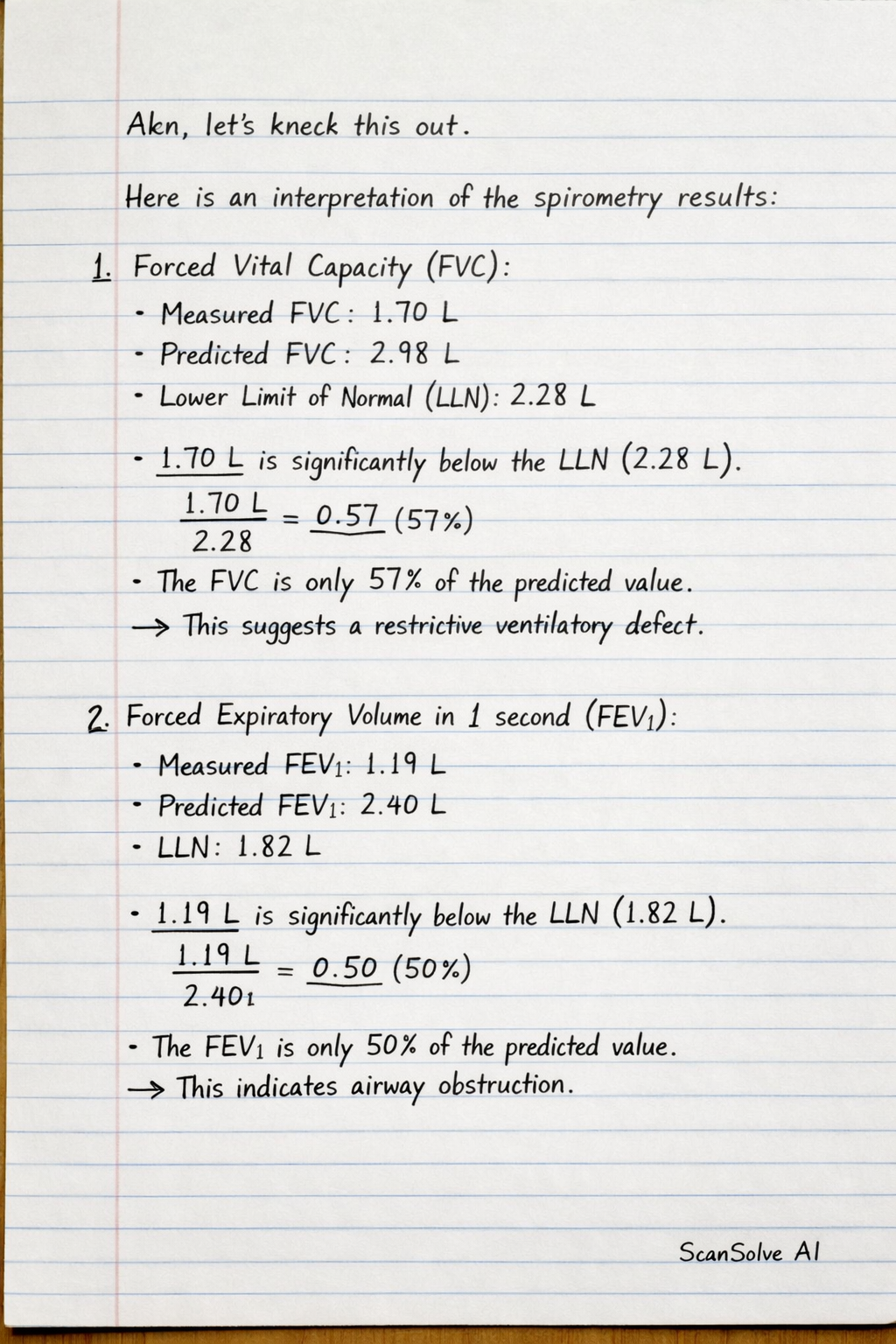
Here is an interpretation of the spirometry results:
-
Forced Vital Capacity (FVC):
- Measured FVC:
- Predicted FVC:
- Lower Limit of Normal (LLN):
- The measured FVC () is significantly below the LLN () and is only of the predicted value. A reduced FVC suggests a restrictive ventilatory defect.
-
Forced Expiratory Volume in 1 second (FEV1):
- Measured FEV1:
- Predicted FEV1:
- LLN:
- The measured FEV1 () is significantly below the LLN () and is only of the predicted value. This indicates a significant reduction in the amount of air that can be forcefully exhaled in the first second, which is characteristic of airway obstruction.
-
FEV1/FVC Ratio:
- Measured FEV1/FVC:
- Predicted FEV1/FVC:
- LLN:
- The measured FEV1/FVC ratio () is at the LLN. While not definitively below the LLN, it is significantly lower than the predicted value (). A ratio at or below the LLN is indicative of an obstructive ventilatory defect.
-
Peak Expiratory Flow Rate (PEFR):
- Measured PEFR:
- This value is not compared to predicted or LLN in the table, but it is generally reduced in obstructive patterns.
-
Forced Expiratory Flow 25-75% (FEF25-75):
- Measured FEF25-75:
- Predicted FEF25-75:
- LLN:
- The measured FEF25-75 () is significantly below the LLN () and is only of the predicted value. This is a sensitive indicator of small airway obstruction.
-
Forced Expiratory Time (FET):
- Measured FET:
- A prolonged FET (typically seconds) is consistent with airway obstruction.
Interpretation of Graphs:
- Flow-Volume Loop (Top Left): The expiratory limb (upper curve) shows a significantly reduced peak flow and a concave or "scooped out" shape, especially in the mid-to-late phase of expiration, compared to the predicted curve (dashed line). This is a classic sign of airway obstruction. The overall size of the loop is also smaller than predicted, reflecting reduced lung volumes.
- Volume-Time Curve (Bottom Left): The curve shows a significantly reduced total volume exhaled (FVC) compared to the predicted curve. The exhalation also appears prolonged to reach the maximum volume, consistent with obstruction.
- Pre-Bronchodilator Bar Graph (Middle Right): This visual summary clearly shows that FVC, FEV1, and FEV1/FVC are all positioned in the red zone, indicating values below the LLN.
Conclusion:
Based on the numerical data and the graphical representations, the spirometry results indicate a mixed ventilatory defect.
- The reduced FEV1/FVC ratio ( at LLN, significantly below predicted) and the very low FEV1 and FEF25-75, along with the scooped-out flow-volume loop and prolonged FET, confirm a significant obstructive component.
- The significantly reduced FVC ( of predicted, below LLN) confirms a restrictive component.
Note on Preliminary Impression: The preliminary impression on the report, "FEV1/VC and VC are within normal limits indicating a Normal Study," is incorrect based on the provided numerical data and graphical evidence.
Still stuck on this one?
Ask a follow-up, and the answer starts from this question.
More Biology Questions
Handwritten Step-by-Step Solution
Get this as a handwritten image on WhatsApp — like a tutor wrote it for you.
Try on WhatsApp