It appears the question asks to design an experiment to show the effect of a factor on the rate of photosynthesis, and then asks for the physical equation and procedure. The specific factor is not cle
This biology question covers important biological concepts and processes. The step-by-step explanation below helps you understand the underlying mechanisms and reasoning.
ScanSolve AI Answer
It appears the question asks to design an experiment to show the effect of a factor on the rate of photosynthesis, and then asks for the physical equation and procedure. The specific factor is not clearly visible in the image. I will assume the question is asking about the effect of light intensity on the rate of photosynthesis, as it is a common experiment.
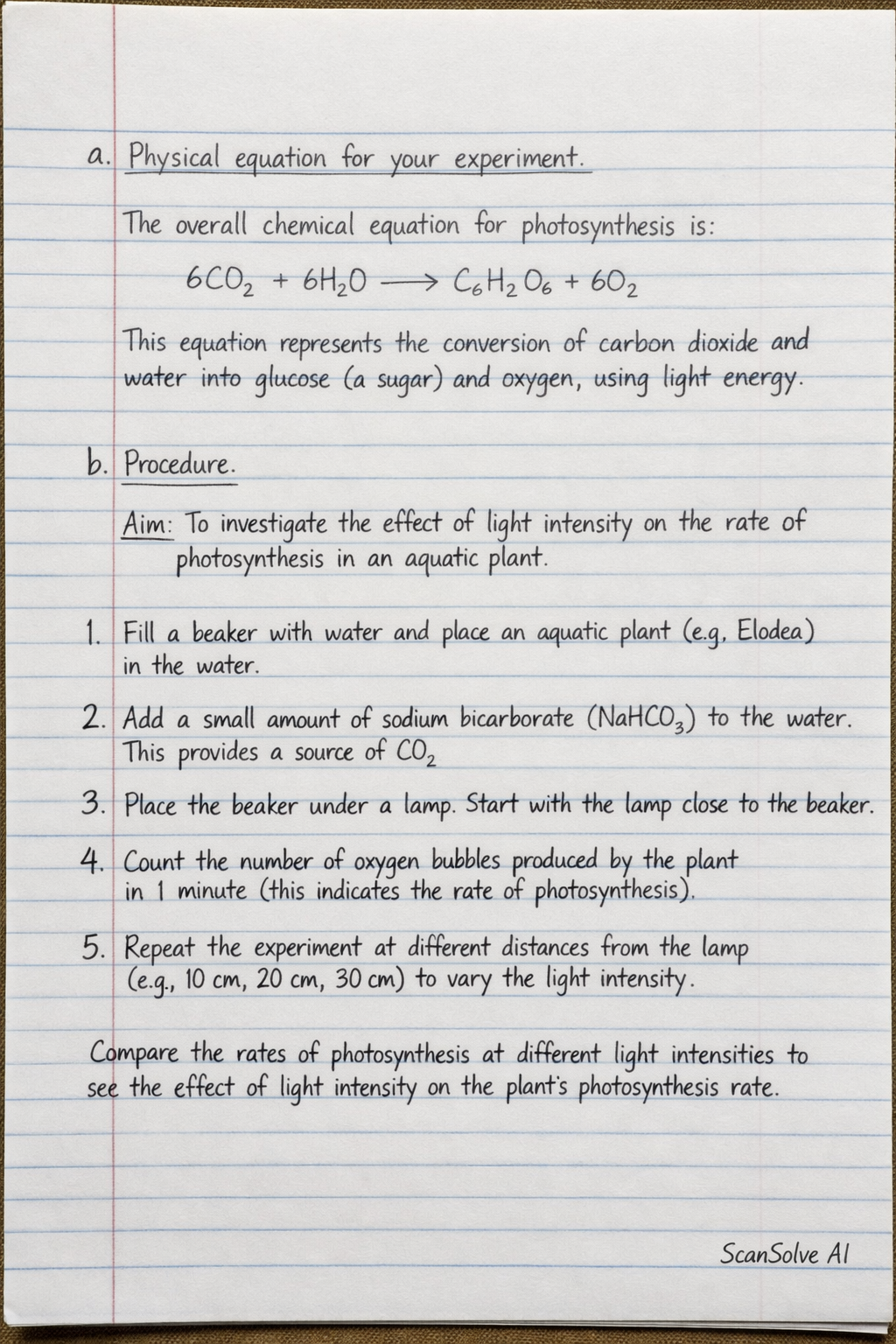
a. Physical equation for your experiment
The overall chemical equation for photosynthesis is:
$$6\text{CO}_2 + 6\text{H}_2\text{O} \xrightarrow{\text{light energy}} \text{C}_6\text{H}_{12}\text{O}_6 + 6\text{O}_2$$
This equation represents the conversion of carbon dioxide and water into glucose (a sugar) and oxygen, using light energy.
b. Procedure
Aim: To investigate the effect of light intensity on the rate of photosynthesis in an aquatic plant.
Materials:
Aquatic plant (e.g., Elodea or Cabomba*)
Beaker or test tube
Water (preferably distilled water with dissolved sodium hydrogen carbonate to provide CO$_2$)
Light source (e.g., lamp)
Ruler or meter stick
Stopwatch
Thermometer (optional, to monitor temperature)
Method:
1. Preparation:
Cut a fresh shoot of the aquatic plant about 5-10 cm long.
Place the cut end of the plant shoot upwards in a beaker or test tube filled with water. Add a pinch of sodium hydrogen carbonate to the water to ensure a sufficient supply of carbon dioxide for photosynthesis.
Ensure the cut end is clean and free of damage to allow for efficient oxygen bubble release.
2. Setup:
Place the beaker/test tube containing the plant in a dark room or area to minimize external light interference.
Position a light source (lamp) at a measured distance from the plant. This distance will determine the light intensity.
3. Experimentation (Varying Light Intensity):
Step 1: Start with the light source at a specific distance (e.g., 10 cm) from the plant. Allow the plant to acclimatize for 5 minutes.
Step 2: Start the stopwatch and count the number of oxygen bubbles released from the cut end of the plant in a fixed time period (e.g., 1 minute). Record this number.
Step 3: Repeat the counting for at least two more 1-minute intervals at the same distance to ensure reliability and calculate an average.
Step 4: Increase the distance between the light source and the plant (e.g., to 20 cm, 30 cm, 40 cm, etc.). This decreases the light intensity reaching the plant.
Step 5: For each new distance (and thus new light intensity), repeat steps 2 and 3.
Step 6: Ensure other factors like temperature (by using a heat shield or allowing cooling time) and CO$_2$ concentration remain constant throughout the experiment.
4. Data Collection:
Record the distance of the light source from the plant and the corresponding average number of oxygen bubbles produced per minute in a table.
5. Analysis:
Plot a graph with light intensity (which can be represented as $1/d^2$ where $d$ is the distance from the light source, or simply the distance itself) on the x-axis and the rate of oxygen bubble production (bubbles/minute) on the y-axis.
Observe how the rate of photosynthesis changes with varying light intensity.
Expected Results:
As the light intensity increases (i.e., the lamp is moved closer to the plant), the rate of oxygen bubble production will generally increase up to a certain point, after which it may plateau due to other limiting factors (e.g., CO$_2$ concentration or temperature).
It appears the question asks to design an experiment to show the effect of a factor on the rate of photosynthesis, and then asks for the physical equation and procedure. The specific factor is not cle
|Biology
It appears the question asks to design an experiment to show the effect of a factor on the rate of photosynthesis, and then asks for the physical equation and procedure. The specific factor is not cle
ScanSolve AI Answer
It appears the question asks to design an experiment to show the effect of a factor on the rate of photosynthesis, and then asks for the physical equation and procedure. The specific factor is not clearly visible in the image. I will assume the question is asking about the effect of light intensity on the rate of photosynthesis, as it is a common experiment.
a. Physical equation for your experiment
The overall chemical equation for photosynthesis is:
6CO2+6H2OlightenergyC6H12O6+6O2
This equation represents the conversion of carbon dioxide and water into glucose (a sugar) and oxygen, using light energy.
b. Procedure
Aim: To investigate the effect of light intensity on the rate of photosynthesis in an aquatic plant.
Materials:
Aquatic plant (e.g., Elodea or Cabomba)
Beaker or test tube
Water (preferably distilled water with dissolved sodium hydrogen carbonate to provide CO2)
Light source (e.g., lamp)
Ruler or meter stick
Stopwatch
Thermometer (optional, to monitor temperature)
Method:
Preparation:
Cut a fresh shoot of the aquatic plant about 5-10 cm long.
Place the cut end of the plant shoot upwards in a beaker or test tube filled with water. Add a pinch of sodium hydrogen carbonate to the water to ensure a sufficient supply of carbon dioxide for photosynthesis.
Ensure the cut end is clean and free of damage to allow for efficient oxygen bubble release.
Setup:
Place the beaker/test tube containing the plant in a dark room or area to minimize external light interference.
Position a light source (lamp) at a measured distance from the plant. This distance will determine the light intensity.
Experimentation (Varying Light Intensity):
Step 1: Start with the light source at a specific distance (e.g., 10 cm) from the plant. Allow the plant to acclimatize for 5 minutes.
Step 2: Start the stopwatch and count the number of oxygen bubbles released from the cut end of the plant in a fixed time period (e.g., 1 minute). Record this number.
Step 3: Repeat the counting for at least two more 1-minute intervals at the same distance to ensure reliability and calculate an average.
Step 4: Increase the distance between the light source and the plant (e.g., to 20 cm, 30 cm, 40 cm, etc.). This decreases the light intensity reaching the plant.
Step 5: For each new distance (and thus new light intensity), repeat steps 2 and 3.
Step 6: Ensure other factors like temperature (by using a heat shield or allowing cooling time) and CO2 concentration remain constant throughout the experiment.
Data Collection:
Record the distance of the light source from the plant and the corresponding average number of oxygen bubbles produced per minute in a table.
Analysis:
Plot a graph with light intensity (which can be represented as 1/d2 where d is the distance from the light source, or simply the distance itself) on the x-axis and the rate of oxygen bubble production (bubbles/minute) on the y-axis.
Observe how the rate of photosynthesis changes with varying light intensity.
Expected Results:
As the light intensity increases (i.e., the lamp is moved closer to the plant), the rate of oxygen bubble production will generally increase up to a certain point, after which it may plateau due to other limiting factors (e.g., CO2 concentration or temperature).
Need help with your own homework?
Get instant step-by-step solutions to any question. Free to start.