
We read your photo as:
Describe the layers of the human skin and the chain of infection.
ScanSolve AI Answer
Answers
3 partsStep-by-step solution
9 steps1a. Anatomy of the Human Skin
The human skin is composed of three primary layers:
- Epidermis: The outermost layer, primarily protective, preventing water loss and pathogen entry. It contains keratinocytes and melanocytes.
- Dermis: Located beneath the epidermis, it provides strength and elasticity. It contains connective tissue, blood vessels, nerves, hair follicles, and glands.
- Hypodermis (Subcutaneous tissue): The deepest layer, composed mainly of adipose tissue, which insulates the body, stores energy, and absorbs shock.
A well-labeled diagram would illustrate these three distinct layers and their associated structures (e.g., hair follicle, sweat gland, nerve endings, blood vessels).
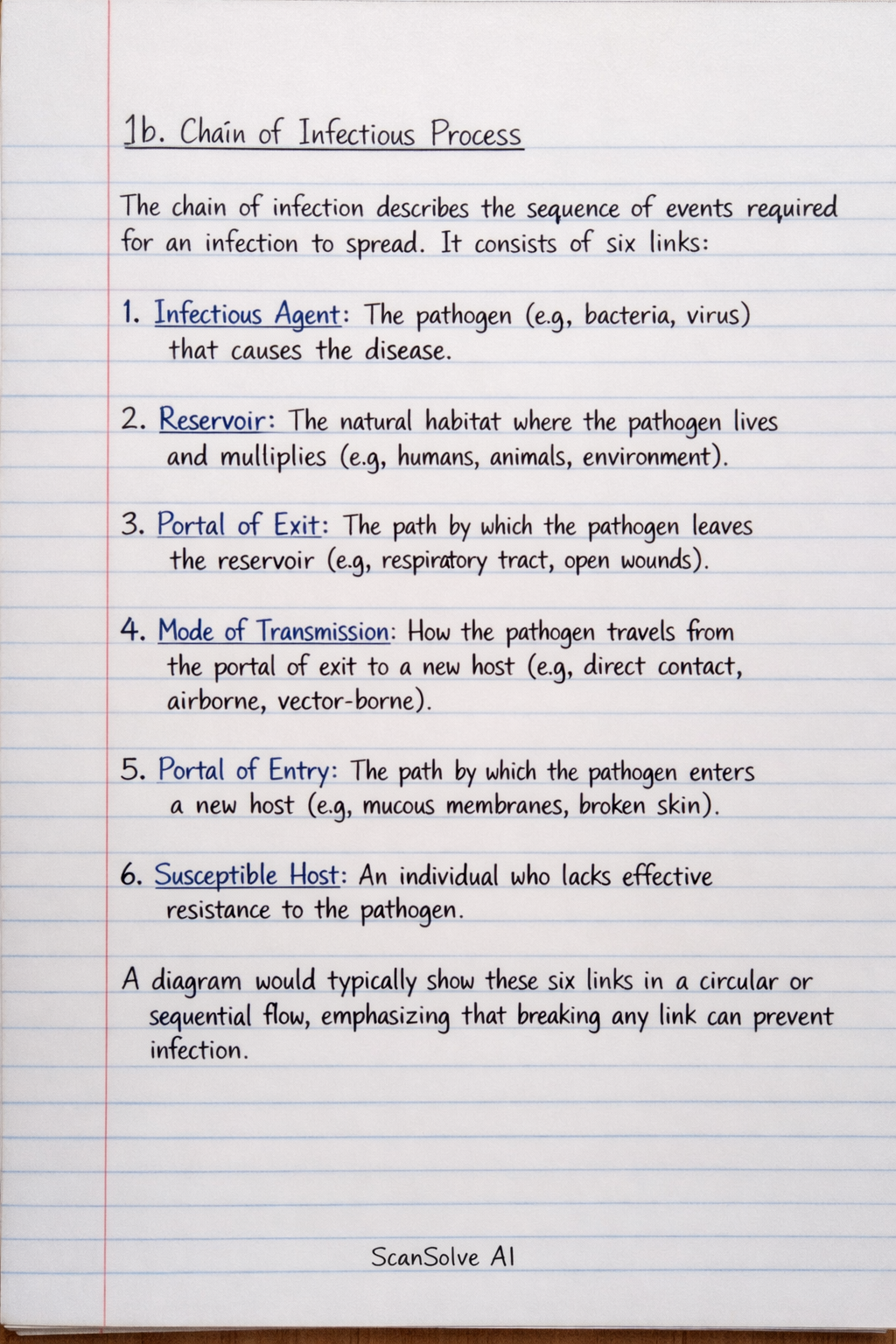
1b. Chain of Infectious Process
The chain of infection describes the sequence of events required for an infection to spread. It consists of six links:
- Infectious Agent: The pathogen (e.g., bacteria, virus) that causes the disease.
- Reservoir: The natural habitat where the pathogen lives and multiplies (e.g., humans, animals, environment).
- Portal of Exit: The path by which the pathogen leaves the reservoir (e.g., respiratory tract, open wounds).
- Mode of Transmission: How the pathogen travels from the portal of exit to a new host (e.g., direct contact, airborne, vector-borne).
- Portal of Entry: The path by which the pathogen enters a new host (e.g., mucous membranes, broken skin).
- Susceptible Host: An individual who lacks effective resistance to the pathogen.
A diagram would typically show these six links in a circular or sequential flow, emphasizing that breaking any link can prevent infection.
1c. Factors Predisposing Mrs. Tayo to Pressure Sores
Mrs. Tayo's risk factors for pressure sores include:
- Spinal cord injury: Leads to immobility and sensory loss, preventing her from shifting weight or feeling discomfort.
- Obesity: Increased body mass can lead to greater pressure on bony prominences and impaired circulation in adipose tissue.
- Prolonged admission (2 months): Extended periods of immobility in bed or a chair increase sustained pressure on vulnerable areas.
1d. Eight Areas of the Body Most Likely to Develop Pressure Sores
- Sacrum
- Ischial tuberosities (buttocks)
- Heels
- Elbows
- Occiput (back of head)
- Scapulae (shoulder blades)
- Trochanters (hips)
- Ankles (malleoli)
1e. Nursing Measures for Prevention of Pressure Sore
- Regular Repositioning: Turn the patient every 2 hours in bed and every hour in a chair to relieve pressure.
- Skin Assessment: Daily inspection of skin, especially over bony prominences, for redness, warmth, or breakdown.
- Skin Hygiene: Keep skin clean and dry, using mild cleansers and moisturizing dry skin. Avoid vigorous scrubbing.
- Nutrition and Hydration: Ensure adequate protein, calorie, vitamin, and fluid intake to support skin integrity and healing.
- Pressure-Relieving Devices: Use specialized mattresses, cushions, and heel protectors to redistribute pressure.
- Mobility and Activity: Encourage and assist with ambulation or range-of-motion exercises as tolerated to improve circulation.
- Education: Teach the patient and family about pressure sore prevention and early signs.
2c. Convert Temperature Readings
The formulas for temperature conversion are:
- Celsius to Fahrenheit:
- Fahrenheit to Celsius:
Part i· 3 steps
Convert to Fahrenheit
Substitute the value into the formula.
Perform the multiplication.
Perform the addition.
The converted temperature is .
Part ii
Convert to Fahrenheit
Substitute the value into the formula.
Perform the multiplication.
Perform the addition.
The converted temperature is .
Part iii
Convert to Centigrade
Substitute the value into the formula.
Perform the subtraction.
Perform the multiplication.
The converted temperature is .
Try one yourself
A new problem that tests the same skill.
Still stuck on this one?
Ask a follow-up, and the answer starts from this question.
More Biology Questions
Handwritten Step-by-Step Solution
Get this as a handwritten image on WhatsApp — like a tutor wrote it for you.
Try on WhatsApp