
We read your photo as:
Explain why lidocaine is less effective in infected tissue.
ScanSolve AI Answer
Step-by-step solution
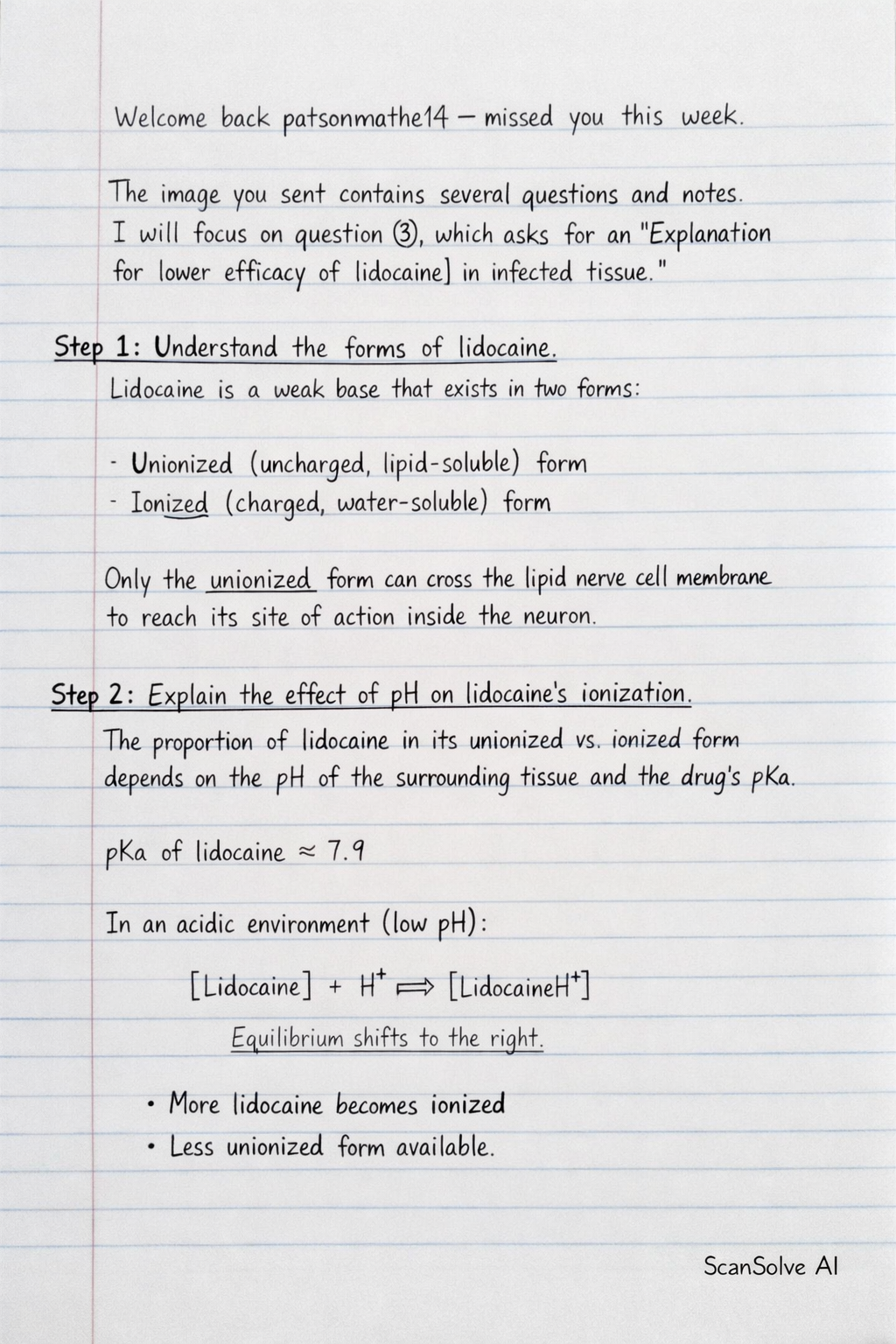
4 stepsThe image you sent contains several questions and notes. I will focus on question ③, which asks for an "Explanation for lower efficacy [of lidocaine] in infected tissue."
Understand the forms of lidocaine.
Lidocaine is a weak base that exists in two forms: an unionized (uncharged, lipid-soluble) form and an ionized (charged, water-soluble) form. Only the unionized form can readily cross the lipid nerve cell membrane to reach its site of action inside the neuron.
Explain the effect of pH on lidocaine's ionization.
The proportion of lidocaine in its unionized versus ionized form is dependent on the pH of the surrounding tissue and the drug's pKa. In an acidic environment (lower pH), the equilibrium shifts, causing a higher percentage of the weak base (lidocaine) to become ionized.
Relate tissue infection to pH and drug efficacy.
Infected or inflamed tissues are typically more acidic (have a lower pH) due to metabolic byproducts and inflammatory processes. When lidocaine is injected into such an environment, a greater proportion of the drug remains in its ionized form. Since the ionized form cannot easily cross the nerve membrane, less of the drug reaches the inside of the nerve cell where it needs to bind to sodium channels. This results in a delayed or reduced anesthetic effect.
Suggest an alternative.
In cases of infection where lidocaine's efficacy is compromised, other local anesthetics like Mepivacaine may be preferred. Mepivacaine has a slightly lower pKa than lidocaine, meaning a relatively higher fraction of it will remain in the unionized form at a given acidic pH, allowing more drug to penetrate the nerve membrane and exert its anesthetic action.
The explanation for lower efficacy of lidocaine in infected tissue is:
Infected tissue has a low pH, which causes lidocaine (a weak base) to remain predominantly in its ionized form. Since only the unionized form can cross the nerve membrane, much less drug reaches the sodium channels inside the nerve cell, leading to delayed or reduced anesthesia. In such cases, Mepivacaine can be a more effective alternative.
Still stuck on this one?
Ask a follow-up, and the answer starts from this question.
More Biology Questions
Handwritten Step-by-Step Solution
Get this as a handwritten image on WhatsApp — like a tutor wrote it for you.
Try on WhatsApp