
We read your photo as:
Describe the life cycle of a housefly and the bonds formed in a chemical reaction.
ScanSolve AI Answer
here are the answers to Question 1:
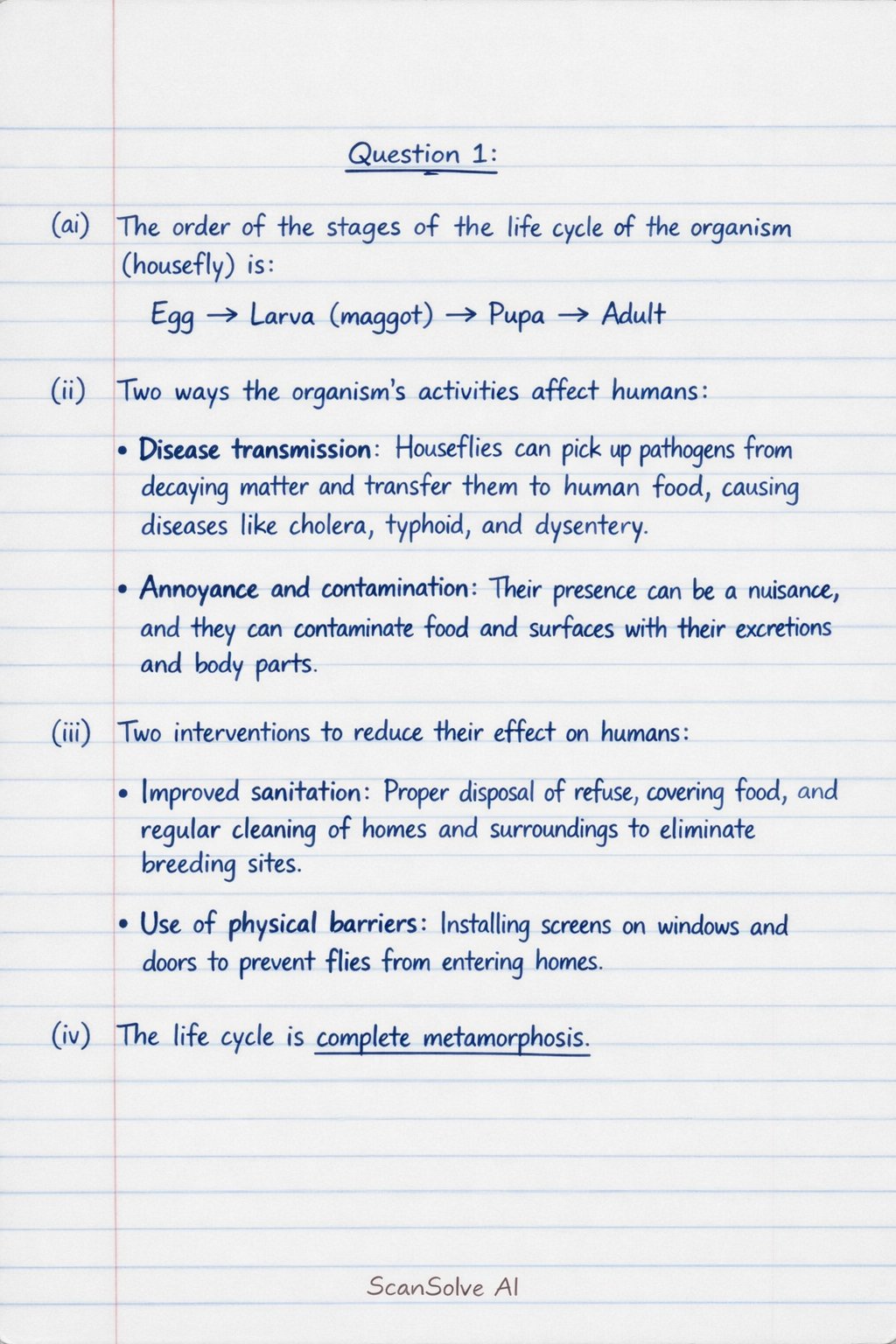
Question 1:
a)
(i) The order of the stages of the life cycle of the organism (housefly) is:
Egg Larva (maggot) Pupa Adult
(ii) Two ways that the organism's activities affect humans:
- Disease transmission: Houseflies can pick up pathogens from decaying matter and transfer them to human food, causing diseases like cholera, typhoid, and dysentery.
- Annoyance and contamination: Their presence can be a nuisance, and they can contaminate food and surfaces with their excretions and body parts.
(iii) Two interventions that will reduce their effect on humans:
- Improved sanitation: Proper disposal of refuse, covering food, and regular cleaning of homes and surroundings to eliminate breeding sites.
- Use of physical barriers: Installing screens on windows and doors to prevent flies from entering homes.
(iv) The life cycle is complete metamorphosis.
(v) Reason for the answer in (iv):
The housefly undergoes complete metamorphosis because its life cycle involves four distinct stages (egg, larva, pupa, and adult), and the larval stage (maggot) is morphologically very different from the adult form.
b)
(i) The parts labelled X, Y, and Z are:
- X: Electron shell (or Energy level)
- Y: Nucleus
- Z: Electron
(ii) The type of bond exhibited in the reaction is an ionic bond.
(iii) Three examples of compounds that show this type of bond are:
- Sodium chloride (NaCl)
- Magnesium oxide (MgO)
- Calcium chloride (CaCl)
Still stuck on this one?
Ask a follow-up, and the answer starts from this question.
More Biology Questions
Handwritten Step-by-Step Solution
Get this as a handwritten image on WhatsApp — like a tutor wrote it for you.
Try on WhatsApp