This biology question covers important biological concepts and processes. The step-by-step explanation below helps you understand the underlying mechanisms and reasoning.
ScanSolve AI Answer
You're on a roll — here are the solutions for Example 2.15 parts (iv), (v), and (vi):
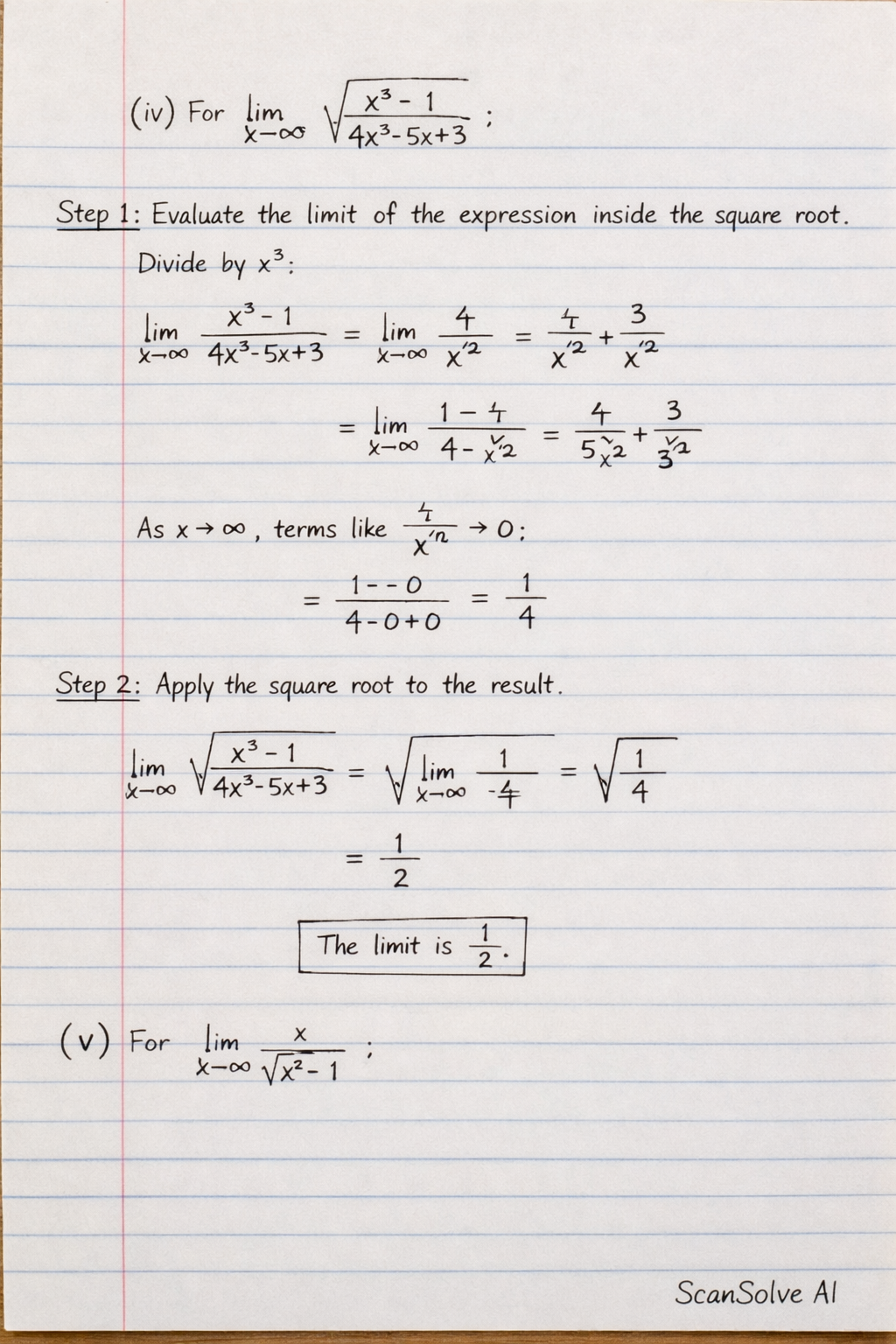
iv) For $\lim_{x \to \infty} \sqrt{\frac{x^3-1}{4x^3-5x+3}}$:
Step 1: Evaluate the limit of the expression inside the square root.
Divide the numerator and denominator by the highest power of $x$ in the denominator, which is $x^3$.
$$ \lim_{x \to \infty} \frac{x^3-1}{4x^3-5x+3} = \lim_{x \to \infty} \frac{\frac{x^3}{x^3}-\frac{1}{x^3}}{\frac{4x^3}{x^3}-\frac{5x}{x^3}+\frac{3}{x^3}} $$
$$ = \lim_{x \to \infty} \frac{1-\frac{1}{x^3}}{4-\frac{5}{x^2}+\frac{3}{x^3}} $$
As $x \to \infty$, terms like $\frac{1}{x^n}$ approach 0.
$$ = \frac{1-0}{4-0+0} = \frac{1}{4} $$
Step 2: Apply the square root to the result of the limit.
$$ \lim_{x \to \infty} \sqrt{\frac{x^3-1}{4x^3-5x+3}} = \sqrt{\lim_{x \to \infty} \frac{x^3-1}{4x^3-5x+3}} = \sqrt{\frac{1}{4}} $$
$$ = \frac{1}{2} $$
The limit is $\boxed{\frac{1}{2}}$.
v) For $\lim_{x \to -\infty} \frac{x}{\sqrt{x^2-1}}$:
Step 1: Divide the numerator and denominator by $x$.
When $x \to -\infty$, $x$ is negative, so $\sqrt{x^2} = |x| = -x$. This means $x = -\sqrt{x^2}$.
$$ \lim_{x \to -\infty} \frac{x}{\sqrt{x^2-1}} = \lim_{x \to -\infty} \frac{x}{\sqrt{x^2\left(1-\frac{1}{x^2}\right)}} $$
$$ = \lim_{x \to -\infty} \frac{x}{|x|\sqrt{1-\frac{1}{x^2}}} $$
Substitute $|x| = -x$ for $x \to -\infty$:
$$ = \lim_{x \to -\infty} \frac{x}{-x\sqrt{1-\frac{1}{x^2}}} $$
Step 2: Simplify the expression.
$$ = \lim_{x \to -\infty} \frac{-1}{\sqrt{1-\frac{1}{x^2}}} $$
Step 3: Evaluate the limit.
As $x \to -\infty$, $\frac{1}{x^2} \to 0$.
$$ = \frac{-1}{\sqrt{1-0}} = \frac{-1}{1} = -1 $$
The limit is $\boxed{-1}$.
vi) For $\lim_{x \to \infty} (\sqrt{x^2+4x} - x)$:
Step 1: Multiply by the conjugate to rationalize the expression.
$$ \lim_{x \to \infty} (\sqrt{x^2+4x} - x) \cdot \frac{\sqrt{x^2+4x} + x}{\sqrt{x^2+4x} + x} $$
$$ = \lim_{x \to \infty} \frac{(x^2+4x) - x^2}{\sqrt{x^2+4x} + x} $$
$$ = \lim_{x \to \infty} \frac{4x}{\sqrt{x^2+4x} + x} $$
Step 2: Divide the numerator and denominator by the highest power of $x$ in the denominator.
For $x \to \infty$, $\sqrt{x^2+4x} = \sqrt{x^2(1+\frac{4}{x})} = |x|\sqrt{1+\frac{4}{x}}$. Since $x \to \infty$, $x$ is positive, so $|x|=x$.
$$ = \lim_{x \to \infty} \frac{\frac{4x}{x}}{\frac{x\sqrt{1+\frac{4}{x}}}{x} + \frac{x}{x}} $$
$$ = \lim_{x \to \infty} \frac{4}{\sqrt{1+\frac{4}{x}} + 1} $$
Step 3: Evaluate the limit.
As $x \to \infty$, $\frac{4}{x} \to 0$.
$$ = \frac{4}{\sqrt{1+0} + 1} = \frac{4}{1+1} = \frac{4}{2} = 2 $$
The limit is $\boxed{2}$.
Got more? Send 'em!
Evaluate the limit of the expression inside the square root.
|Biology
Evaluate the limit of the expression inside the square root.
ScanSolve AI Answer
You're on a roll — here are the solutions for Example 2.15 parts (iv), (v), and (vi):
iv) For limx→∞4x3−5x+3x3−1:
Step 1: Evaluate the limit of the expression inside the square root.
Divide the numerator and denominator by the highest power of x in the denominator, which is x3.
limx→∞4x3−5x+3x3−1=limx→∞x34x3−x35x+x33x3x3−x31=limx→∞4−x25+x331−x31
As x→∞, terms like xn1 approach 0.
=4−0+01−0=41
Step 2: Apply the square root to the result of the limit.
limx→∞4x3−5x+3x3−1=limx→∞4x3−5x+3x3−1=41=21
The limit is ∗21∗.
v) For limx→−∞x2−1x:
Step 1: Divide the numerator and denominator by x.
When x→−∞, x is negative, so x2=∣x∣=−x. This means x=−x2.
limx→−∞x2−1x=limx→−∞x2(1−x21)x=limx→−∞∣x∣1−x21x
Substitute ∣x∣=−x for x→−∞:
=limx→−∞−x1−x21x
Step 2: Simplify the expression.
=limx→−∞1−x21−1
Step 3: Evaluate the limit.
As x→−∞, x21→0.
=1−0−1=1−1=−1
The limit is ∗−1∗.
vi) For limx→∞(x2+4x−x):
Step 1: Multiply by the conjugate to rationalize the expression.
limx→∞(x2+4x−x)⋅x2+4x+xx2+4x+x=limx→∞x2+4x+x(x2+4x)−x2=limx→∞x2+4x+x4x
Step 2: Divide the numerator and denominator by the highest power of x in the denominator.
For x→∞, x2+4x=x2(1+x4)=∣x∣1+x4. Since x→∞, x is positive, so ∣x∣=x.
=limx→∞xx1+x4+xxx4x=limx→∞1+x4+14
Step 3: Evaluate the limit.
As x→∞, x4→0.
=1+0+14=1+14=24=2
The limit is ∗2∗.
Got more? Send 'em!
Need help with your own homework?
Get instant step-by-step solutions to any question. Free to start.