
We read your photo as:
List eight economic importance of plant diseases.
Biology
ScanSolve AI Answer
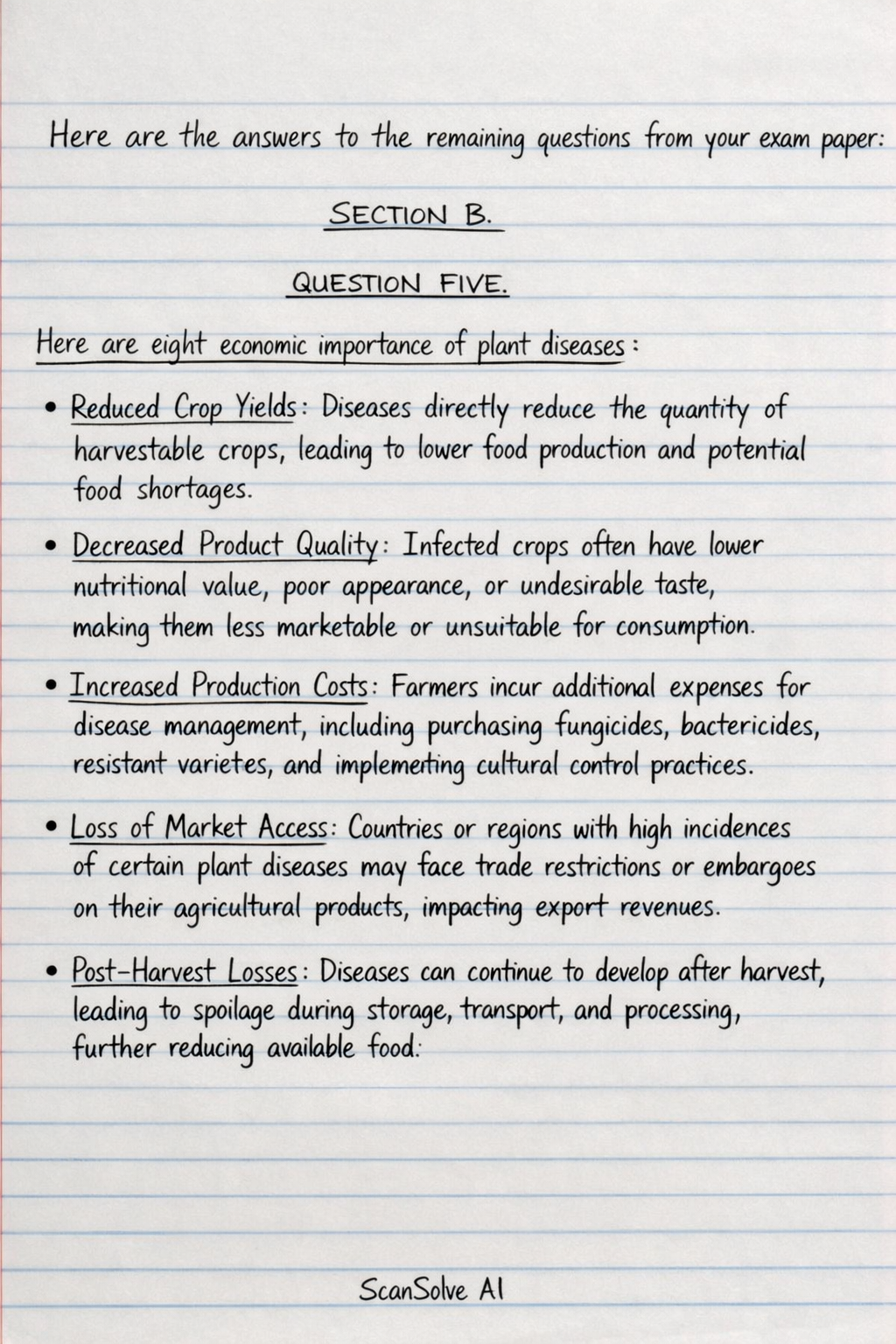
Here are the answers to the remaining questions from your exam paper:
SECTION B
QUESTION FIVE
Here are eight economic importance of plant diseases:
- Reduced Crop Yields: Diseases directly reduce the quantity of harvestable crops, leading to lower food production and potential food shortages.
- Decreased Product Quality: Infected crops often have lower nutritional value, poor appearance, or undesirable taste, making them less marketable or unsuitable for consumption.
- Increased Production Costs: Farmers incur additional expenses for disease management, including purchasing fungicides, bactericides, resistant varieties, and implementing cultural control practices.
- Loss of Market Access: Countries or regions with high incidences of certain plant diseases may face trade restrictions or embargoes on their agricultural products, impacting export revenues.
- Post-Harvest Losses: Diseases can continue to develop after harvest, leading to spoilage during storage, transport, and processing, further reducing available food.
- Impact on Food Security: Widespread plant diseases can threaten food security, especially in developing countries, by reducing staple crop availability and increasing food prices.
- Environmental Impact of Pesticides: The extensive use of chemical pesticides to control diseases can lead to environmental pollution, harm beneficial organisms, and pose health risks.
- Reduced Biodiversity: Severe disease outbreaks can lead to the loss of specific crop varieties or wild plant species, diminishing genetic diversity and ecosystem resilience.
QUESTION SIX
The plant disease pyramid illustrates the five essential elements that must be present and interact for a plant disease to occur and develop. These elements are:
- Susceptible Host: This refers to the plant species or variety that is vulnerable to infection by a particular pathogen. Factors influencing host susceptibility include its genetic makeup (e.g., lack of resistance genes), age, nutritional status, and overall health. A healthy, resistant plant is less likely to develop severe disease.
- Virulent Pathogen: This is the disease-causing agent, such as a fungus, bacterium, virus, or nematode. For disease to occur, the pathogen must be present and capable of infecting the host. Its virulence (ability to cause disease) and the amount of inoculum (number of pathogen propagules) are critical factors.
- Favorable Environment: These are the external conditions that promote the interaction between the host and the pathogen, facilitating infection and disease development. Environmental factors like temperature, humidity, rainfall, soil type, and light intensity can either favor or inhibit disease. For example, high humidity often favors fungal diseases.
- Time: This refers to the duration for which the susceptible host, virulent pathogen, and favorable environment must co-exist for disease to develop. Sufficient time is needed for the pathogen to infect the host, multiply, and for symptoms to manifest. The length of this period varies greatly depending on the specific disease.
- Human Activity: This element acknowledges the significant role human actions play in influencing disease development and spread. Activities such as planting susceptible crops, monoculture, improper irrigation, poor sanitation, movement of infected plant material, and pesticide application (or lack thereof) can either exacerbate or mitigate disease outbreaks.
Was this helpful?
Still stuck on this one?
Ask a follow-up, and the answer starts from this question.
Got a different question?Ask your own question
More Biology Questions
QWhat are the economic importance of mushrooms, ways to control bacterial infections, the kingdom of…QMention five (5) beneficial effects of micro-organism to humans. State five (5) harmful effects of…QIdentify and describe the function and economic importance of common farm parasites and laboratory…QState two ways in which weeds are economically important and describe eight methods used in water…QList five importance of water in agricultural production
Handwritten Step-by-Step Solution
Get this as a handwritten image on WhatsApp — like a tutor wrote it for you.
Try on WhatsApp