
We read your photo as:
List five characteristics of insect pollinated flowers. In a tabular form, state two differences between arteries and veins.
ScanSolve AI Answer
Step-by-step solution
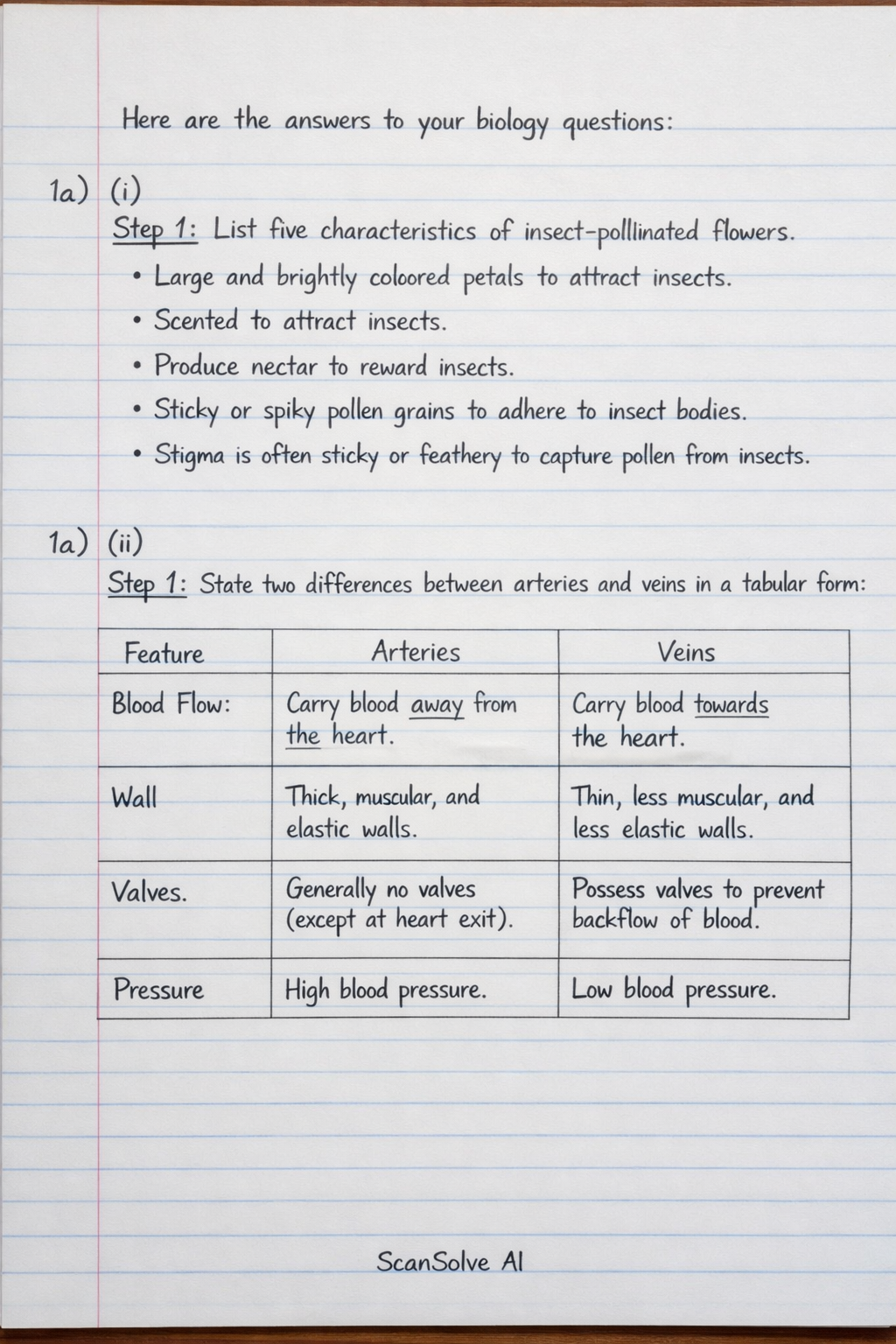
12 stepsHere are the answers to your biology questions:
1a) (i)
List five characteristics of insect-pollinated flowers.
- Large and brightly colored petals to attract insects.
- Scented to attract insects.
- Produce nectar to reward insects.
- Sticky or spiky pollen grains to adhere to insect bodies.
- Stigma is often sticky or feathery to capture pollen from insects.
1a) (ii)
State two differences between arteries and veins in a tabular form.
Feature Arteries Veins Blood Flow Carry blood away from the heart. Carry blood towards the heart. Wall Thick, muscular, and elastic walls. Thin, less muscular, and less elastic walls. Valves Generally no valves (except at heart exit). Possess valves to prevent backflow of blood. Pressure High blood pressure. Low blood pressure. 1b) (i)
Describe the human female reproductive system diagram.
As an AI, I cannot draw diagrams. However, a well-labelled diagram (10-12 cm long) of the human female reproductive system should show the following structures:
- Ovaries (produce eggs and hormones)
- Fallopian tubes (oviducts, transport eggs to the uterus)
- Uterus (womb, where a fertilized egg implants and develops)
- Cervix (lower, narrow part of the uterus)
- Vagina (birth canal, connects uterus to the outside)
- Endometrium (inner lining of the uterus)
1b) (ii)
Explain the process of absorption of water and dissolved mineral salts from the soil to the apex of the plant.
Water is absorbed by root hairs from the soil primarily by osmosis, moving from a region of higher water potential in the soil to a lower water potential inside the root cells. Mineral salts are absorbed by root hairs through diffusion (if concentration is higher in soil) and active transport (if concentration is lower in soil, requiring energy). Once absorbed, water and minerals enter the xylem vessels in the root. They are then transported upwards through the stem to the apex of the plant, mainly driven by the transpiration pull, which is the cohesive force of water molecules and the evaporative loss of water from leaves.
2a) (i)
List the four stages of complete metamorphosis in chronological order.
- Egg
- Larva
- Pupa
- Adult
2a) (ii)
Mention six structural adaptations to prevent water loss in xerophytes.
- Thick, waxy cuticle on leaves to reduce transpiration.
- Sunken stomata in pits to create a humid microenvironment.
- Reduced leaf surface area (e.g., spines or needles) to minimize evaporation.
- Hairy leaves to trap a layer of moist air.
- Deep root systems to access groundwater.
- Succulent stems or leaves to store water.
2b) (i)
Give three characteristics of plants in tropical rainforests.
- Broad leaves to maximize light absorption in low light conditions.
- Drip tips on leaves to shed excess water and prevent fungal growth.
- Buttress roots for support in shallow, nutrient-poor soils.
- Epiphytic growth (plants growing on other plants) to reach sunlight.
2b) (ii)
Describe the process of mitosis with annotated diagrams.
As an AI, I cannot draw diagrams. However, the process of mitosis involves the following stages, which would be represented by annotated diagrams:
- Prophase: Chromatin condenses into visible chromosomes, each consisting of two sister chromatids. The nuclear envelope breaks down, and the spindle fibers begin to form.
- Metaphase: Chromosomes align along the metaphase plate (equator of the cell), with spindle fibers attached to their centromeres.
- Anaphase: Sister chromatids separate and are pulled apart by the shortening spindle fibers towards opposite poles of the cell. Each chromatid is now considered a full chromosome.
- Telophase: Chromosomes arrive at the poles and begin to decondense. New nuclear envelopes form around the two sets of chromosomes, and the spindle fibers disappear. Cytokinesis (division of the cytoplasm) usually overlaps with telophase, resulting in two genetically identical daughter cells.
3a) (i)
List five materials that are transported in animals.
- Oxygen
- Carbon dioxide
- Nutrients (e.g., glucose, amino acids, fatty acids)
- Hormones
- Waste products (e.g., urea)
3a) (ii)
Mention three major zones in a marine habitat.
- Intertidal zone (littoral zone): Area between high and low tide marks.
- Neritic zone: Shallow water over the continental shelf.
- Oceanic zone: Open ocean beyond the continental shelf.
- Benthic zone: The seafloor.
- Pelagic zone: The open water column.
3a) (iii)
State four functions of the liver.
- Detoxification of harmful substances (e.g., drugs, alcohol).
- Production of bile for fat digestion.
- Metabolism of carbohydrates, fats, and proteins.
- Storage of glycogen, vitamins, and minerals.
- Synthesis of plasma proteins (e.g., albumin, clotting factors).
3b)
Explain the process of feeding in Amoeba with diagrams.
As an AI, I cannot draw diagrams. However, the process of feeding in Amoeba (phagocytosis) would be explained with diagrams showing:
- Detection: An Amoeba detects a food particle (e.g., bacterium, algae) in its environment.
- Pseudopod formation: The Amoeba extends temporary cytoplasmic projections called pseudopods (false feet) to engulf the food particle.
- Engulfment: The pseudopods surround the food particle, eventually fusing to form a food vacuole (phagosome) inside the Amoeba's cytoplasm.
- Digestion: Lysosomes containing digestive enzymes fuse with the food vacuole, releasing enzymes to break down the food into simpler substances.
- Absorption: Digested nutrients are absorbed into the cytoplasm.
- Egestion: Undigested waste material is expelled from the Amoeba by exocytosis.
Still stuck on this one?
Ask a follow-up, and the answer starts from this question.
More Biology Questions
Handwritten Step-by-Step Solution
Get this as a handwritten image on WhatsApp — like a tutor wrote it for you.
Try on WhatsApp