
We read your photo as:
List five key features of mammals and distinguish between monotremes, marsupials, and placental mammals.
Biology
ScanSolve AI Answer
-
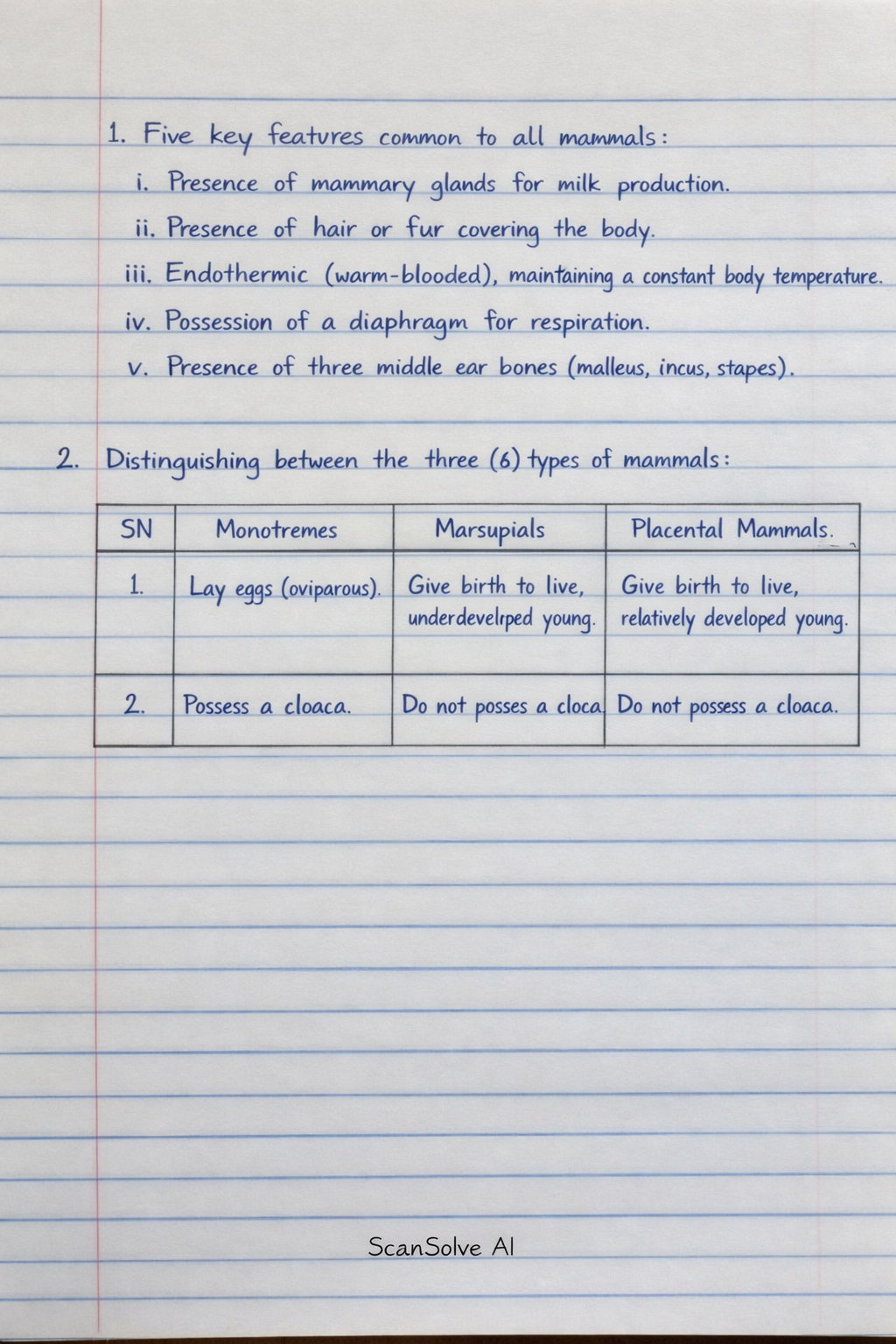
Five (5) key features common to all mammals: i. Presence of mammary glands for milk production. ii. Presence of hair or fur covering the body. iii. Endothermic (warm-blooded), maintaining a constant body temperature. iv. Possession of a diaphragm for respiration. v. Presence of three middle ear bones (malleus, incus, stapes).
-
Distinguishing between the three (3) types of mammals:
| SN | Monotremes | Marsupials | Placental Mammals |
|---|---|---|---|
| 1 | Lay eggs (oviparous). | Give birth to live, underdeveloped young. | Give birth to live, relatively developed young. |
| 2 | Possess a cloaca. | Do not possess a cloaca. | Do not possess a cloaca. |
| 3 | Mammary glands lack nipples; milk secreted through pores. | Mammary glands have nipples, typically within a pouch. | Mammary glands have nipples. |
| 4 | Young develop outside the mother's body in an egg. | Young complete development in a maternal pouch (marsupium). | Young complete development inside the uterus, nourished by a placenta. |
| 5 | Short gestation period, followed by external egg incubation. | Short gestation period, followed by a longer period of development in the pouch. | Long gestation period, with extensive internal development. |
| Example.1 | Platypus | Kangaroo | Human |
| Example.2 | Echidna | Koala | Dog |
Was this helpful?
Still stuck on this one?
Ask a follow-up, and the answer starts from this question.
Got a different question?Ask your own question
More Biology Questions
QCompare the reproductive strategies of monotremes, marsupials, and placental mammals. Identify at…QBIO 004 ASSIGNMENT 1. Differentaiate between mammals and aves in terms of their excretion 2…QA. Describe the key features of the mammalian reproductive system, including internal fertilization…QWhat are two external characteristics of mammals?QClass Mammals: 3.1 Prototheria (distinctive characters, distribution and affinities) 3.2 Metatheria…
Handwritten Step-by-Step Solution
Get this as a handwritten image on WhatsApp — like a tutor wrote it for you.
Try on WhatsApp