
We read your photo as:
List three hexoses, their sources, structures, and biochemical importance.
ScanSolve AI Answer
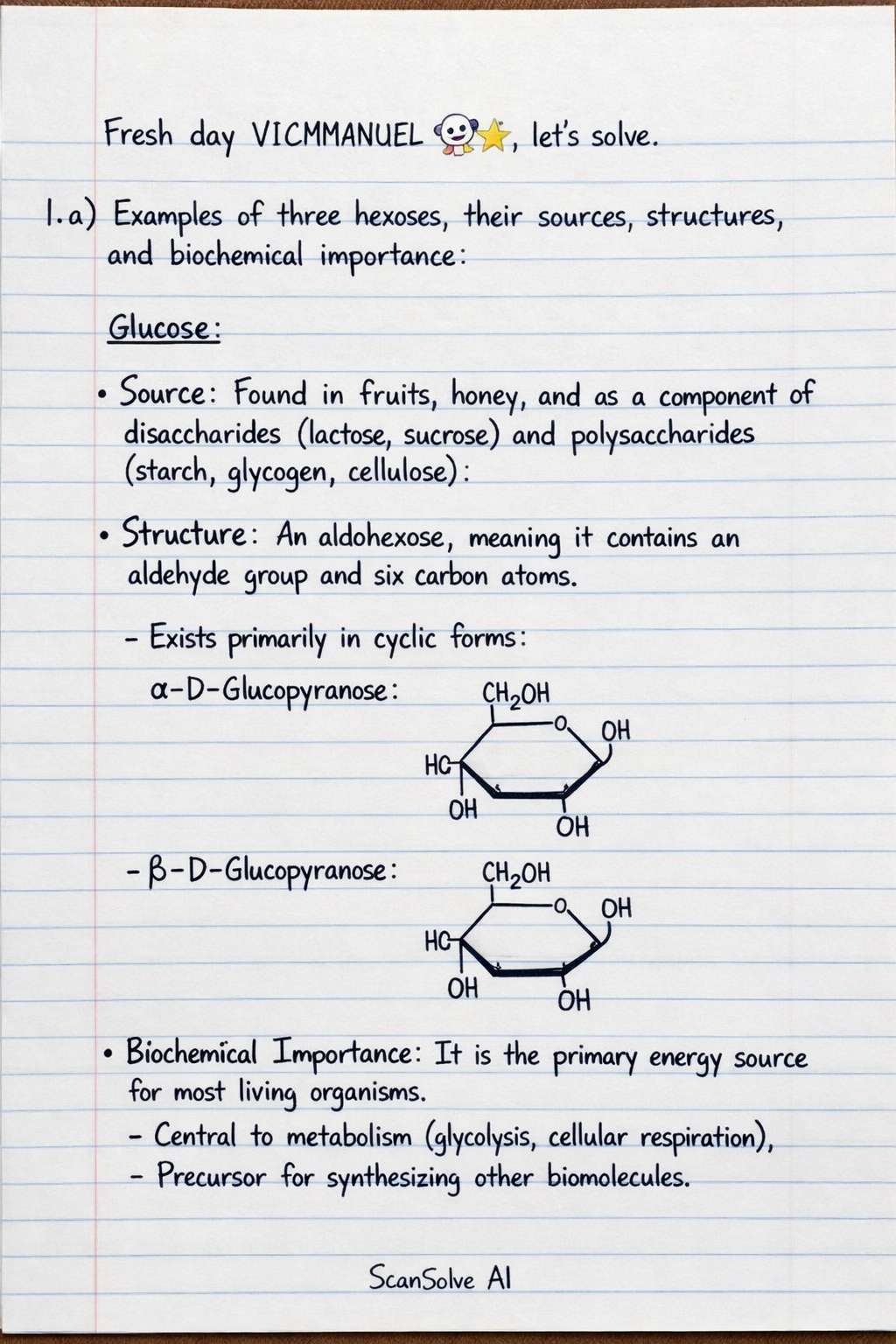
1. a) Examples of three hexoses, their sources, structures, and biochemical importance:
-
Glucose
- Source: Found in fruits, honey, and as a component of disaccharides (lactose, sucrose) and polysaccharides (starch, glycogen, cellulose).
- Structure: An aldohexose, meaning it contains an aldehyde group and six carbon atoms. It primarily exists in cyclic forms (-D-glucopyranose and -D-glucopyranose) in solution.
- Biochemical Importance: It is the primary energy source for most living organisms, central to metabolism (glycolysis, cellular respiration), and a precursor for synthesizing other biomolecules.
-
Fructose
- Source: Found in fruits, honey, and as a component of sucrose (table sugar).
- Structure: A ketohexose, meaning it contains a ketone group and six carbon atoms. It typically forms five-membered furanose rings in solution.
- Biochemical Importance: A dietary sugar, metabolized in the liver, and can be converted to glucose or fat. It is also a component of seminal fluid, providing energy for sperm.
-
Galactose
- Source: Primarily found as a component of lactose (milk sugar) and in glycolipids and glycoproteins.
- Structure: An aldohexose, an epimer of glucose at C-4. It exists mainly in cyclic pyranose forms.
- Biochemical Importance: A crucial component of lactose, important for infant nutrition. It is also involved in the synthesis of glycolipids, glycoproteins, and proteoglycans, which are vital for cell recognition and communication.
1. b) Explanation of isomers:
-
i. Aldo-keto isomers: These are monosaccharides that have the same chemical formula but differ in the type of carbonyl group. Aldoses contain an aldehyde group () at one end of the carbon chain (e.g., glucose), while ketoses contain a ketone group () usually at the second carbon (e.g., fructose).
-
ii. Epimers: These are stereoisomers that differ in configuration at only one chiral carbon center, excluding the anomeric carbon. For example, glucose and galactose are C-4 epimers, meaning they differ in the orientation of the hydroxyl group at the fourth carbon.
-
iii. Enantiomers: These are stereoisomers that are non-superimposable mirror images of each other. They have identical chemical and physical properties in a non-chiral environment but differ in their interaction with plane-polarized light (one rotates light clockwise, the other counter-clockwise) and with other chiral molecules. D-glucose and L-glucose are enantiomers.
-
iv. - and -anomers: These are cyclic monosaccharide isomers that differ in the configuration at the anomeric carbon (the carbon derived from the carbonyl carbon of the open-chain form). In the cyclic form, if the hydroxyl group on the anomeric carbon is on the opposite side of the ring from the group (for D-sugars), it's an -anomer. If it's on the same side, it's a -anomer.
1. c) Advantages of using triacylglycerols as storage fuels:
- High energy yield: Triacylglycerols are highly reduced molecules, meaning they contain many C-H bonds. Their complete oxidation yields significantly more energy per gram (approximately or ) compared to carbohydrates or proteins (approximately or ).
- Anhydrous storage: Triacylglycerols are hydrophobic and stored in an anhydrous (water-free) state. This reduces the overall weight of stored fuel, as carbohydrates like glycogen are stored with a significant amount of water (about of water per of glycogen), making them less efficient for long-term, compact energy storage.
- Insulation and protection: Adipose tissue, where triacylglycerols are stored, also provides thermal insulation against cold and mechanical protection against physical shock for vital organs.
Still stuck on this one?
Ask a follow-up, and the answer starts from this question.
More Biology Questions
Handwritten Step-by-Step Solution
Get this as a handwritten image on WhatsApp — like a tutor wrote it for you.
Try on WhatsApp